
I recently compared the Fuji 16-55mm f/2.8II lens against all the premium Fujfiilm primes in that focal range. The reason I did that was because the zoom lens is said by many to be like a bag of primes.
The Nikon Z 24-120mm f/4 isn’t quite in the same category in terms of how it is viewed. It’s not Nikon’s premium zoom option but it is a really good one that covers an incredibly useful focal range. So the question here isn’t whether the zoom is as good as the primes, it’s not, but whether it’s worth buying the primes for those of us who own the 24-120mm. How much better is sharpness, how much difference does f/1.8 make vs f/4 actually make, and are there other benefits that make it worth spending the money to add primes to your kit. You can see how the zoom compares against the Nikon Z 50mm 1.8S here and against the Nikon Z 85mm 1.8S here.
I purchased all the lenses mentioned in this article with my own money. Some of the links in this post are affiliate links, which means I may earn a small commission if you decide to buy through them.

I’ve been shooting the 24-120mm f4 for months, I’ve owned the 1.8S primes for well over a year. I bought the primes while I was still living in the Philippines and used them for candid travel photography , family photos and some street photography. I’ve reviewed them all individually. In my collection I own the 20mm, 35mm, 50mm and 85mm lenses. I also own the 14-30mm f/4 and 24-120mm f/4. I previously owned the Nikon 24-70mm f/2.8 (the original one) and found it to be an exceptional lens but sold it a couple of years back as I felt it sat in the middle ground between the more practical 24-120mm with its really useful focal range and the primes with their ability to isolate subjects and shoot in low light.
Now that I’ve been living on the edge of the Scottish Highlands for nearly 6 months, I’ve found myself appreciating good zoom lenses more than in recent years. So the aim of this series of articles is to see whether I would buy the primes again, if I had to start over and more importantly, whether it’s worth it for most people.
Size and weight
The Nikon Z 24-120mm f/4 is not a small lens at 630 grams, it feels substantial, and really well matched to my Nikon Z8, it also handles well on my Z6III, on my Zf, it’s horrible. However, it is below the point where I feel the size and weight become a major factor. When it’s mounted on the Z8, it balances well, doesn’t feel front heavy and I happily clip it on to my Peak Design Capture Clip when hiking. It has a telescopic zoom design which extends the barrel as you zoom through the focal ranges but even fully extended, it never feels unweildy.
It has a 77mm filter size which is pretty common and allows me to use my existing filters.
The 35mm 1.8S lens on the other hand feels compact, considerably smaller and lighter than the zoom at 370 grams and in general is in a different ballpark altogether in terms of handling. However, both feel equally well made, being S line lenses.
I’m not going to add much to this as it’s pretty obvious that you’re paying a size and weight penalty in return for the flexibility of the zoom. Whether it suits your shooting style and priorities is very subjective but neither is too heavy nor too small, theyre just obviously different.
Methodology
To test the lenses I’ve looked through my Lightroom catalogue at the various shots I’ve taken with each lens over the last year as well as shot some test images for more technical comparisons. The test shots were taken on my Nikon Z8, on a solid tripod (Leofoto Summit LM-364C). I started by focusing the 24-120mm as close as I could to the test subject, then shooting images through the aperture range. I then replicated this with the 35mm lens at the same distance before testing the prime at it’s minimum focus distance. Finally, I shot them both from approximately 6 feet away from the subject in order to see whether this affected sharpness and also to show an actual example of the difference that f/1.8 vs f/4 makes in terms of subject isolation and bokeh at a mid-range focusing distance.
Image Quality


The Nikon Z 24-120mm f/4S lens is a sharp zoom, even wide-open at f/4, its decently sharp. Stopping down to f/5.6 it gets sharper still where I’d call it excellent, not quite on the level of the f/2.8 pro zoom but still more than good enough for everything from posting online to prints. At f/5.6 there is more detail and contrast. Viewed at 100% in Lightroom, the differences are quite obvious. At normal viewing distances on anything less than an A2 sized print and I doubt most people would be able to tell.

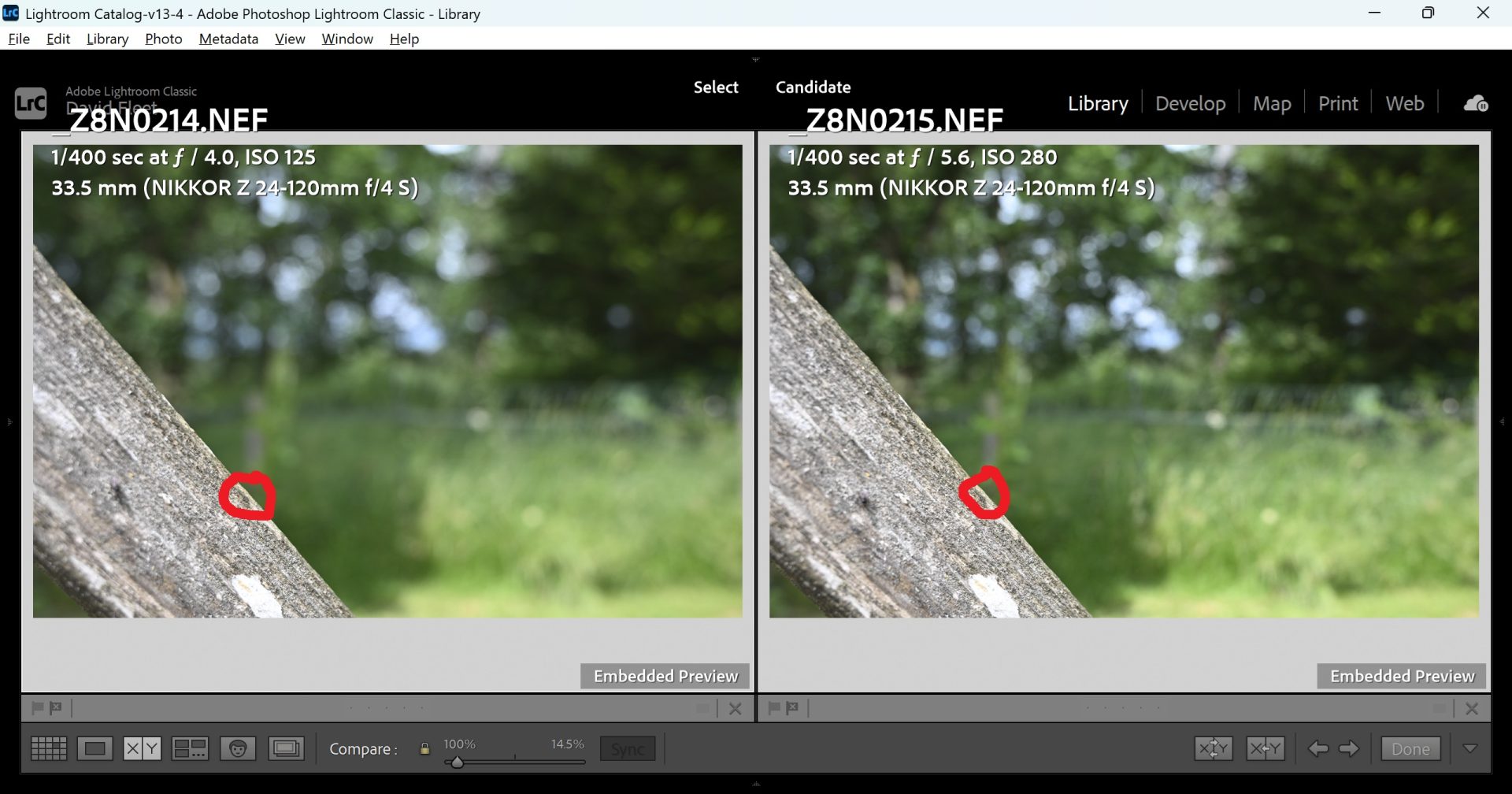
What surprised me somewhat is that the 35mm 1.8S is noticeably sharper at f/1.8 than the 24-120mm f/4 is at f/4. Unlike the Fuji comparisons I recently wrote, there is a noticeable difference in centre sharpness between the zoom and the prime lens. I also noticed that even though I didn’t get the Zoom bang on 35mm (it was 33.5mm), the prime is giving a wider field of view. I double checked this and confirmed it was the case.
Once the 35mm 1.8S lens is stopped down to f/4, it sharpens up even more and increases the gap between itself and the 24-120mm lens. The prime is substantially sharper at f/4 than the zoom, showing a lot more detail and contrast.

Once the Nikon Z 24-120mm f/4 is stopped down to f/5.6 it sharpens up and closes the gap to the prime. At f/5.6 sharpness is excellent for the zoom and pin sharp with the prime. In my personal opinion, once we are at these levels of sharpness, which one wins almost becomes irrelevant as they’re both sharp enough to look great on screen or in print.
Nikon quotes the 24-120mm as having a minimum focus distance of 35cm compared with 25cm on the 35mm 1.8S. 10cm doesn’t sound much on paper and it’s hard to visualise the difference by looking at the numbers alone, so here is a comaprison of them both shot wide-open at their respective minimum focus distances.

I think the difference, when you actually see it in a shot is much more dramatic than the numbers would suggest. The Nikon Z 24-120mm f/4S, at roughly 35mm focal length simply will not focus as closely as the 35mm 1.8S. This has a profound effect, combined with the larger aperture of the prime on it’s ability to thow backgrounds out of focus in a way that the zoom cannot get anywhere near. I would note that the zoom is considered to have an impressive minimum focus distance, and of course you can zoom in further to throw the background out of focus more, if of course, you are able to step back and shoot from further away.
This kind of test is useful but how often do you shoot at such close distances? I can’t think of many times in the last 20 years that I’ve done this. So to see what f/1.8 vs f/4 looks like in a more likely scenario, I moved the tripod back to 6 feet away from the subject and shot both lenses wide open to give a more realistic idea of the difference.

Judge for yourself, but the 35mm 1.8S is able to isolate the subject and throw the background more out of focus than the 24-120mm. That was always going to be the case but at this kind of mid-range shooting distance, I’m actually a little underwhelmed with the difference between the two. Yes the prime looks better but I still wouldn’t exactly call it a blown out or creamy background. My thoughts on this are that it shows that the distance to subject and between the subject and background, would have more effect on the ability to blur backgrounds than simply going from f/4 to f/1.8.
Verdict
These two lenses are designed for completely different roles, but where they overlap, the prime is clearly better in terms of shrapness, ability to islolate subjects and of course, will perform better in low light. That was always going to be the case, but how much sharper it is was the real take-away from my testing. However, if you shoot landscapes, general photography, travel, then in this focal range, if you already own the zoom, I don’t see the case for saying the prime lens is worth it. Stopped down to f/5.6, the zoom is already showing excellent sharpness. 35mm is a storytelling focal length where often, we want all of the scene to be in focus so the brighter aperture isn’t as much of a benefit as it may be at longer focal lengths. And, of course, you can always shoot the zoom at a longer focal length in order to give more background separation if you want to. For landscapes, the Nikon Z 24-120mm f/4 is already good enough if like me, you usually stop down to f/8 and beyond. In this particular comparison, the prime simply doesn’t offer enough of an advantage in every day shooting scenarios to justify the additional cost.
See the latest pricing for the Nikon Z 24-120mm f/4S
However, if you are a prime shooter, value all the things that primes offer, then the 35mm 1.8S is incredibly sharp, nice and compact, well built and can create photos that are not possible with a zoom. I really enjoy mine, particularly when I was shooting travel photography abroad but for most people, who own the zoom, I’d say save your money and consider a different focal length, if you are looking to compliment your zoom with a prime.
So would I buy the prime again now that I own the zoom? Well yes I would, but that’s because of my particular style of shooting, where I often prefer to slow down, simplify and shooting with prime lenses allows me to do that. 35mm also happens to be one of my favourite focal lengths.
3 second to the answer , F4 vs F1.8 , sharpness not the only metric
Case close
Hi Frank,
For some people, yes, it may be as simple as that. If f/1.8 is important to you then there’s only one choice.
All the best
David
After several comparisons of my own, I’ve come to basically the same conclusion on the Nikon prime versus zoom. And even the kit zoom versus the premier edition there isn’t enough difference to justify the price.
Hi Michael,
Thanks for your thoughts.
All the best
David
Excellent comparison and I agree with your findings and opt for f/1.4 primes (I shoot with DSLRs) to increase the gap between them and zooms.
I also appreciate your reasons for moving to the Z system, none of which apply to me, especially the ergonomics, confirming my choice, never to do so. 🙂
Hi Pat,
Thanks for your comment. I toyed with the idea of going back to DSLR myself a few years ago with a Nikon D850. For me, the Z8 now gives me what I was looking for. I’m still envious of your DSLRs battery life though 😀
All the best
David
I have both lenses, the Nikon Z 24-120 is my main travel lens but when i go out in the evening i use the 35mm 1.8s lens., they are both very sharp. The main advantage of the 35 mm 1.8s lens (combined with the high iso capabilities of my Nikon Z6 III) is that it gives you “night vision” and its pretty lightweight so easy to carry around.
I actually made a picture of a house in Kyoto in a very dark park that i could barely see with my eyes but after processing the photo in Lightroom it was a very usable picture.
Hi Harmen,
Thanks for your comment. I love the ‘night vision’ comment. When I first shot the Z6III in the Philippines at night, I was looking at the high ISO performance and thinking the same thing.
All the best
David