
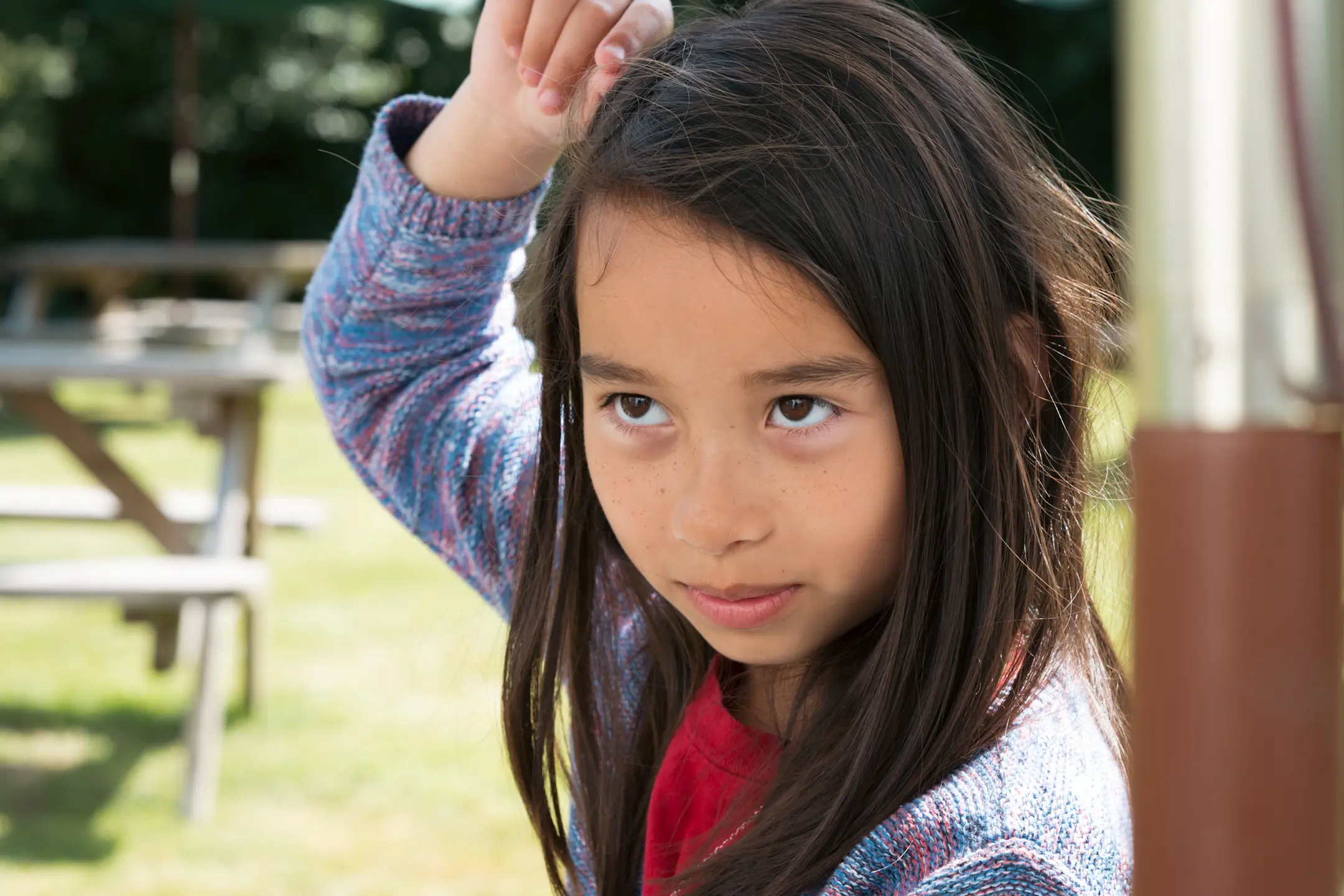
85mm is not a focal length I shoot that often, even though it’s my preferred portrait focal length. I guess thats because unlike 35mm and 50mm, its not a particularly good focal length for general shooting, or at least, it’s not a particularly easy focal length to use for general shooting as it feels considerably narrower than 50mm. It requires you to shoot differently, to either step way back, or focus on details, fill the frame with subjects or isolate elements of a frame. The depth of field is also naturally shallower than wider focal lengths and so it has the ability to blow out backgrounds to a greater degree too. Once you get up in to this focal length range, even the f/4 of the Zoom lens can start to isolate subjects enough for some people’s needs. So given the price of the prime, is there enough difference to justify buying it if you already own the zoom? I’ve already compared both the 35mm 1.8S and 50mm 1.8S in this series of articles. If your’e interested in those comparisons then here are the articles.
Nikon Z 35mm 1.8S vs 24-120mm f/4S
Nikon Z 50mm 1.8S vs 24-120mm f/4S
Some of the links in this article are affiliate links. This means that if you click on them and make a purchase, I may earn a small commission at no additional cost to you. I only recommend equipment that I have personally used and tested.

Today was my Mum’s birthday ( I wont say her age or she will kill me) so I took her out for lunch at a lovely pub not so far from where I live. For those visiting Perthshire I can highly recommend the Smiddy Haugh (great food and service). I brought along the Z6III (full Nikon Z6III review here) and 85mm 1.8S (for more details see my Nikon 85mm 1.8S review) to get some memories. I chose the Z6III over the Z8 for its smaller size and weight as photography wasn’t the point of the outing but still, when you’re a photographer the camera always comes along.
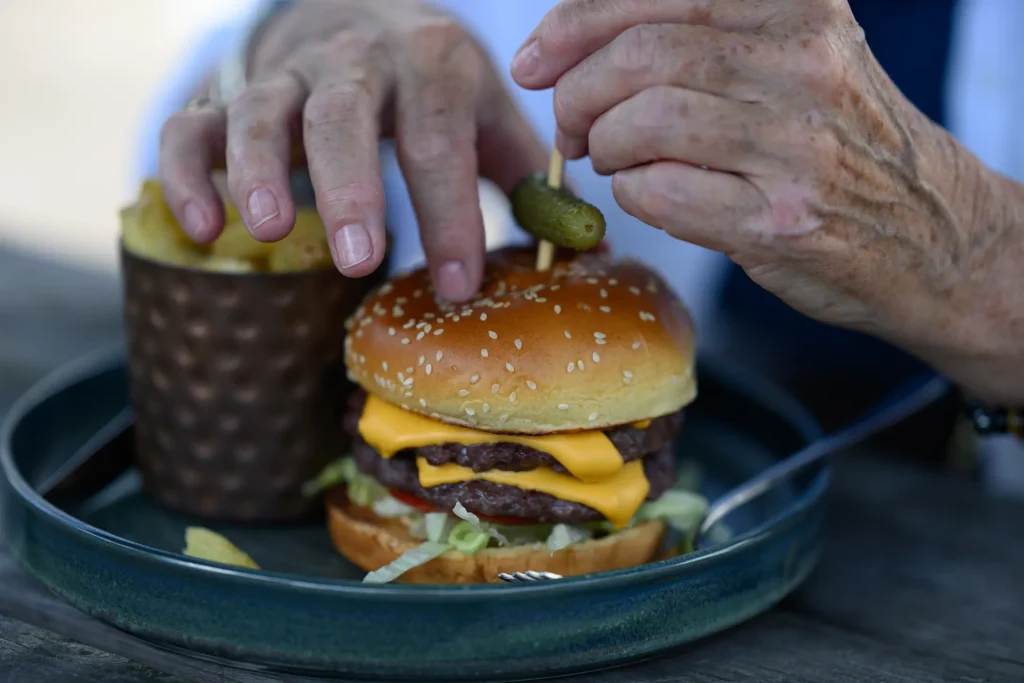
I’ve shot the 85mm 1.8S in the Philippines and here in Scotland. I’ve always been impressed with its optical quality. Today was no different. But given that I own the 24-120mm f/4 (see my Nikon Z 24-120mm f/4S review for more details) and most of my portraits these days are for family projects, is it really worth having an $800 lens in addition to the zoom or is the zoom good enough?
To test the lenses fairly, I set up my Z8 (which I reviewed in full here) on a tripod, found the minimum focusing distance of the Nikon Z 85mm 1.8S and shot a test subject from wide-open to f/8. I then swapped lenses and mounted the 24-120mm f/4S and zoomed to 85mm and replicated the same process. I then shot the 24-120mm at its minimum focus distance to show the difference and I also shot both lenses wide-open from approximately 6 feet away to give an idea of the look you can get from typical portrait distances.
Size and Weight
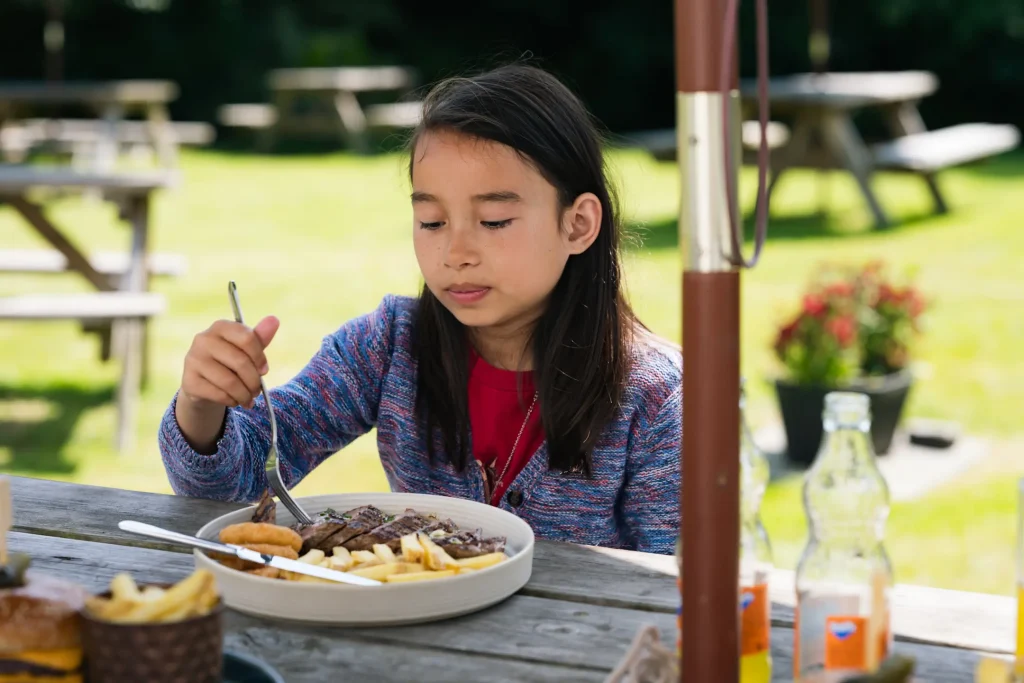
The Nikon Z 85mm 1.8s is noticeably larger than both the Nikon Z 35mm 1.8S and 50mm 1.8S that have featured in the previous comparisons. The weight of 470 grams feels fine when shot on any of the Nikon Z bodies with a decent grip (see my roundup of the best Nikon Z cameras). It’s more the size that is noticeable in terms of its length. Nikon have opted for a lens that is longer and thinner than something like the Fuji 56mm 1.2WR for example. I have two thoughts on this, one is that I prefer a chunkier but shorter lens in terms of looks but the extra length of the 85mm 1.8S does give plenty of room for your left hand to support the lens from and space to manually focus comfortably if you wish (I never do). While the 24-120mm f/4S is hevaier at 630 grams and takes a larger 77mm filter compared to the 85mm’s 67mm filter ring, it doesn’t feel like it’s in an altogether different size and weight category. In my opinion, size and weight savings aren’t substantial enough to choose the prime over the zoom in this case. Both lenses feel well made, are weather sealed and focus quickly and accurately.
Image Quality
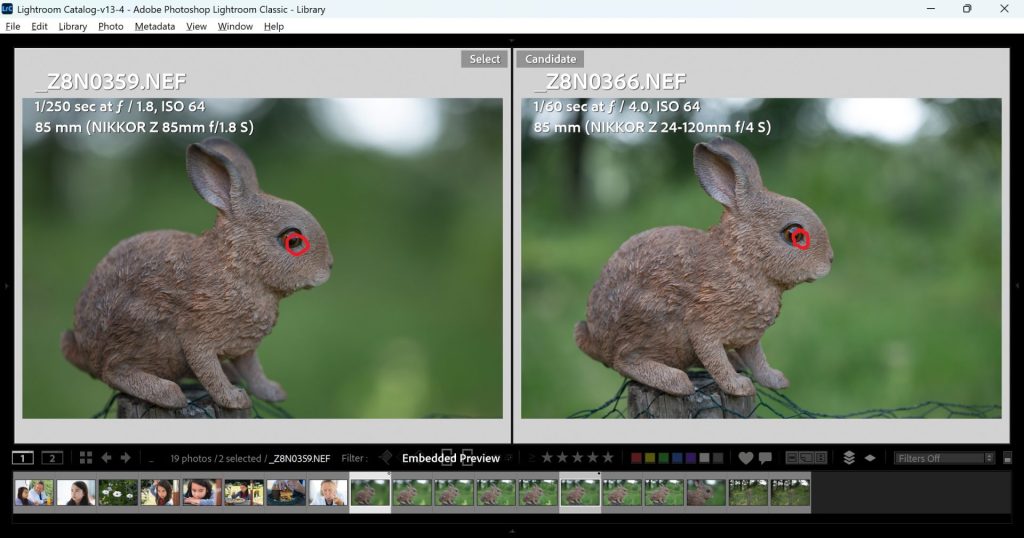
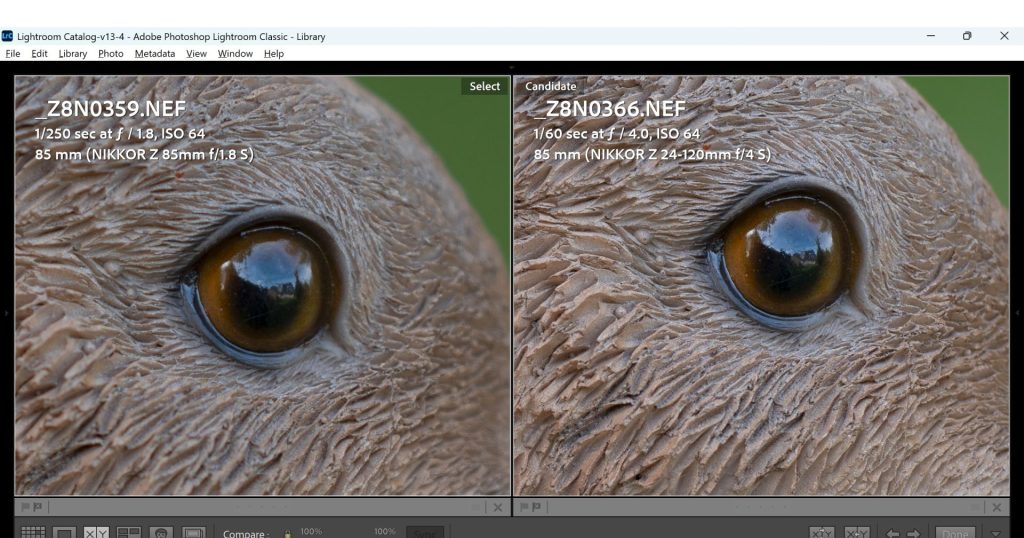
When both lenses are shot wide-open two things are apparent, one is that the depth of field of the Nikon Z 85mm 1.8S at f/1.8 is very narrow and secondly, at f/4, the Nikon Z 24-120mm is sharper. Both lenses are more than sharp enough for any normal use.
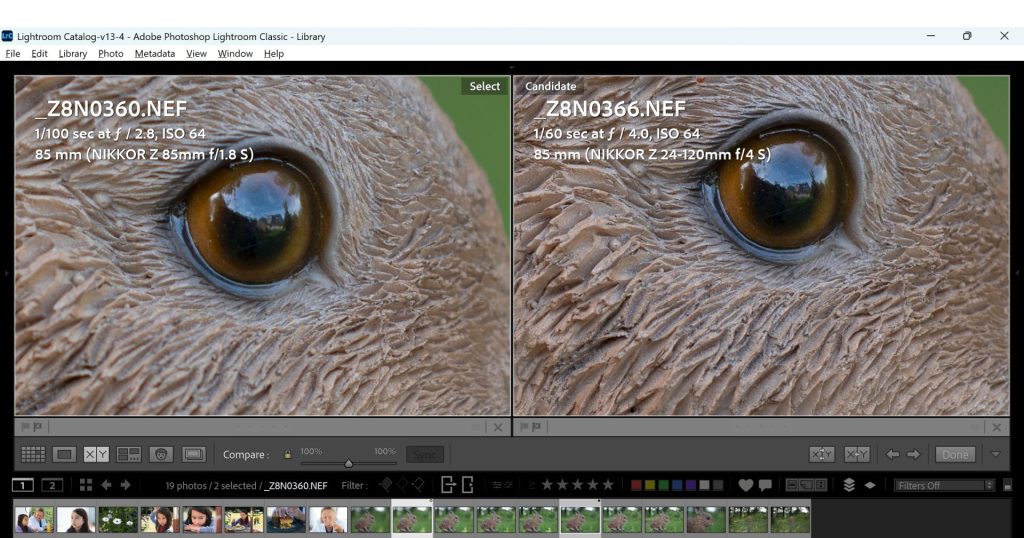
When the 85mm 1.8S was stopped down to f/2.8 it sharpened up a little and the depth of field became more manageable, allowing for more of the subject to be in the critical plane of focus. Both lenses are now very comparable in terms of sharpness and when viewing the photos at full screen, both look pin sharp. When zooming in to 100% crops, the zoom still has a very slight edge in terms of sharpness.
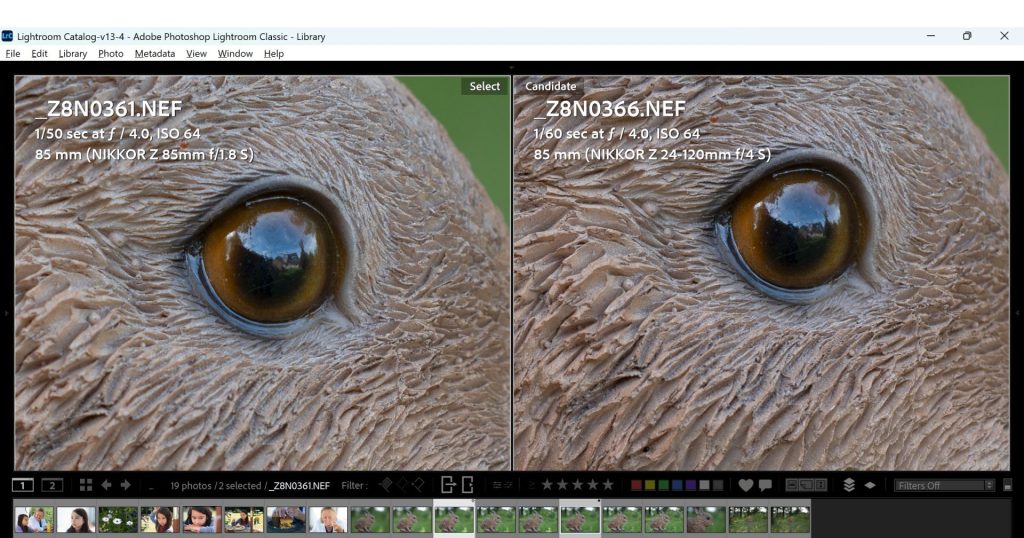
At f/4 both lenses are essentially identical in terms of sharpness. Even zoomed in to 100% I cannot meaningfully tell the difference in terms of sharpness.
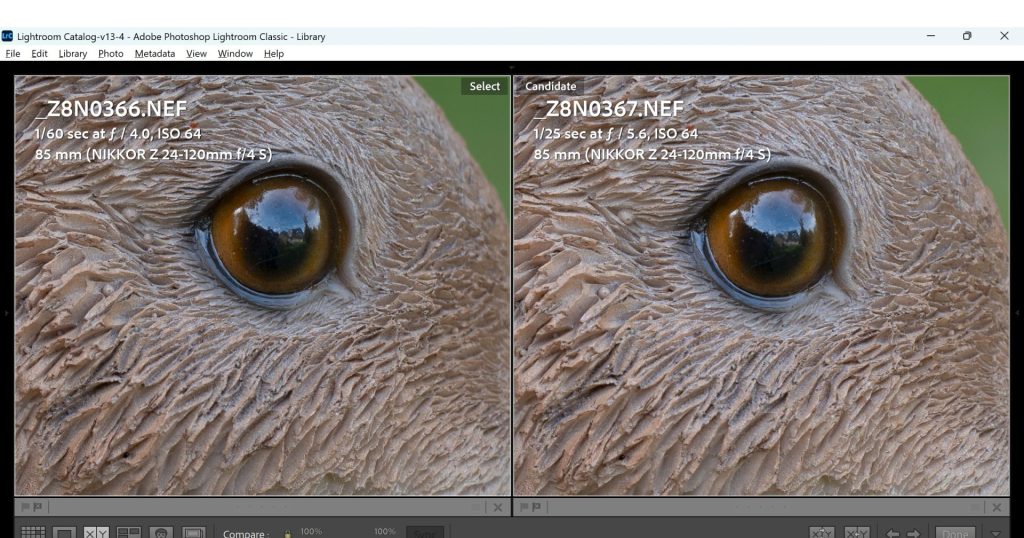
When stopped down from f/4 to f/5.6, the Nikon Z 24-120mm f/4 at 85mm doesn’t really show any improvement in terms of sharpness. It’s already bitingly sharp at f/4.
After shooting these test shots at the Nikon Z 85mm 1.8S’ minimum focusing distance of 80cm, I moved the Nikon Z 24-120mm f/4S in until I reached its minimum focus distance of a claimed 35cm. I then took a shot to show the difference between the two, which is not insignificant.
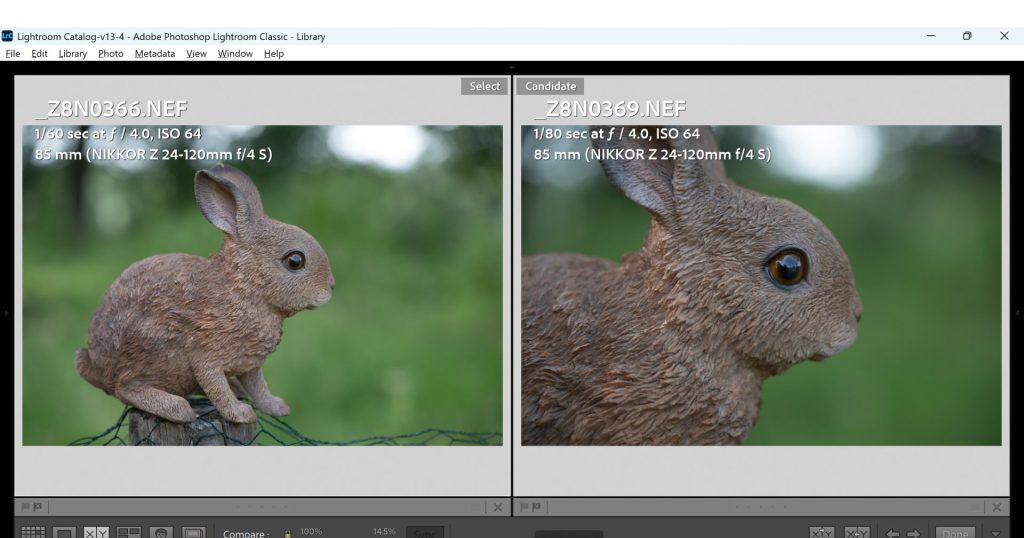
At this point I should note that there is a differrence between the marked 85mm position and what the camera states is 85mm on the Nikon Z 24-120mm f/4S. I found that I had to zoom in past the position marked as 85mm on the zoom lens in order to obtain what the camera and Lightroom reports as being 85mm focal length. Even with the additional zoom, at an indicated 85mm as shown in the Lightroom screenshots, the zoom shows a slightly wider field of view than the Nikon Z 85mm 1.8S prime lens at this focus distance.
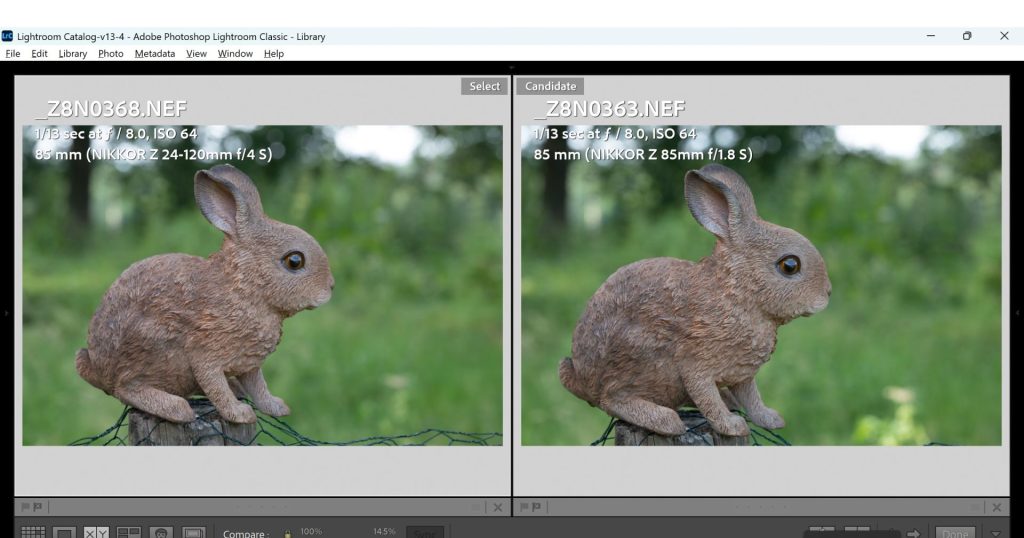
After these tests, I then paced out approximatley 6 feet from the subject and shot both lenses wide-open in order to give a more realistic real-world shooting distance and show the difference between f/1.8 and f/4.
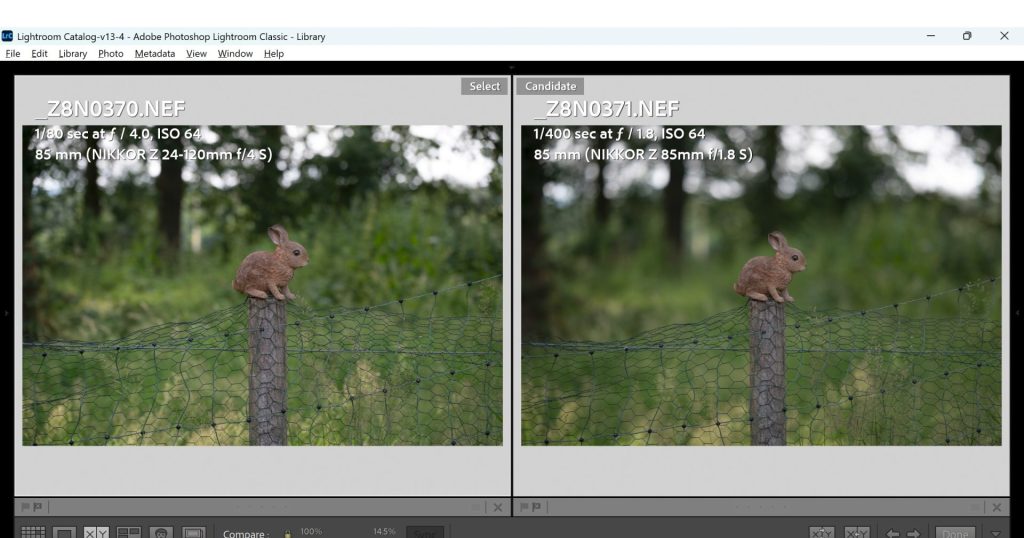
At this distance, it is now the Nikon Z 85mm 1.8S lens that is giving a slightly wider field of view. The Nikon Z 24-120mm f/4S is exhibiting some variable focus breathing which is depending upon the distance to subject.
When shooting close in to the subject, the f/4 aperture of the zoom lens gives decent subject separation, that for a lot of people will be more than enough to give their subjects enough pop to separate them from the background, once the distance to subject increases, as in the shot above, the background at f/4 becomes quite distracting. The larger aperture of the prime lens starts to show its advantage in scenarios like this. If you can’t control your background, distance to subject or you simply want the ability to use shallow depth of field creatively, the prime lens starts to show its value.
Verdict
If you shoot portraits, family photos creatively or value depth of field control highly, then yes, the prime lens is worth adding to your kit as it truly can create photos that stand out. It’s very sharp, has excellent bokeh and is in my opinion, the best portrait lens for most people, for the Nikon Z mount. Not to mention the low light benefits of f/1.8 vs f/4, which for portrait subjects where you usually need a minimum shutter speed of 1/160 or more can be critical.
But what if you own the Nikon Z 24-120mm f/4S, are a general photographer who shoots a bit of everything, including your children and family. Is it worth buying the Nikon Z 85mm 1.8S too?

It really depends on how much value you put on those photos. For me personally, shots like the one above make it worth keeping the 85mm in my bag because in confined spaces, where I don’t have total freedom to move subjects, my position and the environment, it gives me the ability to capture moments and keep them looking special. Would I buy the prime again, now that I have the 24-120mm f/4S, probably not as it’s not a focal length I use that often so I would either work within the zooms constraints in terms of aperture or opt for a more flexible prime in the Nikon Z 50mm 1.8S which can capture a wider variety of subjects and therefore represents a better value proposition. Let’s not forget that you can also zoom the 24-120mm f/4S in to 120mm which will naturally give you more subject separation if you have the distance to move back and still frame your shot as you want to. If i was shooting portraits for a living or as my main subject, then yes, the prime is absolutely worth it.
You can check out the latest price for the Nikon Z 24-120mm f/4S here.
You can see the latest price for the Nikon Z 85mm 1.8S here.
Unmentioned is the ability of the 24-120 to zoom beyond 85mm iI often find 100-120 mm yields better portraits.
Hi Jim,
That’s true about the ability to zoom in beyond 85mm with the zoom. I mentioned this at the bottom of the article. Although I prefer the look of 85mm for portraits, it does add to the flexibility of the zoom.
All the best
David
The only Zoom lens I own is a Sigma sport 70 to 200 F2.8, all my other 7 lenses are primes, Nikon 400mm F4.5, 85mm F1.8 and 20mm F1.8, the others Tamron 45mm F1.8, 35mm F1.4 and Viltrox 135mm F1.8 I find the primes are lenses I can be more creative with. The two cameras give me versatility Z6II and Z8 due to their sensors, With my previous Nikon DLSR I used all zoom and struggled to be creative, I just find primes are the way to go.
Hi Derek,
Thanks for your comment. I completely understand your preference for primes. It’s not lways about the technical stuff. Being inspired plays a huge role too. That’s why I still get better photos when I shoot primes.
All the best
David