

Last Update February 23rd 2026:
I’ve continued shooting with the XF 56mm f/1.2 WR this year, it’s a lens I’ll likley never sell. My impressions remain the same: the autofocus isn’t as quick as Fuji’s linear-motor primes, but the image quality wide open is still fantastic — and every time I use it, I’m reminded why I keep it in my kit and why it’s still one of the best Fujifilm lenses available today. For a more flexible alternative see my full Fuji 16-55mm f/2.8II review and how the prime compares against the zoom.
Ask a lot of photographers about fast lenses and their eyes will light up. It’s the dream for many of us to own our brand’s premium prime — that exotic, wide-aperture lens that promises creamy backgrounds and the kind of subject separation you just can’t fake.
With bokeh and shallow depth of field more fashionable than ever, Fujifilm’s classic 56 mm f/1.2 has always been the go-to portrait lens for X-Series shooters. I owned the original 56 mm f/1.2 for a long time and liked the image quality, but its autofocus was clunky and it wasn’t weather-sealed — two things that often frustrated me.
Fuji has addressed both with the new XF 56 mm f/1.2 R WR, and because 56 mm is my preferred focal length for portraits and detail shots, I picked one up alongside my X-T5 a couple of years ago. This review comes from two years of real-world use, mostly here in the Philippines, photographing family and travel scenes in a variety of light and weather.
But is the XF 56 mm f/1.2 R WR really worth paying the premium for that ultra-fast f/1.2 aperture or will the Fuji 50mm f/2 do the job?
This article contains affiliate links. If you purchase something through these links, I may earn a small commission at no extra cost to you. This helps support the site and the work I put into these reviews.
TL;DR — Fujifilm XF 56mm f/1.2 WR
- Sharp wide open: noticeably sharper at f/1.2 than the original 56mm, with smoother, creamier bokeh.
- Improved close-focus: new 50 cm minimum distance makes the lens far more versatile for tighter portraits.
- Autofocus: better than the old version, accurate and reliable, but still not as fast as Fuji’s linear-motor primes.
- Build quality: beautifully made, fully weather-sealed, balances well on the X-T5 despite being heavier than Fuji’s other fast primes.
- Who it’s for: portrait shooters, family photographers, anyone wanting the “special look” only an f/1.2 lens gives.
- Recommendation: worth the investment if you shoot this focal length often. Casual users may prefer the cheaper 50mm f/2 WR.
| Focal length | 56 mm (≈ 85 mm full-frame equivalent) |
|---|---|
| Angle of view | 28.5° |
| Optical construction | 13 elements in 8 groups (including 2 aspherical and 1 ED element) |
| Maximum aperture | f/1.2 |
| Minimum aperture | f/16 |
| Diaphragm | 11 rounded blades (1/3 EV steps) |
| Minimum focus distance | 0.50 m |
| Maximum magnification | 0.14× (approx.) |
| Filter thread | 67 mm |
| Dimensions (Ø × L) | 79.4 mm × 76 mm |
| Weight | Approx. 445 g |
| Weather-resistance | Yes — WR (weather-sealed) |
Build Quality & Handling
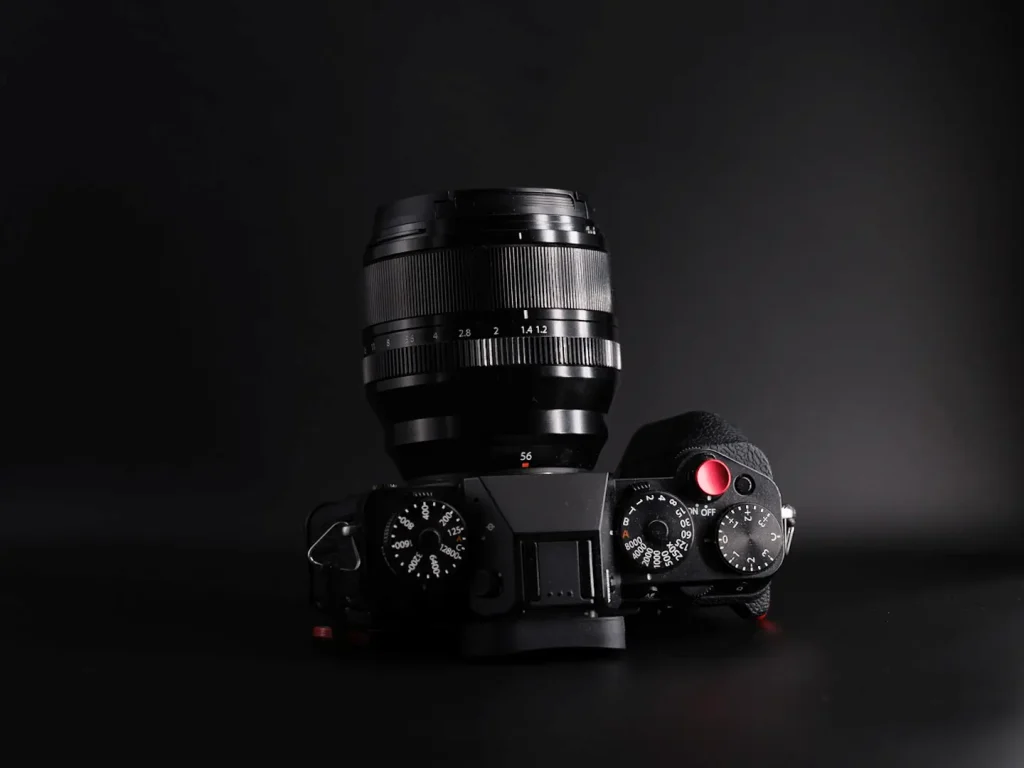
There are no surprises here — the XF 56 mm f/1.2 R WR is built to the same high standard as Fuji’s other premium primes like the 23 mm and 33 mm f/1.4 WR. Compared to those two it’s definitely heavier and a little bulkier, but it still balances nicely on the X-T5. I actually like Fuji’s design choice here: the lens is shorter and fatter rather than long and skinny, which keeps the camera from feeling front-heavy and (to my eye) looks better than something like Nikon’s 85 mm f/1.8 Z.
The metal barrel feels solid and confidence-inspiring in the hand. The aperture ring offers well-defined ⅓-stop clicks with just the right resistance — no sloppy play. One of my must-haves when paying for a premium prime is weather sealing, and Fuji didn’t disappoint: there’s a gasket at the mount, multiple internal sealing points, and a fluorine coating on the front element to help shed moisture. In practice I haven’t used this lens in truly bad weather as much as my 23 mm and 33 mm f/1.4, but I’ve had no hesitation shooting in light drizzle here in the Philippines. (That said, being a portrait lens, my usual subjects — wife and daughters — didn’t jump at the chance to test it in a monsoon.)
The focus ring is smooth, but this isn’t really a lens I’d choose for manual focus. At f/1.2 the depth of field is razor thin and subject movement makes precision tricky; the manual focus response also feels a little jumpy rather than perfectly linear. Fuji supplies a fairly large lens hood, but overall the package is still reasonable in size. Sitting here next to my Nikon Z8 + 50 mm f/1.8 Z, the 56 mm is actually slightly shorter and about the same diameter — so it’s not some hulking monster.
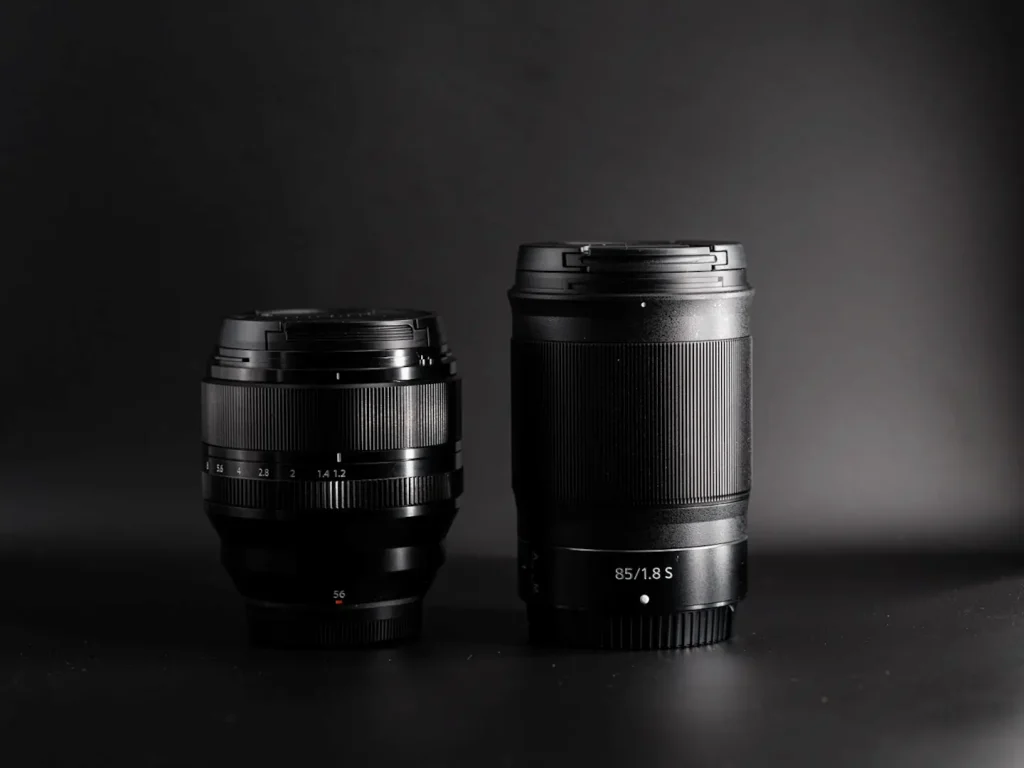
The newer 67 mm filter thread is a touch bigger than the original 56’s 62 mm, but it hasn’t mattered to me in real-world use. I’ve mostly stopped adding filters to my primes anyway. All told, while this lens is heavier than Fuji’s other fast WR primes, it handles well and feels like a premium tool — solid, balanced, and confidence-inspiring on the X-T5.
Image Quality

The original XF 56 mm f/1.2 was never a bad performer, but the new WR version is clearly sharper wide open — both in the centre and right out to the edges (not that corners matter much at f/1.2). On the X-T5’s 40 MP sensor it’s already bitingly sharp at f/1.2, and stopping down to f/2–f/4 only adds a touch more crispness. The older lens needed to be at least at f/2 before it felt this sharp; once both are stopped down past f/2 the gap narrows.
Fuji also cut the minimum focus distance to 50 cm (vs 70 cm before), which lets you get closer for tighter portraits and more dramatic background blur. Combined with the new 11-blade diaphragm, the bokeh is smoother and creamier than the old lens — the previous 9-blade design sometimes gave less perfect bokeh balls.


Optical flaws are much better controlled too. The original 56 was prone to purple/green fringing in high-contrast scenes and could flare badly if light hit the front element at the wrong angle. The WR version shows almost no fringing and handles flare far better, helped by Fuji’s updated coatings. Contrast also feels a little higher, giving images more punch and pop straight out of camera.
Overall, while the first-generation 56 mm was a solid portrait lens, this update brings a stack of refinements. The standout gains for me are razor-sharp performance wide open and the smoother, rounder bokeh — together they make the WR version feel like a true modern premium prime rather than a holdover from Fuji’s early X-mount days.
Autofocus & Usability

Fuji has definitely improved autofocus on the XF 56 mm f/1.2 R WR, but not to the same level as the newer 23 mm f/1.4 WR or 33 mm f/1.4 WR. This lens doesn’t use Fuji’s fastest linear AF motor, and you can feel it: focus is quicker and more confident than the old 56 mm, but it’s still not snappy. You’ll sometimes notice a two-step movement — a quick lock, then a small refinement — and there’s still a hint of the old-style focus motor sound rather than the silent glide of the linear designs. In my comparison of the Fuji 56mm 1.2 vs 50mm f2 I found the 50mm f2 was faster to focus.
The big step forward is accuracy. My hit rate with people (including my two constantly moving daughters) is now around 75% wide open, which is a noticeable improvement over the original. I’ve also switched my X-T5’s AF-C priority to “Focus”, so the camera won’t fire until focus is confirmed. That adds a tiny pause before the shutter fires, but at f/1.2 I’d rather have a sharp keeper than a stream of almost-but-not-quite in-focus frames.
Get My Fujifilm X-T5 Setup Files
Download the exact autofocus settings, custom button layout and film simulations I use on my X-T5. Load them straight onto your camera and skip the trial-and-error.
Download the Setup FilesFree download.
In low light the lens is usable but not lightning fast; it can hesitate a touch compared with Fuji’s linear-motor primes, but it rarely hunts or fails outright. Eye and face detection on the X-T5 work well — just don’t expect the same tracking responsiveness you’d get with the 23 mm f/1.4 WR.
Overall, autofocus is good enough for real-world portraits and family use and a clear step up from the old 56 mm, especially in accuracy. Still, I can’t help wishing Fuji had given this lens a linear motor — it would have made an already excellent portrait prime almost perfect.
Do You Really Need f/1.2?

Check Price
Fujifilm XF 56mm f/1.2 R WR on Amazon
As an Amazon Associate I earn from qualifying purchases — it helps support this site at no extra cost to you.
Who Is the Fujifilm XF 56mm f/1.2 WR For?
This lens is for you if:
- You regularly shoot portraits at an 85mm-equivalent focal length.
- You want maximum subject separation and a distinctive, premium rendering style.
- You photograph your children or family in natural light and want images that feel special rather than clinical.
- You print your work and want sharp, detailed files even at f/1.2.
You may want to consider alternatives if:
- You only occasionally use short telephoto focal lengths.
- You prioritise autofocus speed over rendering character.
- You want something smaller, lighter and more discreet for everyday carry.
So with all that said — is the XF 56 mm f/1.2 R WR worth paying the premium over cheaper alternatives (See my article on the best portrait lenses for Fujifilm)? I’m not going to bore you with every possible shooting scenario because I could reel off plenty. It really boils down to one simple question:
Are portraits and shots at this focal length a major part of your photography?
If they are, then yes — without doubt the 56 mm f/1.2 WR is worth every dollar if you’re a Fujifilm shooter. Between the bright aperture, fantastic rendering and pro-level build quality, this is a lens you can invest in and create images that will stand out for years. For wedding photographers or anyone selling prints and portrait packages, the look this lens delivers is the kind that wows clients and wins repeat business. If you simply love beautiful image quality for your own work, you won’t be disappointed — just be aware it’s not the fastest-focusing lens, so don’t expect to track fast-moving subjects as confidently as with Fuji’s other modern primes.
Fujifilm XF 56mm f/1.2 R WR
Premium short-telephoto prime with exceptional sharpness at f/1.2 and beautifully smooth rendering.
Check Latest PriceAs an Amazon Associate I earn from qualifying purchases — at no extra cost to you.
If you’re a more general shooter — you usually shoot wider or standard focal lengths and only occasionally dip into short telephoto — you may be better off saving money with the original 56 mm f/1.2 and living with its quirks. If you don’t mind extra weight, the Viltrox 75 mm f/1.2 is also a compelling lower-cost option with lovely rendering. And if you just want this focal length covered but won’t use it heavily, the Fuji 50 mm f/2 WR is small, fast to focus and much cheaper.
For me personally, while it’s not one of my most used lenses, every time I shoot with it, I’m glad that I have it in my bag. The images I get from it are worth every Dollar it cost me and to get anything substantially better on Full frame would cost a lot more than the Fuji 56mm 1.2WR lens.
Frequently Asked Questions
Is the Fujifilm XF 56mm f/1.2 WR sharper than the original version?
Yes. The WR version is noticeably sharper wide open at f/1.2, both in the centre and towards the edges. The older lens needed to be stopped down to around f/2 before it reached similar levels of crispness.
How good is the autofocus compared to Fuji’s other modern primes?
Autofocus is definitely improved over the old 56mm, especially in accuracy, but it’s still not as fast as Fuji’s linear-motor primes like the 23mm and 33mm f/1.4 WR. It’s reliable for portraits and family work but not ideal for tracking fast-moving subjects.
Is the 56mm f/1.2 WR good for low-light photography?
Yes. The bright f/1.2 aperture helps a lot in low light, and AF remains usable, though it’s still a touch slower than Fuji’s faster linear-motor lenses. Eye and face detection perform well on the X-T5.
How is the bokeh compared to the older 56mm?
It’s smoother thanks to the new 11-blade diaphragm and closer focusing distance, giving more rounded and pleasing out-of-focus rendering than the original.
Is the lens weather-sealed?
Yes. The 56mm f/1.2 WR is fully weather-sealed with multiple internal seals, a mount gasket and fluorine coating on the front element.
Is the 56mm f/1.2 WR too heavy for the X-T5?
It’s heavier than Fuji’s other modern f/1.4 primes, but it still balances well. Its shorter, wider design helps avoid front-heaviness on the X-T5.
Is this a good lens for general everyday shooting?
It can be, but it’s mainly designed as a portrait and detail lens. If you only use this focal length occasionally, the Fuji 50mm f/2 WR may be a more sensible choice.
Do you really need f/1.2 on Fujifilm?
Only if portraits or short-telephoto work form a significant part of your photography. The 56mm f/1.2 WR excels when you want shallow depth of field, strong subject separation and a premium rendering style. If you only rarely shoot at this focal length, cheaper alternatives exist.
How does it compare to the Fuji 50mm f/2 WR?
The 50mm f/2 WR is faster to focus, lighter and far cheaper. But the 56mm f/1.2 WR delivers a noticeably more premium look thanks to its brighter aperture, smoother bokeh and richer rendering.