

Updated March 2026 — After using the XF 33mm f/1.4 WR for over a year alongside Fuji’s other premium primes, here’s how it holds up and whether it still feels like the right choice amongst the growing X-mount lineup.
Is this a worthy successor to Fuji’s legendary 35mm f/1.4?
I’ve loved the 50mm equivalent focal length ever since I bought the Canon 50mm f/1.8 “plastic fantastic” for my 450D way back in 2008 or 2009. That lens transformed my images compared to the kit zoom I started with — and it was the first time I understood how a prime lens could help your photography. If you are looking for a wider prime lens then see my comparison of the 18mm 1.4WR vs the 23mm 1.4WR lenses or if you’re still deciding which lenses to buy, then see my full Fuji lens recommendations article. I also compared the Fuji 33mm 1.4Wr against Fuji’s best professional zoom.

The XF 33mm f/1.4 WR is Fujifilm’s best standard prime to date — fast, sharp, weather-sealed, and built to last. Autofocus is snappy and reliable, even with fast-moving subjects, and image quality is excellent wide open. It’s larger than the 35mm f/2 or the older 35mm f/1.4. If you want small and light, the 35mm f/2 is hard to beat. But if you’re after the best lens, the combination of fast, reliable autofocus and beautiful image quality makes the 33mm f/1.4 WR worth every dollar over the 35mm f/1.4 — you’ll walk away with far more keepers. I trusted it for my daughter’s first birthday. That says everything.
✅ Check Current Price — Fujifilm XF 33mm f/1.4 R LM WR
View Price on Amazon →50mm gives you a natural view of the world. It doesn’t exaggerate like a wide-angle, and it doesn’t compress reality like a telephoto. It lets your subject do the talking, which is exactly what I want most of the time. People call it “standard,” but I’ve never found it boring. If anything, its versatility is what keeps it interesting.
Over the years, I owned the original Fujifilm XF 35mm f/1.4 and used it extensively on the X-Pro1 and other Fuji bodies. I compare the Fuji 33mm and 35mm f2 lenses here. That lens has earned near-legendary status thanks to its beautiful rendering and character. But let’s be honest: the autofocus was sluggish, and it lacked weather sealing — both of which became more noticeable as the Fuji system matured.
Nearly a decade later, Fujifilm finally released the XF 33mm f/1.4 R LM WR. On paper, it’s everything we asked for. But does it live up to the legacy of the original 35mm? Looking for something wider? Take a look at my Fujifilm 18mm f/1.4WR lens review.
- Focal Length: 33mm (50mm equivalent)
- Maximum Aperture: f/1.4
- Minimum Aperture: f/16
- Aperture Ring: Yes, with ‘A’ position lock
- Autofocus: Linear Motor (LM) – fast and silent
- Weather-Sealed: Yes
- Minimum Focus Distance: 30cm
- Maximum Magnification: 0.15x
- Filter Thread Size: 58mm
- Length: 73.5mm
- Weight: 360g
🛠 Build and Handling

The XF 33mm f/1.4 R LM WR — a bit of a mouthful — is larger than the original 35mm f/1.4 and comes in a little heavier, but it still feels perfectly balanced on my X-T5 (which I reviewed here). I never notice the weight, and it doesn’t make the setup feel front-heavy or bulky. Yes, it’s significantly larger than Fuji’s 35mm f/2, but that lens feels tiny on the X-T5 in comparison.
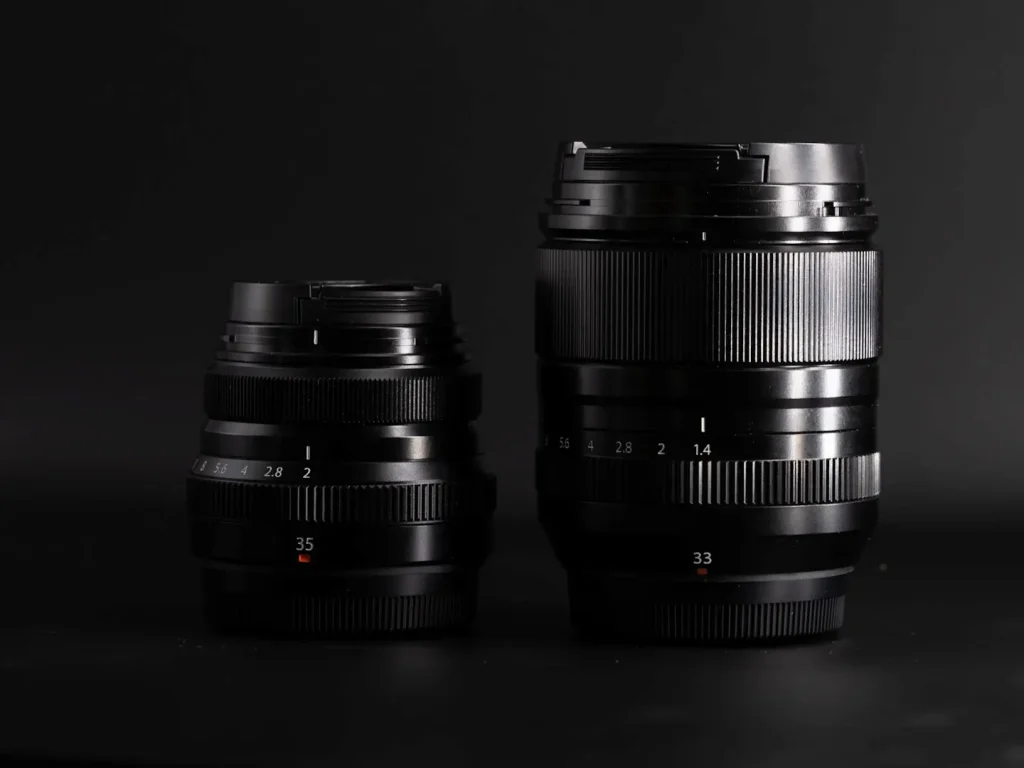

Unlike the original 35mm f/1.4, the 33mm no longer has a manual focus clutch to quickly switch to MF. I rarely used that anyway, and with the X-T5’s AF+MF option, the change is irrelevant for how I shoot.
The “WR” badge stands for weather resistance, which I really appreciate. I use my gear throughout Southeast Asia and as of February 2026, Scotland, where the heavens can open without warning at any time. But it’s not just about rain — keeping dust out is just as important.
Build-wise, the lens feels excellent. Not quite like a tank — more like an armoured car. Solid metal construction, with a dense, reassuring feel that suggests there’s some quality glass inside. It’s a world away from my old plastic-fantastic Canon 50mm.
The aperture ring is well-damped, with just the right amount of resistance between stops, and it locks into the ‘A’ position with a reassuring click. The focus ring is typical fare: a little too light for my tastes, and focus-by-wire of course, so the manual experience is fine but nowhere near a proper mechanical lens.
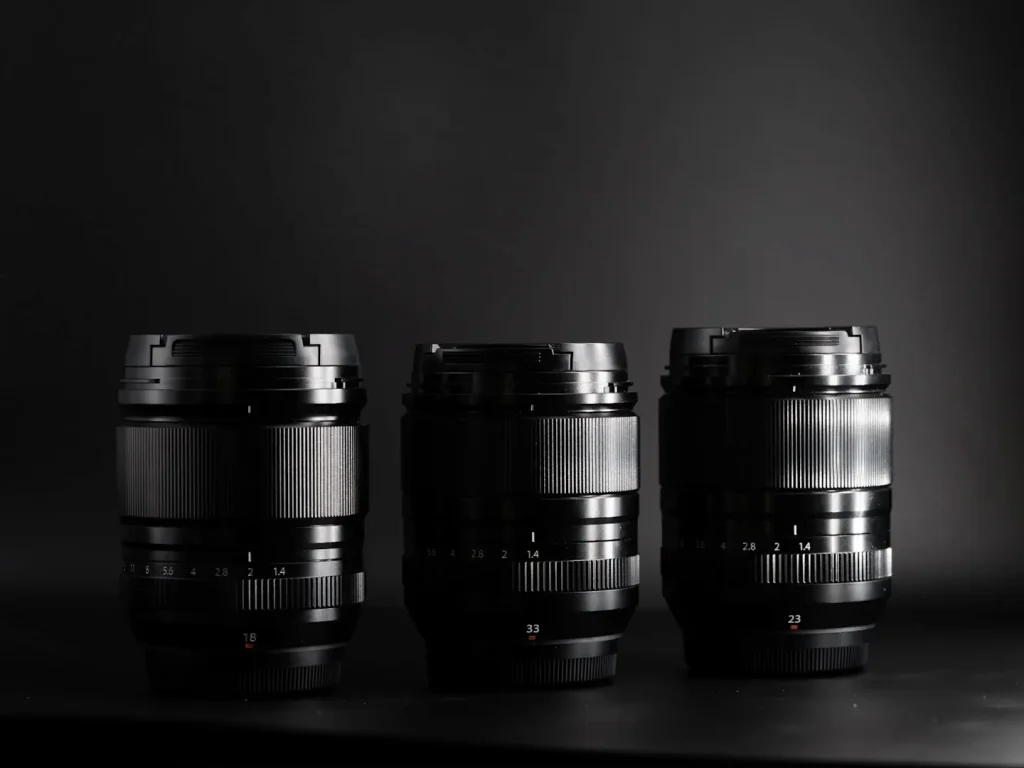
The 58mm filter thread is a nice middle ground — not too big, not too small — and shared with the XF 23mm f/1.4 WR, which helps if you’re buying filters. Sitting on my desk next to the 23mm f/1.4 WR and 18mm f/1.4 WR, the 33mm is a tiny fraction shorter than either, and the trio clearly belongs to the same premium design family. They all feel high-end without the unnecessary bulk of most premium full-frame glass.
⚡ Autofocus Performance
I have to assume that the main reason Fujifilm upgraded the original 35mm f/1.4 was to improve autofocus performance. The “LM” in the name stands for Linear Motor — Fuji’s fastest AF system — and it shows.

The 33mm f/1.4 focuses very quickly, from near to far, and does so virtually silently. It’s light years ahead of the hunting and hesitation I remember from my time using the original 35mm f/1.4. Wide open on the X-T5, it’s confidence-inspiring when photographing people and moving subjects. Get the exact settings I use, including AF, custom settings and film recipes for free.

In AF-C with face detection enabled, it picks up your subject’s face and eyes quickly and tracks them with real authority. My hit rate for the kind of shots I take — street and travel photography, family moments, kids playing and moving around — is very high. I’d estimate 80%+ keepers depending on the situation, and even higher for less demanding scenes.
Is it perfect? Not quite. But when I do get a missed shot, I rarely blame the lens. It’s usually down to my timing, or the eye-AF momentarily grabbing the wrong eye — something I’ve seen happen with every brand, even Sony. That’s just part of the game when shooting with shallow depth of field.


In general photography, whether in AF-C or AF-S, this lens keeps up and performs really well. If you’re trying to track kids racing around at breakneck speed using AF-C + tracking, you might get a few misses — especially wide open — but unless you’re using the latest Sony bodies, that’s par for the course. And with a bit of experience, it’s easy to work around.
This might just be one of the fastest focusing lenses Fujifilm has made. In my experience, it’s a little quicker than the 23mm f2 and 35mm f/2 — and those are already snappy lenses.
🖼 Image Quality
In my opinion, this is where the 33mm f/1.4 WR lens shines the most. Yes, it’s fast to focus. Yes, it’s well built. But it’s the image quality that matters most.

I hear all the time about the rendering of the old 35mm f/1.4 lens — and I agree, it was beautiful. You can still pick it up for around $599. But the new 33mm f/1.4 WR is, in my opinion, every bit as good, although a little more clinical. It has smooth out-of-focus areas and transitions, and it’s sharper both in the middle and across the frame. If you want even creamier bokeh then the 56mm 1.2WR lens is even better or to see what full frame can do I reviewed the Nikon Z 50mm 1.8S lens. and the Nikon Zf.
Looking for even more subject separation and background blur? Here’s my full review of the Fujifilm 56mm f/1.2 WR — Fuji’s king of bokeh and portrait rendering.
Read the 56mm f/1.2 WR Review →
At f/1.4 it performs brilliantly, and stopped down to f/2 there’s a fractional improvement. Sharpness is particularly noticeable when paired with Fuji’s 40MP sensors in the latest generation cameras. As I found when testing the Fuji 23mm 1.4WR

There’s a tiny amount of vignetting in the corners, but generally the lens is well-corrected. I haven’t noticed any chromatic aberrations or fringing — although I haven’t specifically tested for it.
I use this lens quite a lot.

It was Isabelle’s first birthday last week — one of the most important events in any parent’s life. Of all the lenses I could have chosen to take to the beach that day, it was the 33mm f/1.4 WR that I attached to my X-T5.

Why? Because I trust the autofocus, and more importantly, I know this lens gives me the flexibility to capture both contextual scenes and more intimate moments. The image quality and rendering are good enough that I can turn those memories into print-worthy photos — ones I’ll look back on in years to come and say, I can’t believe she’s already turned nine, just as I do now with Sofia.
The fact that I picked this lens over everything else I own for a day that mattered that much… I think that speaks volumes.
🧠 Final Thoughts, Use Cases & Value
The 33mm f/1.4 WR is, without doubt, the best standard prime lens for the Fuji X system. Compared to premium full-frame options, it still feels compact. The build quality is reassuringly solid, and the autofocus is as good as it gets in Fuji land.
Its sharpness wide open makes it an incredibly useful tool for isolating subjects and working in low light. If you were going to pick just one premium prime to add to your arsenal, this — or its sibling, the 23mm f/1.4 WR — would be the top contenders.
If you simply want the best Fuji has to offer, whether for professional or personal work, the 33mm f/1.4 WR won’t disappoint. It’s perfect for general photography, contextual portraits, family photos, and low-light work. Yes, it’s larger than the 35mm f/1.4 and 35mm f/2, but it doesn’t feel out of place on my X-T5.
You can check current pricing and availability here:
View XF 33mm f/1.4 WR on Amazon →
One consideration: it does block a fair bit of the optical viewfinder on the X-Pro series. If that matters to you, this lens might not be the right fit. But for anyone using the EVF, it’s a premium lens that matches incredibly well with Fuji’s top bodies.
That said, if you want nearly as much performance in a much smaller package, the 35mm f/2 is also an excellent choice — I compared the two. But if you want the best, and you need that large aperture, fast and accurate autofocus, and premium build quality, then the investment in this lens will pay itself back many times over.
Frequently Asked Questions
1. Is the Fujifilm 33mm f/1.4 worth it over the 35mm f/1.4?
Yes it is — it’s sharper across the frame and both the build quality and autofocus speed are a big improvement. Not to mention it is now weather sealed.
2. Is the 33mm f/1.4 too big for travel and street photography?
Not at all — combined with my Fuji X-T5 I find it to be perfectly balanced. The 35mm f/2 is still a great choice if you want an even smaller setup though.
3. Is the 33mm f/1.4 better than the 35mm f/2 for everyday use?
Both of these lenses are excellent for everyday use. It really depends on your priorities. Buy the 33mm f/1.4 WR if you value best image quality, low light performance and rendering. Buy the 35mm f/2 if you want great image quality but value size and portability more. Neither will disappoint.
4. Does the 33mm f/1.4 focus faster than older Fuji primes?
Yes, and it’s not even close. The old lenses hunted, were noisy and not always reliable. The 33mm f/1.4 WR is quick, virtually silent and deadly accurate.
I had a different experience. I was expecting a lot. I thought it was good but not great. I MUCH prefer the f2 series, especially the 50mm. They offer basically the same image quality but with vastly reduced weight and size. For the time you need 1.4 either get this or I would go with something like the original 35mm.
Hi, Appreciate your comment. I think a lot depends on how much value you put on size and weight. The 35mmf2 is excellent, especially given the size and price. I’ll be comparing it to the 33mm 1.4 soon. The original 35mm produced beautiful images but the AF was an issue and I wouldn’t want to rely on it anymore for photos that I can’t re-shoot.
Hi there – what are your thoughts on the x-e5? I’ve read a few of your other articles mentioning your love for the x100vi. Do you think the interchangeable lense will make the x-e5 the new it-camera for Fuji?
I like the look of the X-E5, I considered getting one. I’m sure it will be a very good camera. However I didn’t as it does nothing better than my X-T5 or X100VI. It’s not weather sealed, single card slot, no 3 way tilt screen, lower res EVF, misses out on what makes the X100VI special (fixed lens at f2, Internal ND filter, Leaf shutter). So while I’m sure it’s a good camera, at its current price I don’t think it’s going to become as popular as the X100VI and it doesn’t replace the XT5 for more serious work.