
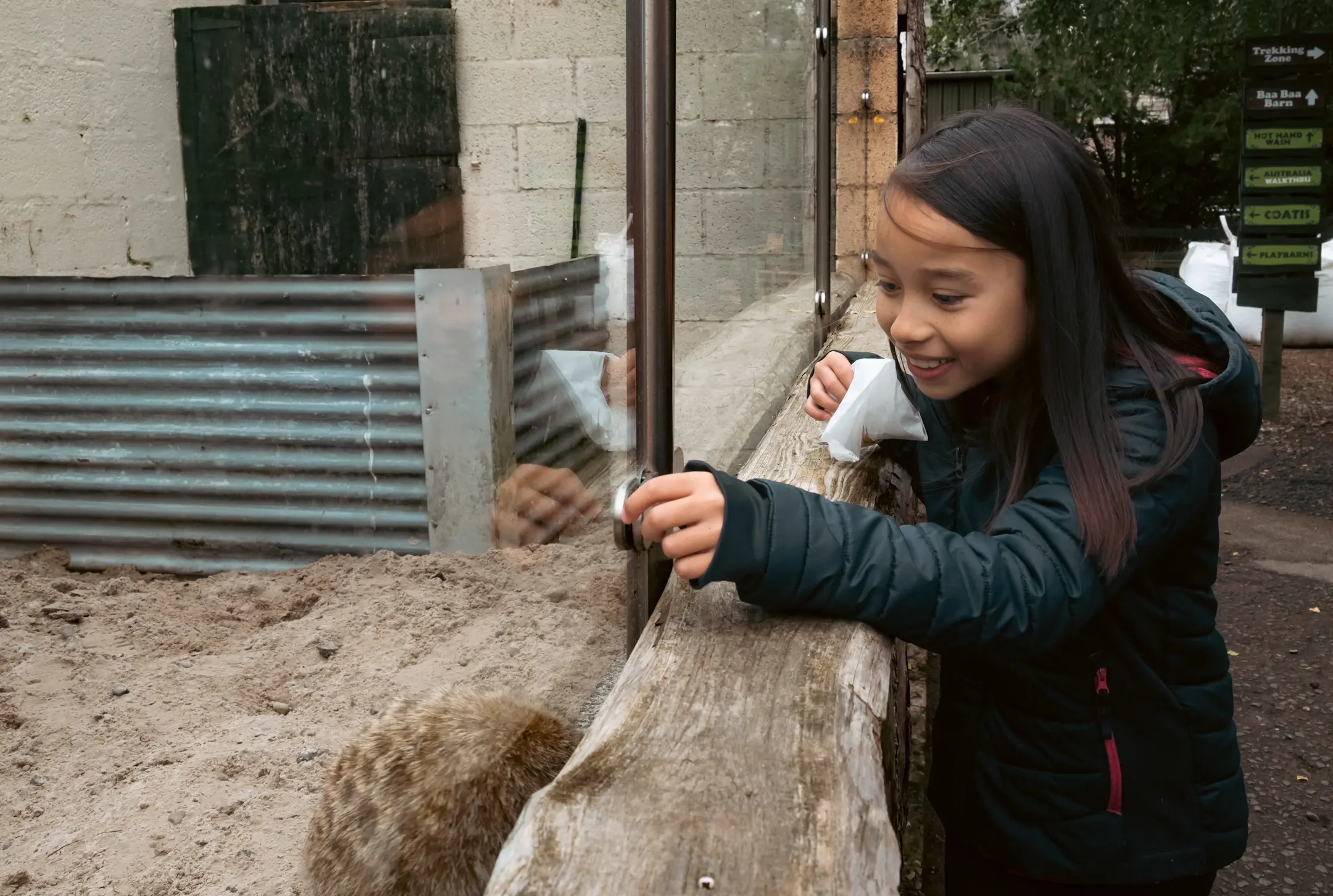
It was my eldest daughter, Sofia’s 10th birthday on Sunday. Despite huge tensions in the house lately about my youngest daughter’s development, I wanted this day to be all about Sofia and her big milestone. I booked us in to go to a local wildlife park where she could interact with the animals, get away from the stressful home environment, and be a kid for the day, even if she is growing up fast.
As I wanted the day to be about her and not photography, I took the Nikon Z50II and the diminutive 16-50mm kit lens to keep things small, light, and unobtrusive. In the morning, I checked the camera over; everything was fine, the battery had only one bar depleted after it’s last outing, and the memory card was inserted and formatted. I attached it to my Peak Design Leash camera strap, and we headed out to Auchingarrich Wildlife Park.
I thought I was prepared for a relaxed day of shooting. It didn’t quite turn out like that.
Struggling with your Z50II settings? If you’re feeling overwhelmed by the menus or aren’t sure you’ve got your camera configured for the best results, I’ve put together a dedicated Nikon Z50II Quick Start Setup Guide. It covers the essential configurations I recommend to get you shooting with confidence—minus the complex technical jargon.

As we walked around the park, shadowed by two particularly greedy young goats, Sofia’s mood seemed to lighten. I could tell she was really enjoying the interactions with the animals as she fed them the contents of the little animal snack bag we had bought.
After around 10 minutes of walking, I’d estimate I had taken 20 photos when, to my surprise, the camera’s battery warning light started flashing at me. How could that be? At home, it had shown only one bar depleted. I turned it off and on again; the indicator briefly returned to white, but within seconds, it went back to flashing red. Despite the battery issues, I still rate the Z50II as a great camera for beginners. You just have to be aware of your battery level throughout the day and perhaps buy a spare.
‘Okay, it’s Sofia’s 10th birthday. It’s important, and I want some memories of the day‘, so I switched into battery management mode. I reduced the number of photos I took and picked my moments a little more, making sure to switch the camera off after every single opportunity.

I only have the battery that came with the camera, so I knew it was unlikely I’d be able to shoot through the day unless I seriously restricted my shot count. Instead, I decided to focus on the experience and spend time with Sofia, even more than I’d planned.

I watched on as my little girl—now a ‘big girl’ at 10 years old, as she likes to tell me—smiled as a meerkat approached her until it was literally on the other side of the glass. Sofia moved her hand slowly towards it, I’m certain wishing she could stroke it. She has an unbreakable love of animals, and this was exactly the kind of medicine she needed today.

We continued around the park, seeing owls, searching for the elusive Scottish Wildcat (who never made an appearance), and walking amongst wallabies and emus in the Australian section, before heading for a delicious lunch at the restaurant. Sofia’s mood had perked up, and I’d still managed to avoid the dreaded black screen of death by carefully managing the battery level.

At lunch, I remembered I had an Anker Nano powerbank with an integrated USB-C cable in the car, so I nipped back and retrieved it. I expected to have to leave the camera and powerbank in my pocket for at least half an hour, but in the end, I managed to rig it up so that the camera could remain around my neck and the powerbank could stay in a chest pocket of my waterproof jacket, allowing the cable to reach without having to put the camera away.

After lunch, now with me feeling more relaxed knowing I could continue capturing moments, we enjoyed wandering the park, which is actually half wildlife experience and half working Scottish farm. The highlights weren’t actually the exotic animals but the interactions Sofia had feeding sheep, donkeys and Fallow deer which shes dreamed of seeing up close for a long time. Our day ended with Sofia spending plenty of time stroking and fussing the beautiful resident sheepdog of the farm before letting her choose a soft toy in the giftshop to add to her collection.
So how did the camera perform for a day of family photography?
I actually found the camera really good; it was light and fast to focus, although I miss a focus joystick as using the rear 4-way controller is not as intuitive. Autofocus with my setup—which I’ve configured to replicate my Nikon Z8 and Z6III—worked well.

The 16-50mm lens is competent and sharp in the centre, but it feels a bit meh. It’s interesting, actually: you can’t use shallow depth of field as a crutch, which makes you work a little harder for compositions. On a day out where spending time with family is the priority, that resulted in fewer keepers, as I didn’t want to keep re-taking shots and delay the day. Having to always unlock the lens is also irritating, but the incredibly small size and weight is a trade-off I think is fair.
I didn’t use the rear LCD screen even once during the day. I found the viewfinder adequate for shooting; it’s not the best at 2.36 million dots, but it never felt like a deal-breaker. It does the job well enough to function, and that’s what I care about. A better viewfinder is always nice, but I’d take this over not having one at all.

When I got home, after eating a slice or two of the cake my mum had made for Sofia, I took the opportunity to view the photos I’d taken. I shot 117 photos throughout the day and ended up with 12 that I thought were worth editing. Some are nice; others I edited simply because I liked Sofia’s expression or because they serve as a record of the time we spent together—especially during what has been the hardest three months of our lives. A few were edited specifically to give me more insight into how the Z50II RAW files behave in post.
Overall, considering the lens used, I was happy with the files. They felt like Nikon files in terms of color and dynamic range, and I was even able to shoot a couple of indoor shots at ISO 12800 that turned out to be perfectly usable—one of which I converted to black and white just to see how the result looked.
Would I have gotten ‘better’ images using a full-frame Nikon Z camera with a prime lens? Almost certainly. But would I have even taken it with me on a day meant for Sofia? I doubt it. That is what I took away from today regarding the Z50II: it’s just like a Nikon, only smaller.