

In this final article in my series testing whether the Fujifilm XF 16-55mm f/2.8 II can really be considered a bag of primes, I’m putting it up against the Fuji XF 56mm f/1.2 WR, the latest version of what is arguably Fujifilm’s finest portrait lens.
Unlike the other prime lenses featured in this series, the XF 56mm f/1.2 WR is a far more specialised tool. It was designed with portrait photography in mind, whereas the XF 16-55mm f/2.8 II is intended to be a versatile lens capable of handling almost any subject.
So, as I headed out to compare the two lenses, one question was at the forefront of my mind:
If you’re a portrait, wedding or family photographer who primarily photographs people, can the XF 16-55mm f/2.8 II really replace the XF 56mm f/1.2 WR?
This article contains affiliate links. If you buy something through these links, I may earn a small commission at no extra cost to you.
Size and Weight
Unlike the other primes in this series, the XF 56mm f/1.2 WR is noticeably larger than the others and is actually slightly heavier than the zoom, so any argument for choosing it based on size or weight alone falls flat.
It does offer an even brighter f/1.2 aperture compared to the f/1.4 offered by all the other prime lenses tested so far. The lens never feels particularly heavy or bulky when holding it on my X-T5 but it’s definitely substantial. It feels noticeably thicker than the the 16-55mm f/2.8II which is quite surprising and says a lot about how much Fuji have managed to shrink down the mark II version of the zoom.
How I Compared the Two Lenses
I decided not to test the XF 56mm f/1.2 WR against the dry stone wall used in the previous articles in this series for one simple reason: sharpness at mid distances isn’t the primary reason people buy this lens.
While the XF 56mm f/1.2 WR is certainly capable of shooting landscapes, it’s not a lens many photographers are going to spend around $1,000 on for that purpose.
What’s far more relevant is how sharp the lens is wide open, how close it can focus and, perhaps most importantly, how depth of field behaves both close up and at typical portrait distances. Those are the characteristics that define a lens like this, so that’s what I decided to test.
As usual, I mounted both lenses on my Fujifilm X-T5 and placed the camera on a tripod. All images were taken using the camera’s two-second self-timer to eliminate any possibility of movement from pressing the shutter affecting the results.
To determine the minimum focusing distance of the XF 56mm f/1.2 WR, I moved the camera as close to the subject as possible until the lens would no longer acquire focus, then gradually backed away in very small increments until focus was achieved. I then took shots with the 16-55mm f/2.8II at the same distance to compare sharpness before repeating the minimum focus setup separately for the zoom lens and taking shots for comparison.
Once I’d established the minimum focusing distance for both lenses, I compared sharpness, subject separation and depth of field behaviour at their widest apertures and at a range of portrait-focused shooting distances.
So far in this series, I’ve become used to the prime lenses focusing closer than the zoom. I hadn’t looked up the specifications for the XF 56mm f/1.2 WR before starting this test, so I began with the XF 16-55mm f/2.8 II, fully expecting the prime to be able to shoot from the same distance, if not closer.
It turned out the opposite was true.
Fujifilm quotes a minimum focusing distance of 50cm for the XF 56mm f/1.2 WR compared to just 30cm for the XF 16-55mm f/2.8 II. That’s a substantial difference and meant the prime simply couldn’t focus from the same position as the zoom.
As a result, after completing my usual close-focus tests, I repeated them from 50cm so that both lenses could be photographed from exactly the same position and compared fairly.
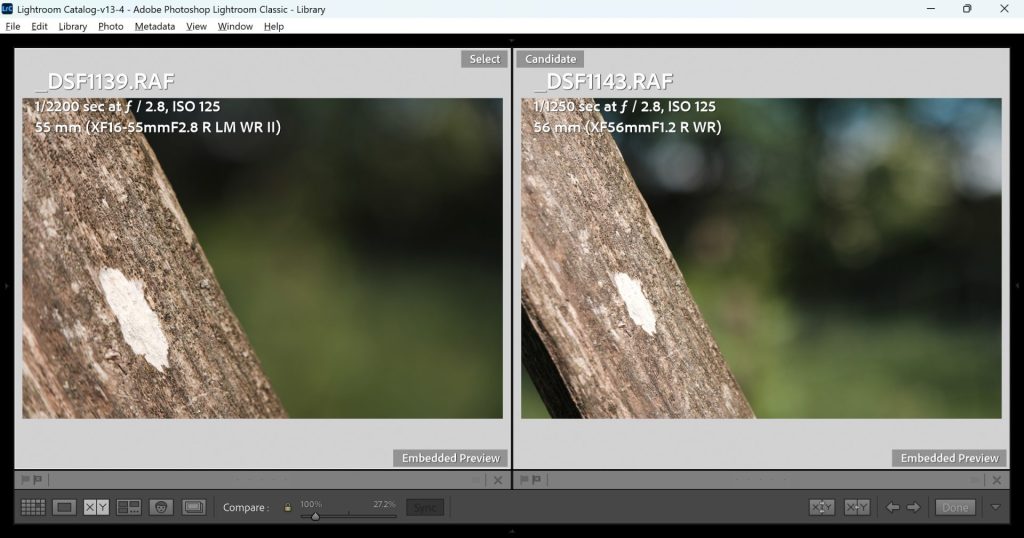
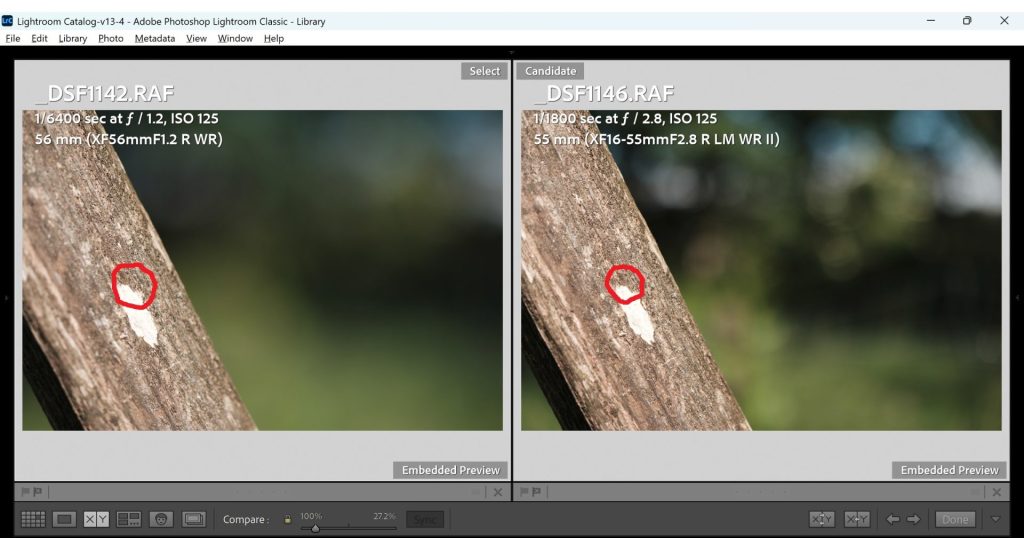
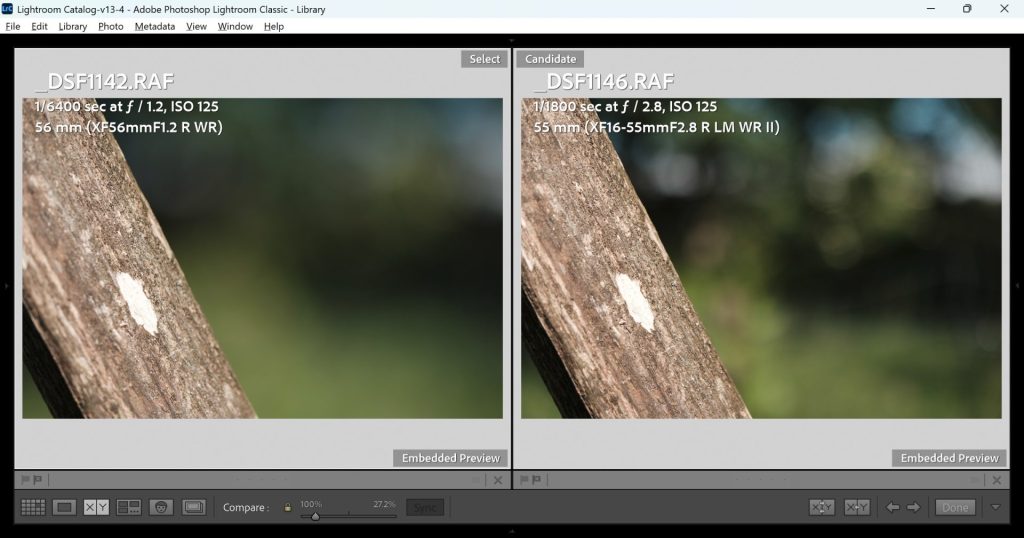
The first comparison shots I took were with both lenses shot wide open: f/1.2 for the prime and f/2.8 for the zoom.
Both lenses are easily sharp enough for portrait photography when used at their widest apertures and, at first glance, the results were surprisingly close.
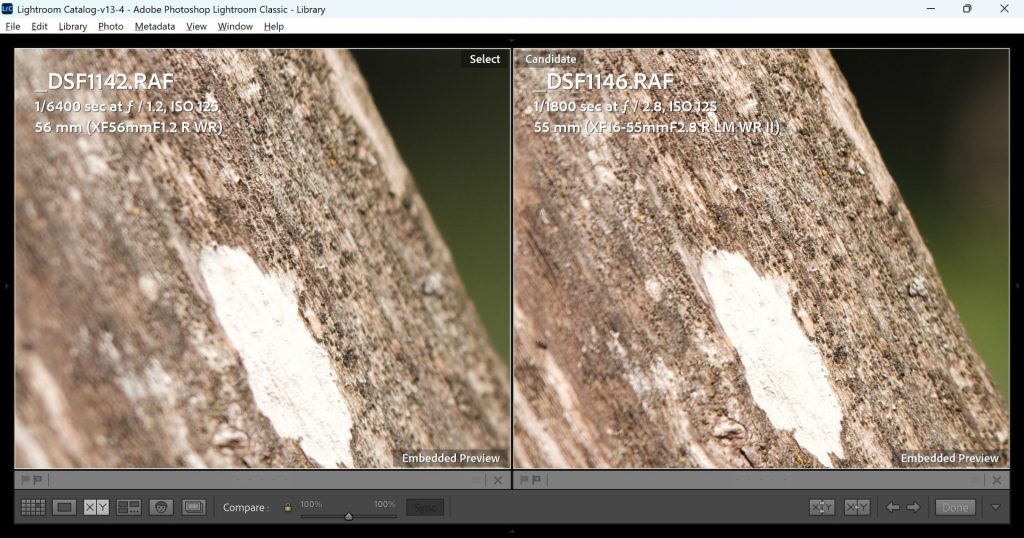
Once I zoomed in to 100%, two things became apparent. Firstly, the XF 16-55mm f/2.8 II is slightly sharper than the XF 56mm f/1.2 WR when both lenses are shot wide open. Having seen how well the zoom has performed throughout this series, and knowing just how difficult it is to design an f/1.2 lens that remains critically sharp at its widest aperture, that result doesn’t surprise me.
What’s important, however, is that the XF 56mm f/1.2 WR is nowhere near soft when shot wide open. It remains critically sharp and easily resolves enough detail to define eyelashes cleanly, for example. It’s only when viewed side-by-side with the zoom at 100% magnification that the difference becomes apparent.
In real-world use, both lenses are sharp enough wide open that I would have no hesitation using either of them that way.
The second thing that immediately stood out was just how thin the depth of field is on the XF 56mm f/1.2 WR at close distances. Shot from 50cm away, you’d struggle to get an entire eye in focus, let alone both eyes. While the zoom produces a pleasant blurred background at f/2.8, the prime is operating in an entirely different league when it comes to shallow depth of field, completely melting the background away.
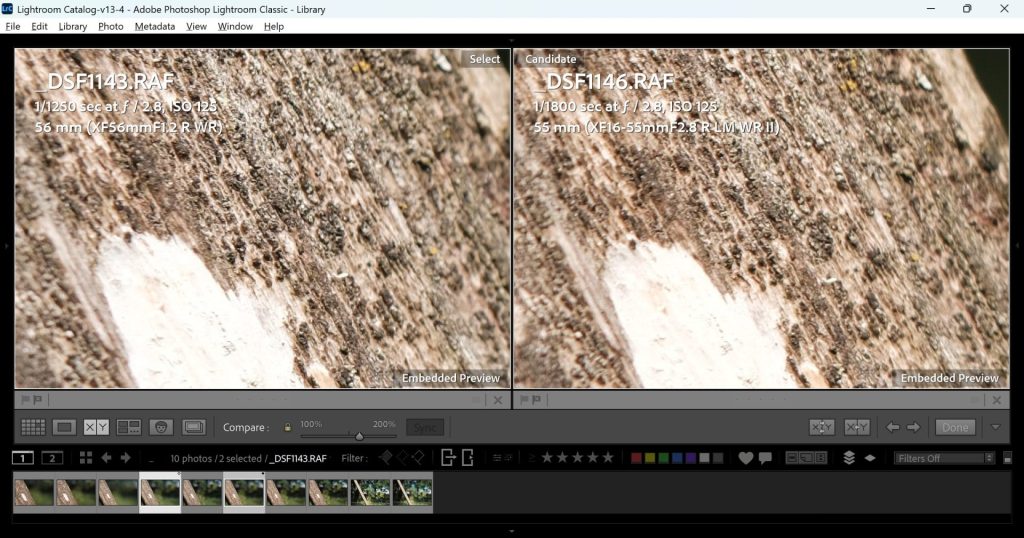
Once I stopped both lenses down to f/2.8, the XF 56mm f/1.2 WR sharpened up and was actually sharper than the XF 16-55mm f/2.8 II at the same aperture.
This was the most substantial difference in sharpness that I found between the two lenses during testing. It’s noticeable at full resolution on a larger screen and even when zoomed to 50% on my 14-inch laptop display.
The zoom is still a very sharp lens, but in this particular test the prime was the clear winner.
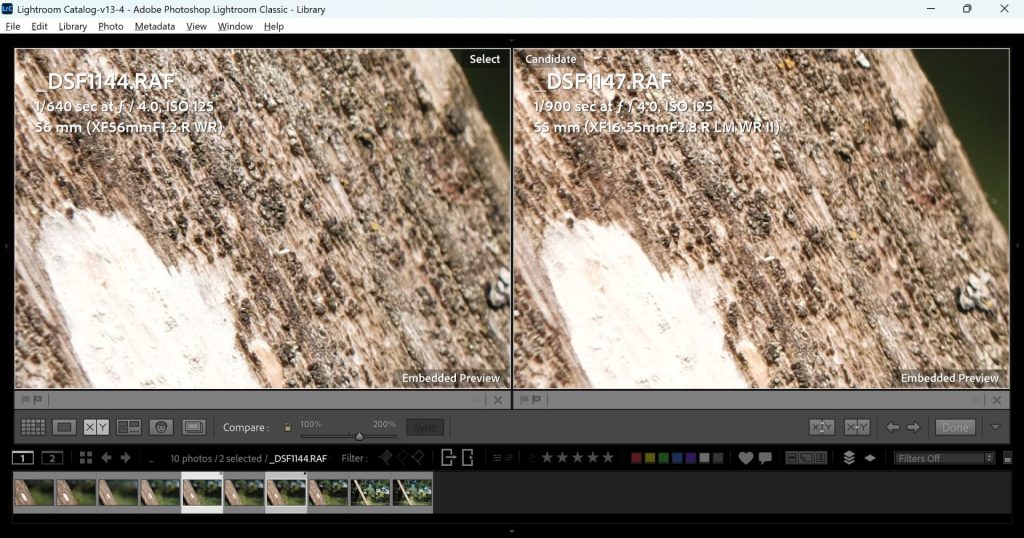
At f/4, the XF 16-55mm f/2.8 II sharpens up and closes the gap considerably. The XF 56mm f/1.2 WR still holds a slight advantage and remains the sharper lens, but the difference is less noticeable than it was at f/2.8.
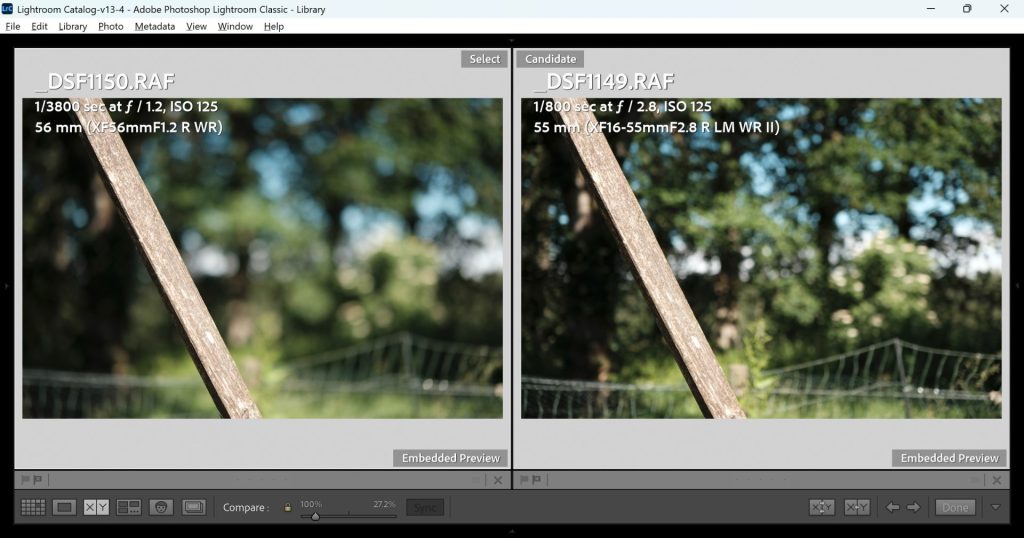
Finally, I wanted to replicate using these lenses at a typical portrait distance of around 6ft from the subject. Again, I shot these images from a tripod with both lenses shot from exactly the same position. Any slight difference in angle of view is simply down to the zoom lens having a maximum focal length of 55mm compared to the prime’s 56mm.
As you can see, while the XF 16-55mm f/2.8 II blurs the background nicely, it remains distracting, the XF 56mm f/1.2 WR gives a much nicer, smoother background.
If you have the option to choose your subject placement and backgrounds, then the XF 16-55mm f/2.8 II can do a really nice job. However, if that’s not an option, the XF 56mm f/1.2 WR gives you the ability to completely obliterate it and isolate your subject much more effectively.
Conclusion
The XF 16-55mm f/2.8 II does a really good job at 55mm, remaining sharp enough wide open to produce very good results. For most photographers, I suspect that’s probably enough for casual portraits, family photos and certainly for isolating subjects when shooting more intimate landscape and detail images.
However, once you move into more specialised portrait or wedding photography, the XF 56mm f/1.2 WR offers the kind of subject separation that the zoom lens simply can’t compete with.
So if I were making a living from photographing people, or if shooting people formed a large part of my photography, I don’t think the zoom replaces it. Not because of sharpness, but because of the creative possibilities and subject separation that the prime lens offers.
One point worth noting is that the XF 16-55mm f/2.8 II focuses more quickly and silently than the XF 56mm f/1.2 WR. The 56mm retains an older-style focus motor and can occasionally hunt for focus, accompanied by the familiar sound of Fujifilm’s older generation lenses.
It’s still fast enough for controlled portraits and most day-to-day photography, but for fast-moving action on a wedding reception dance floor, I wouldn’t fully trust it.
Fortunately, the other prime lenses featured in this series all use Fujifilm’s latest linear motors, making them significantly faster, more reliable and virtually silent in operation.
Check Latest Prices
Interested in either of the lenses featured in this comparison? You can check current pricing and availability below.
Check Latest Price
Check Latest Price