
One of the most common claims I hear about the Fujifilm XF 16-55mm f/2.8 R LM WR II is that it’s like having a bag full of prime lenses in a single package. As someone who owns both the zoom and several of Fujifilm’s premium primes, I wanted to put that claim to the test.
This article is the second in a series where I’m comparing the XF 16-55mm f/2.8 II against some of Fujifilm’s best prime lenses, including the XF 18mm f/1.4 WR, XF 23mm f/1.4 WR, XF 33mm f/1.4 WR and XF 56mm f/1.2 WR. Using both controlled tests and real-world photography, I want to see how Fujifilm’s flagship zoom stacks up against the lenses many photographers consider the benchmark for image quality in the X Series system.
Having already compared the zoom against the XF 18mm f/1.4 WR, it’s now time to see how it performs against another Fujifilm favourite: the XF 23mm f/1.4 WR.
This article contains affiliate links. If you buy something through these links, I may earn a small commission at no extra cost to you. This helps support the site and allows me to keep creating free content. Thank you for your support.
Size and Weight Comparison
| Specification | XF 23mm f/1.4 WR | XF 16-55mm f/2.8 II |
|---|---|---|
| Weight | 375g | 410g |
| Length | 77.8mm | 95mm |
| Diameter | 67mm | 78.3mm |
| Maximum Aperture | f/1.4 | f/2.8 |
| Filter Thread | 58mm | 72mm |
| Minimum Focus Distance | 19cm | 30cm |
| Weather Sealed | Yes | Yes |
Although the XF 16-55mm f/2.8 II is slightly larger and heavier than the XF 23mm f/1.4 WR, in my experience the differences aren’t meaningful enough to base a purchasing decision on. The 23mm 1.4WR is almost identical in size and weight to the Fuji 18mm 1.4WR.
The XF 16-55mm f/2.8 II is now so light and compact for a professional-grade zoom that, in use, it feels surprisingly close to Fujifilm’s f/1.4 prime lenses in terms of handling.
Bear in mind, however, that the zoom lens extends as you move through the focal range, which does affect the balance of the lens on the camera body.
How I Compared the Two Lenses
To compare the two lenses, I took them with me on a recent walk around a local country estate.
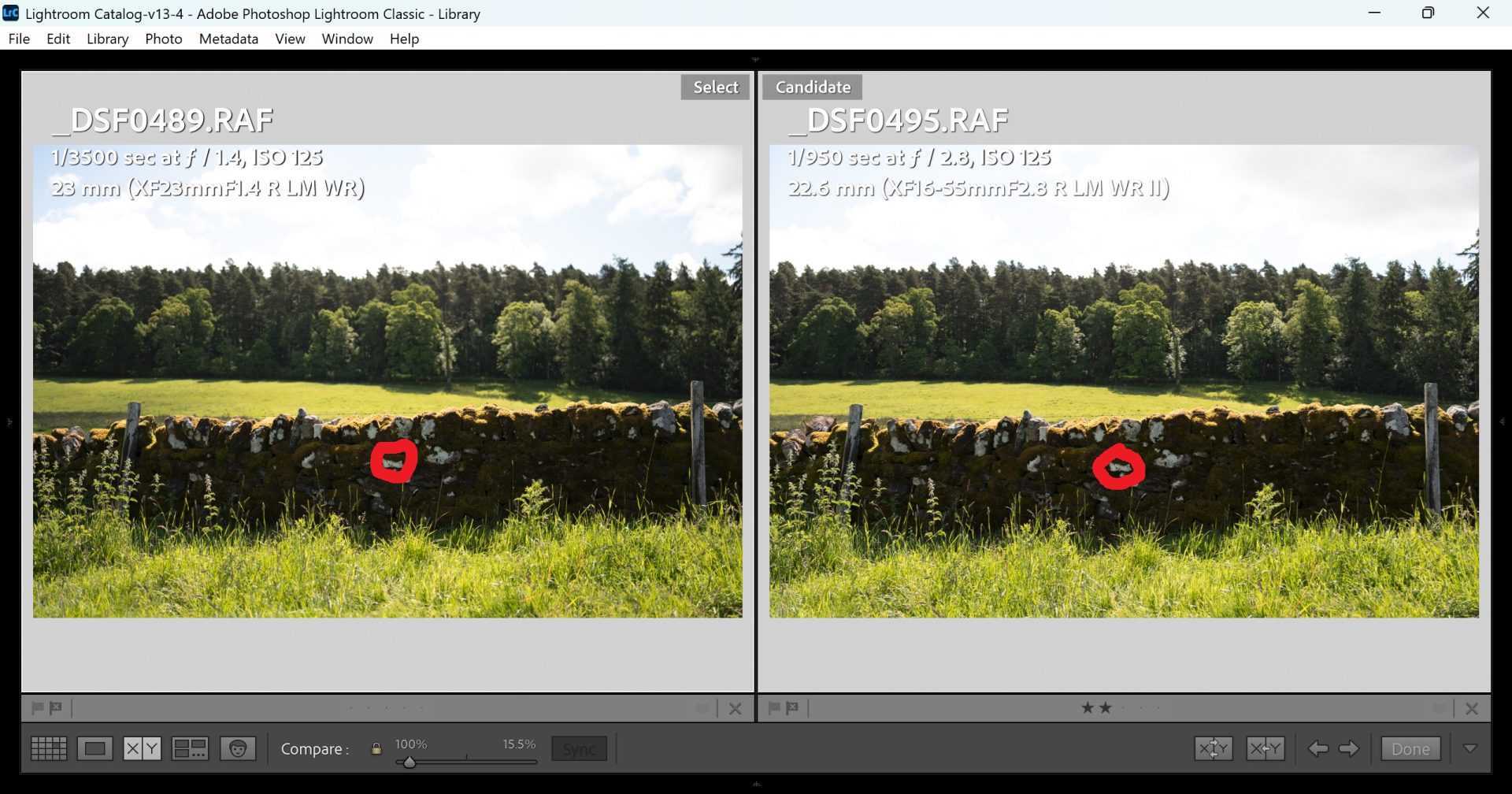
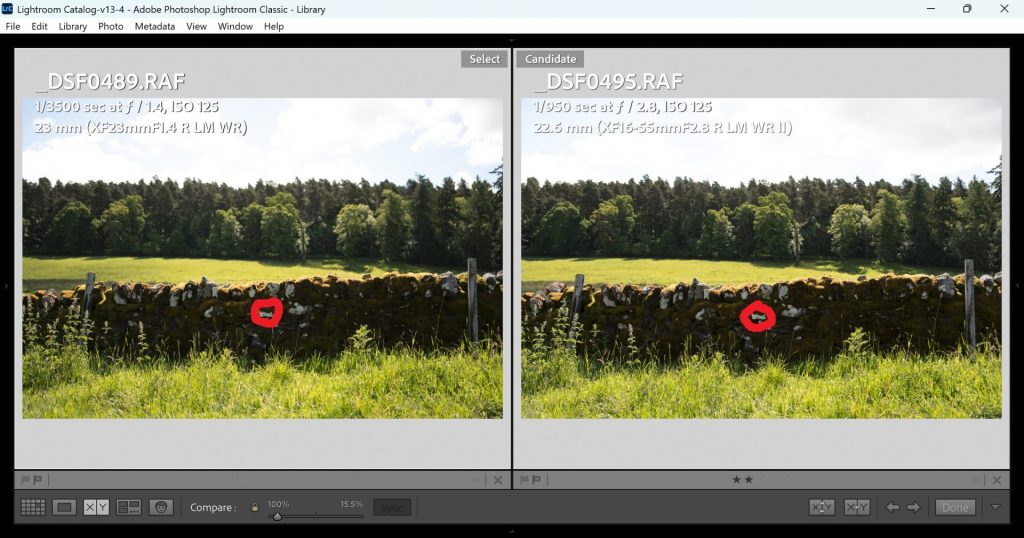
Using my Fujifilm X-T5 mounted on a tripod, I photographed the same section of a dry stone wall with both lenses. The camera position remained unchanged throughout the test, and each image was focused on exactly the same point of the wall, which I’ve highlighted below.
I repeated the test at f/1.4, f/2.8, f/5.6 and f/8 with the XF 23mm f/1.4 WR, and at f/2.8, f/5.6 and f/8 with the XF 16-55mm f/2.8 II set to 23mm. This allowed me to compare both lenses across the apertures most photographers are likely to use in real-world shooting.
Test Scene
Centre Sharpness at Wide Apertures
XF 23mm f/1.4 WR at f/1.4 vs XF 16-55mm f/2.8 II at f/2.8
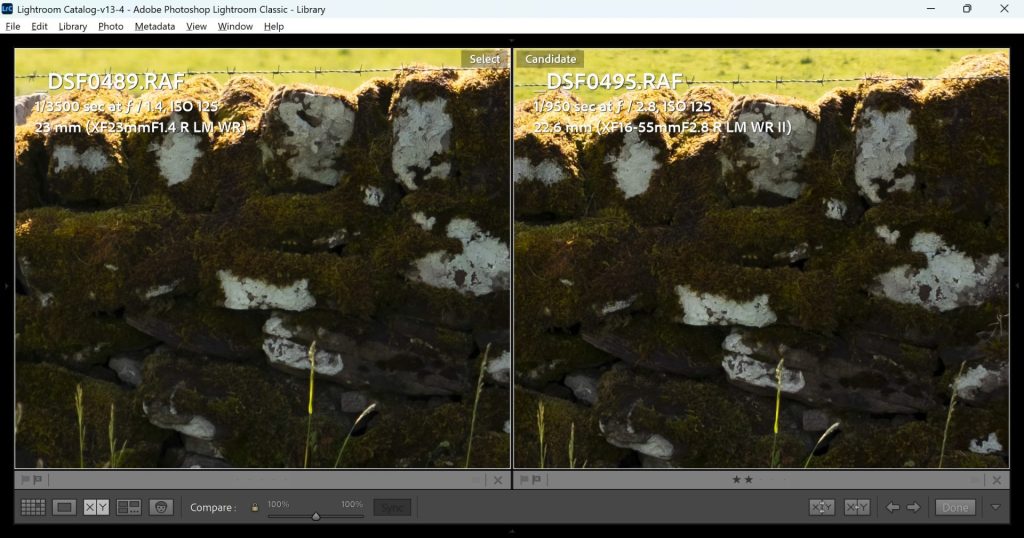
Looking at the images wide open, the XF 16-55mm f/2.8 II holds a slight advantage in sharpness over the XF 23mm f/1.4 WR at f/1.4.
However, the difference isn’t dramatic. The 23mm f/1.4 WR remains impressively sharp wide open, and in normal viewing conditions I doubt many photographers would notice a meaningful difference between the two.
XF 23mm f/1.4 WR at f/2.8 vs XF 16-55mm f/2.8 II at f/2.8
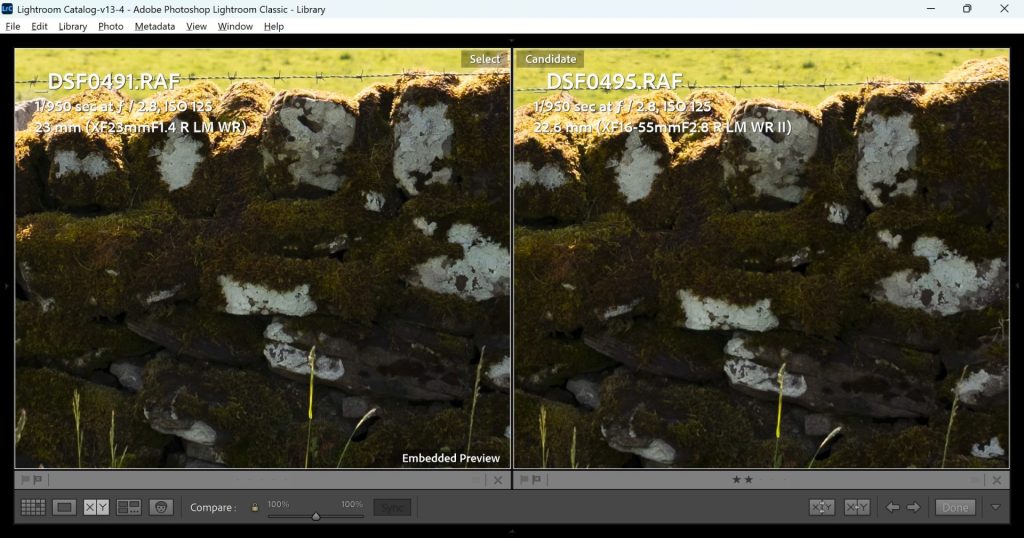
Once both lenses are shot at f/2.8, the situation reverses slightly. The XF 23mm f/1.4 WR now takes a very small lead in centre sharpness, although the difference remains extremely subtle.
Viewed side by side at 100%, the prime lens resolves a touch more detail, but we’re talking about very small differences that are only really visible when directly comparing the files.
Centre Sharpness at f/5.6
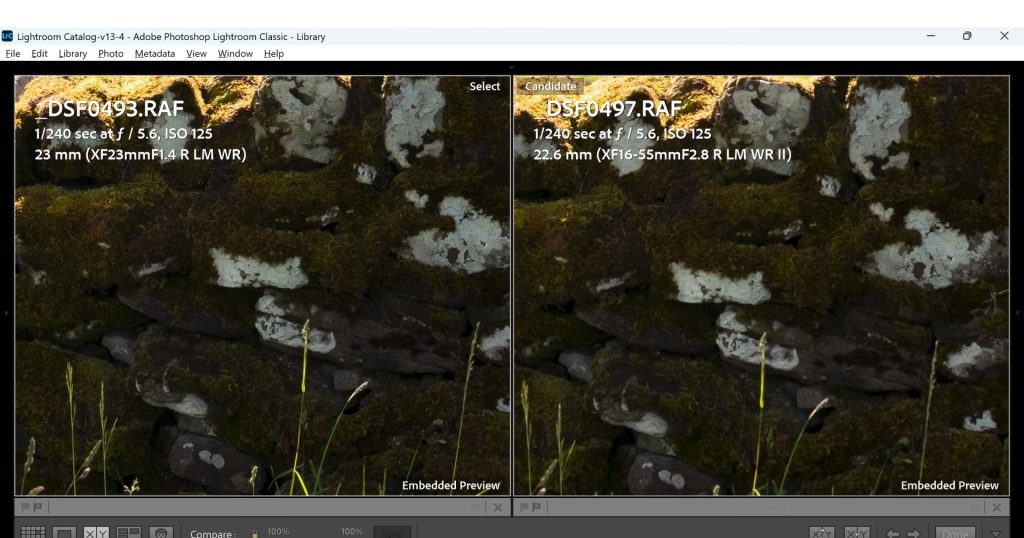
By f/5.6, any meaningful difference between the two lenses has effectively disappeared.
Both lenses produce outstanding levels of detail and sharpness, and even when zooming into the files at 100%, there’s virtually nothing to separate them. If I removed the EXIF data and showed these files to most photographers, I doubt they would be able to identify which lens had taken which image.
Corner Sharpness at f/8
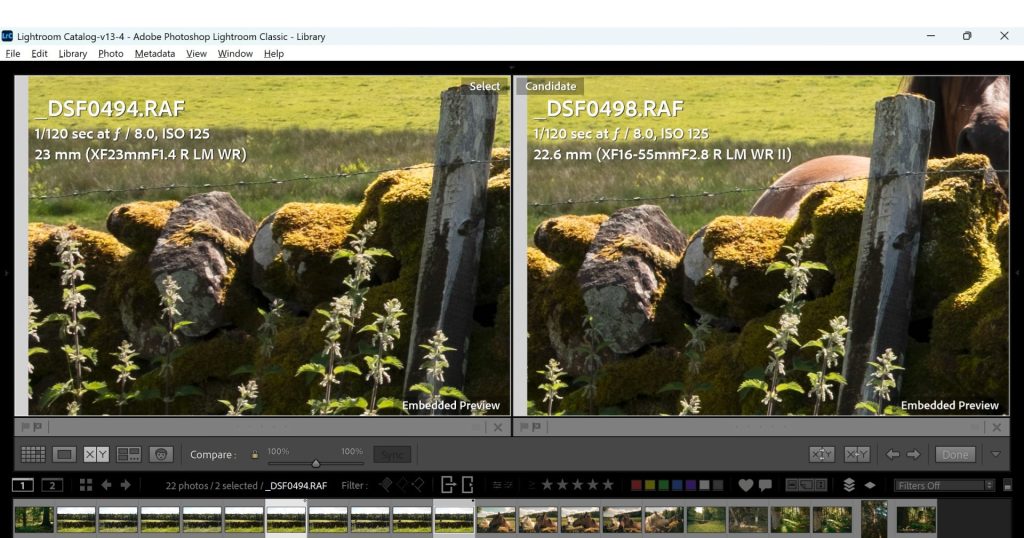
Looking at the extreme edge of the frame, the XF 16-55mm f/2.8 II holds a slight advantage over the XF 23mm f/1.4 WR.
The difference isn’t large enough to affect real-world photography, but the zoom does appear to maintain marginally better corner sharpness once both lenses are stopped down.
This mirrors what I found when comparing the XF 16-55mm f/2.8 II against the XF 18mm f/1.4 WR. The zoom is not merely keeping up with Fujifilm’s premium prime lenses—it is occasionally outperforming them in specific areas.
Sharpness Verdict
Based on my own testing, the XF 16-55mm f/2.8 II and XF 23mm f/1.4 WR are so close in terms of sharpness that I wouldn’t choose one over the other based on sharpness alone.
The prime lens holds a tiny advantage at f/2.8 in the centre of the frame, while the zoom appears marginally stronger in the corners when both lenses are stopped down. However, these differences are extremely small and only become visible during direct side-by-side comparisons.
Just as I found with the XF 18mm f/1.4 WR, the XF 16-55mm f/2.8 II delivers a level of optical performance that is remarkably close to Fujifilm’s premium prime lenses.
Close Focusing and Bokeh Test
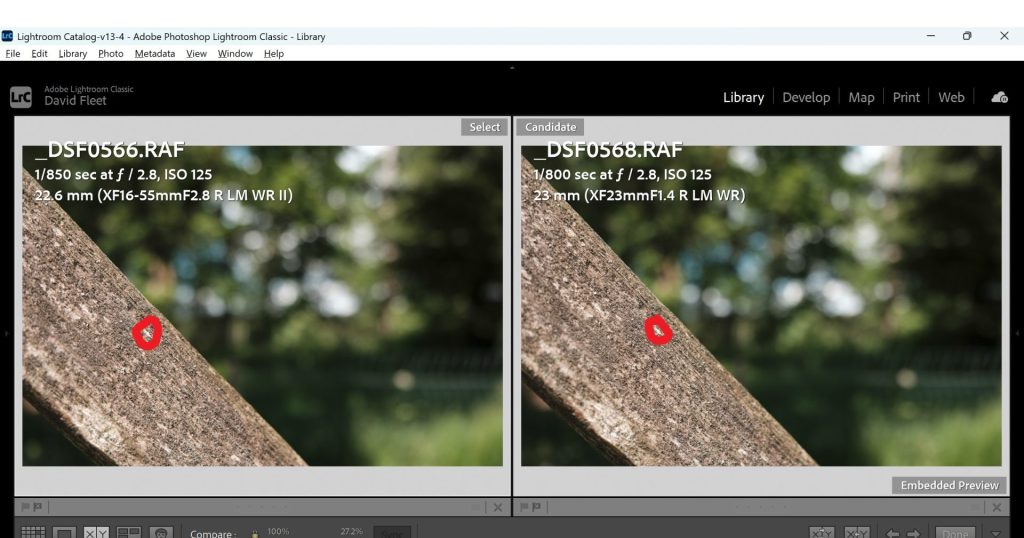
To test the minimum focusing distance of each lens, as well as their close-range sharpness and bokeh performance, I mounted both lenses on my tripod and photographed the same test subject.
As with the sharpness tests, the camera position remained fixed throughout the initial comparison. For the XF 16-55mm f/2.8 II, I set the lens to 23mm and moved the camera as close to the subject as possible until the lens would no longer focus. I then backed off in very small increments until focus was acquired. Fujifilm states a minimum focusing distance of 30cm for the zoom.
I then photographed the same scene with the XF 23mm f/1.4 WR, first at f/2.8 to allow a direct comparison with the zoom, and then again at f/1.4 to demonstrate the difference in subject separation and background blur.
Finally, I moved the camera closer to the subject to take advantage of the XF 23mm f/1.4 WR’s shorter minimum focusing distance of 19cm. This allowed me to see how the combination of closer focusing and a larger maximum aperture affected the types of images that could be created.
Close-Range Sharpness
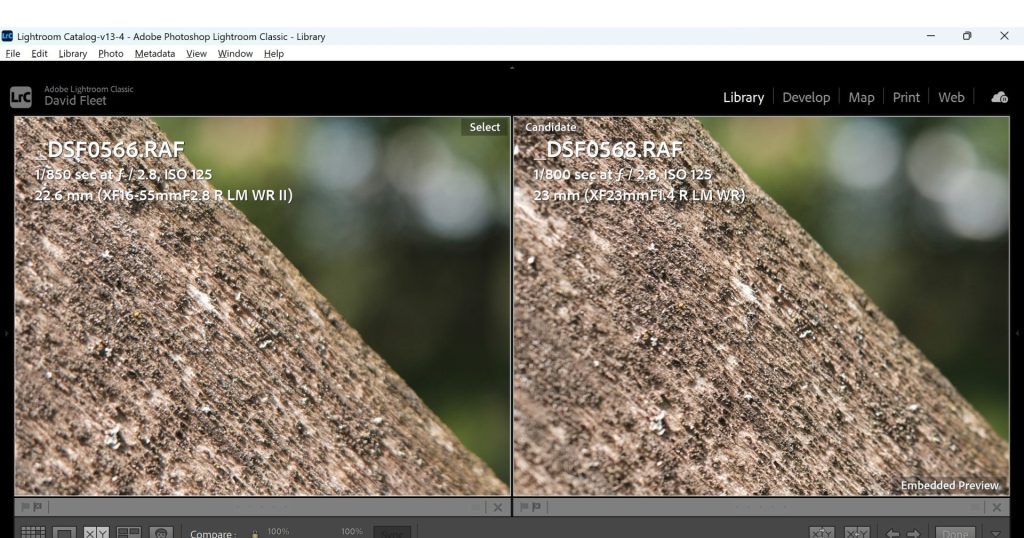
Interestingly, this was one of the few situations where I found a more noticeable difference between the two lenses.
At f/2.8, both lenses remain very sharp, but the XF 23mm f/1.4 WR holds a clear advantage at minimum focusing distance. The difference isn’t dramatic, but it is visible without having to zoom into the files excessively.
This contrasts slightly with the landscape-style sharpness tests earlier in the article, where the two lenses were extremely close and often impossible to separate in real-world use. At close range, the prime lens appears to retain more fine detail and crispness than the zoom.
Bokeh and Subject Separation
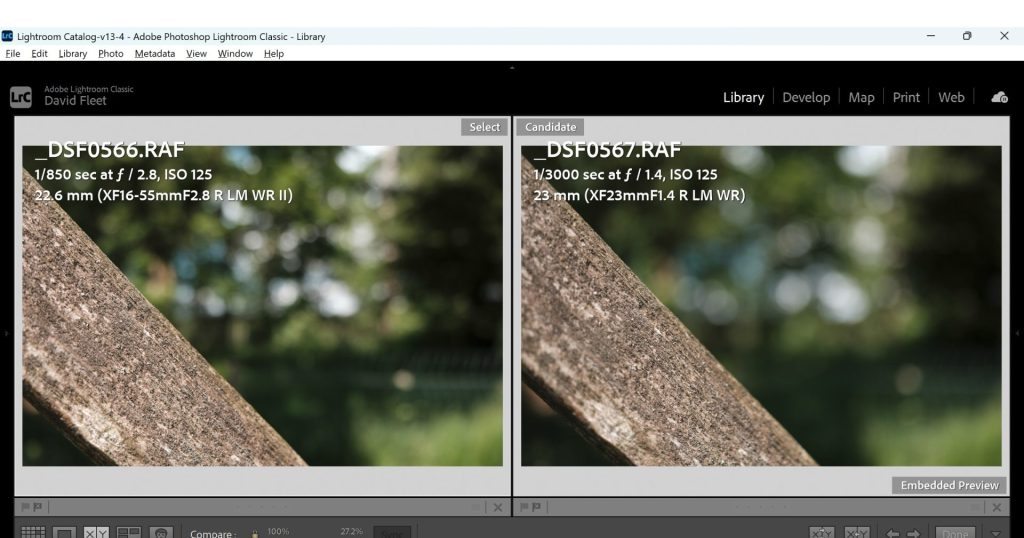
The second difference becomes obvious as soon as the aperture is opened up.
While the XF 16-55mm f/2.8 II produces pleasant background blur, the XF 23mm f/1.4 WR creates a noticeably stronger separation between subject and background. Out-of-focus highlights are rounder, the transition from sharp to blurred areas is smoother, and the overall image has a more three-dimensional appearance. I find tha background highlights from the 16-55mm f/2.8II much more distracting.
The difference is immediately visible when comparing the images side by side and is one of the clearest advantages the prime lens holds over the zoom.
Minimum Focusing Distance Advantage
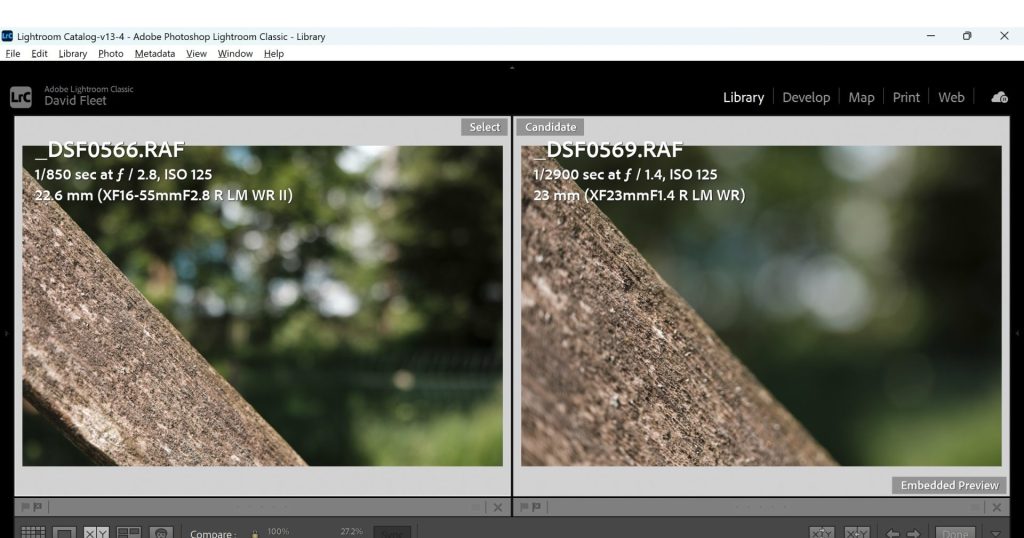
The XF 23mm f/1.4 WR’s shorter minimum focusing distance further increases this advantage.
Being able to focus significantly closer allows the lens to create images that simply aren’t possible with the XF 16-55mm f/2.8 II. The closer perspective enlarges the subject within the frame while simultaneously increasing background blur, creating a much more dramatic result.
For photographers who enjoy photographing details while travelling, shooting food, flowers, environmental portraits, or simply getting close to their subjects, this is a genuine advantage of the prime lens and one that goes beyond simple sharpness measurements.
Close Focus and Bokeh Verdict
While the XF 16-55mm f/2.8 II comes remarkably close to the XF 23mm f/1.4 WR in terms of sharpness at normal shooting distances, the prime lens pulls ahead once close focusing and subject separation enter the equation.
The XF 23mm f/1.4 WR is noticeably sharper at minimum focusing distance, focuses significantly closer, and produces more attractive background blur. Combined with its f/1.4 maximum aperture, it is capable of creating images that the zoom simply cannot replicate.
If your photography involves getting close to subjects and making use of shallow depth of field, the XF 23mm f/1.4 WR retains a meaningful advantage. However, if your subjects are typically photographed at mid-range to infinity, the differences between the two lenses remain surprisingly small.
Final Thoughts
If you like to push in close to your subjects and make use of shallow depth of field, then the XF 23mm f/1.4 WR retains some meaningful advantages over the XF 16-55mm f/2.8 II. Not only does it focus significantly closer, but it also produces more attractive bokeh and greater subject separation. At minimum focusing distance, it was also noticeably sharper than the zoom lens in my testing.
However, if your photography mainly involves landscapes, travel photography, street photography, or subjects photographed at mid-range to infinity, the differences between the two lenses become surprisingly small. In terms of sharpness, the XF 16-55mm f/2.8 II and XF 23mm f/1.4 WR are remarkably close, with neither lens holding a meaningful advantage once both are stopped down.
Just as I found when comparing the zoom against the XF 18mm f/1.4 WR, the XF 16-55mm f/2.8 II is capable of matching one of Fujifilm’s best prime lenses in most shooting situations. While the prime still offers advantages in close-focus performance, subject separation and low-light photography, the gap between these two lenses is far smaller than I expected.
Based purely on sharpness, I wouldn’t choose one over the other. The real decision comes down to whether you value the flexibility of the zoom or the creative possibilities offered by the faster aperture and closer focusing ability of the prime lens.
More Articles in This Series
This article is part of my series comparing the Fujifilm XF 16-55mm f/2.8 II against Fujifilm’s premium prime lenses to see whether you really need the prime.
Check Latest Prices
Interested in either of the lenses featured in this comparison? You can check current pricing and availability below.
Check Latest Price
Check Latest Price
Who Should Buy the XF 16-55mm f/2.8 II?
The XF 16-55mm f/2.8 II is the better choice for photographers who value versatility and convenience above all else. If you regularly shoot landscapes, travel, street photography, family photography, or simply want one lens that can handle almost any situation, the zoom is difficult to beat. Based on my testing, you’re giving up very little in terms of sharpness while gaining the flexibility of multiple focal lengths in a single lens. If I could only own one lens for the Fujifilm X system, this would be very close to the top of my list.
Who Should Buy the XF 23mm f/1.4 WR?
The XF 23mm f/1.4 WR is the better choice for photographers who love the 23mm focal length and want to get the maximum creative potential from it. Its ability to focus significantly closer, produce greater subject separation, and shoot at f/1.4 gives it capabilities that the zoom simply can’t match. If you enjoy environmental portraits, low-light photography, close-up detail shots, or simply prefer the discipline and simplicity of working with a prime lens, the XF 23mm f/1.4 WR remains one of Fujifilm’s finest lenses.