
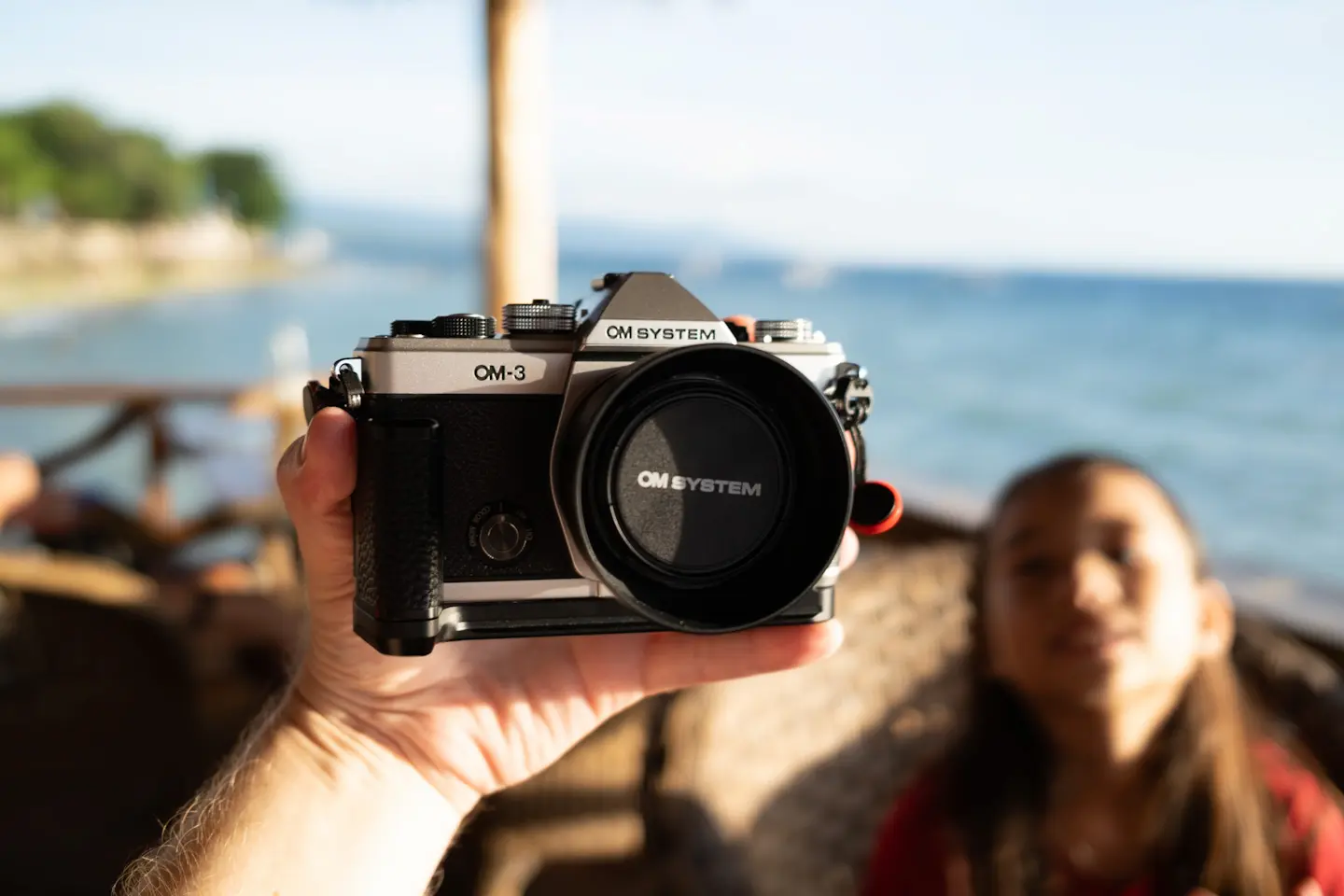
I’ve owned and shot with a huge variety of Micro Four Thirds lenses over the years — everything from the tiny Olympus 9–18mm (which I used while shooting for travel companies up in the Outer Hebrides over a decade ago) to most of the modern PRO lenses.
When I came back to Micro Four Thirds recently with the OM-3, I did so for a couple of reasons. First, I simply enjoy using Micro Four Thirds cameras for travel. The OM-3 is also among the best cameras for taking photos of family.
The computational features, size, and weight mean I can leave the tripod and filters at home and just enjoy making photos. These cameras are rugged, weather-sealed, and the lens lineup is fantastic — from tiny pancake primes to super-telephoto zooms. Modern Micro Four Thirds image quality is excellent, easily good enough for 30×20″ prints, and with the right lenses, even low light performance is more than acceptable for most situations. The OM-3 is part of a new wave of system cameras that make more sense for travel than compacts, and I’ve compared it alongside other interchangeable-lens travel cameras in my dedicated 2025 guide. Click here for my full OM System OM-3 review.

Because of that philosophy, I deliberately kept my OM-3 kit small and only picked up three lenses to start with — enough to cover 90% of my needs without weighing me down. If you prefer to keep things even simpler then my best compact cameras article will be of interest.
Having used most of the Panasonic and Olympus/OM System lineup at some point, this article will break down what I think are the best lenses for travel photography with the OM-3. Everyone’s style is different, so feel free to swap things out — but one of the joys of Micro Four Thirds is that you can pack a complete kit for landscapes, street, portraits, and telephoto without breaking your back or your budget.
Who Is This Article For?
This guide is for OM System OM-3 users who want to build a small, high-quality kit for travel, family photography, and everyday shooting — without overcomplicating things.
- You want a lightweight setup that you’ll actually carry everywhere.
- You care about image quality, but not at the expense of size and usability.
- You prefer a simple, well-thought-out kit rather than owning lots of lenses.
- You’re trying to decide between a zoom, a couple of primes, or a mix of both.
This isn’t a complete list of every Micro Four Thirds lens. It’s a focused guide based on what actually makes sense on the OM-3 — from real-world use, not spec sheets.
TL;DR – Best Lenses for the OM-3
- Best overall lens: 12–40mm f/2.8 PRO II – The most balanced choice for most people.
- Best compact prime: 17mm f/1.8 II – Small, versatile, and perfect for travel and everyday use.
- Best image quality prime: 25mm f/1.2 PRO – The standout lens for portraits and low light.
- Best one-lens travel option: 12–100mm f/4 PRO – Maximum flexibility with no lens changes.
- Best lightweight zoom kit: 12–45mm f/4 PRO + 40–150mm f/4 PRO – Great coverage with minimal weight.
If you want the simplest setup, go with the 12–40mm f/2.8. If you want a small, high-quality kit, pair it with the 17mm f/1.8. If image quality is your priority, add the 25mm f/1.2.
I’ve included affiliate links to all the lenses and have also put together the kits for you on Amazon to make it easy to find all the items in one place. If you click through those links and buy any items then I will earn a small commission for which I am very grateful. So thank you to everyone who uses them. It is literally the only way that I can afford to keep this site going.
🎁 Don’t want another pair of novelty socks this Christmas? Share my Best Gifts for Photographers guide with friends and family — it’s full of gear photographers actually love.
Olympus 12–40mm f/2.8 PRO II – The Ultimate Travel Zoom


I’ve used a lot of standard zoom lenses over the years — from basic kit zooms to Panasonic’s 12–60mm Leica and the 12–35mm f/2.8 — but the one I always come back to is the OM System 12–40mm f/2.8 PRO II.

It offers excellent image quality, staying sharp from wide open across the entire zoom range. The 24–80mm equivalent range covers almost everything I shoot while traveling — landscapes, portraits, and plenty in between. While many photographers like going ultra-wide for landscapes, I’ve found 24mm equivalent wide enough to capture the scene without introducing too much distortion.

The constant f/2.8 aperture is a big advantage, letting me shoot longer in low light before switching to a prime, and it offers just enough subject separation at the long end to handle portrait duty. It also focuses really close, so gives the ability to play with macro shots. The build quality is superb, with a solid feel, smooth focus ring, focus clutch, and reliable weather sealing. It’s a little bigger than the 12–45mm f/4 PRO, but still balances beautifully on the OM-3 and OM-1 Mark II and is far smaller and lighter than equivalent full-frame lenses.
Pros
- Excellent image quality across the entire zoom range
- Highly versatile 24–80mm equivalent focal length
- Constant f/2.8 aperture for low light and subject separation
- Fully weather-sealed, professional-level build quality
- Very close focusing for near-macro style shots
Cons
- Larger and heavier than the f/4 zoom alternatives
- More expensive than entry-level zooms
- Doesn’t offer the extended reach of the 12–100mm
OM System 12–40mm f/2.8 PRO II
My go-to standard zoom for the OM-3 and OM-1 II — weather-sealed, sharp across the frame, and perfect for travel photography.
If you buy through this link, I may earn a small commission — thank you for supporting the site.
Why I Choose It Over Other Options
Some people prefer the OM System 12–100mm f/4 PRO as an all-in-one travel zoom — and it’s excellent — but I find it just a little too large to carry all day on the OM-3. The 12–45mm f/4 PRO is another great alternative if f/2.8 isn’t important to you — it’s lighter and cheaper while still delivering most of the same optical quality.

For me, the 12–40mm f/2.8 II strikes the best balance: compact enough for travel, fast enough for low light, and optically excellent. If I could only have one lens for Micro Four Thirds, this one would be at the top of my list.
OM System 17mm f/1.8 II – The Perfect Everyday Travel Prime

I picked up the OM System 17mm f/1.8 II not because it’s the absolute best lens in the lineup, but because it feels like the perfect match for the OM-3. It’s incredibly small and light, making the camera feel almost pocketable — ideal for travel or days when I want a simple, no-fuss setup. The Mark II version adds weather sealing, which is a big deal for me since I often shoot outdoors in unpredictable conditions.

Optically, it’s sharp wide open, with decent (if not spectacular) bokeh. The 35mm equivalent field of view is one of the most versatile focal lengths you can have — wide enough for street photography and landscapes, but not so wide that it distorts portraits or environmental scenes. Autofocus is fast and confident, and the f/1.8 aperture is bright enough for street shooting well into the evening without needing to raise ISO too far.

If I’m being honest, I don’t love this lens the way I love some of my others — but it’s the one that makes the most sense if you want a small, light, high-quality travel kit. I have also owned the 25mm f/1.8, which I think is optically a little better, but for general travel and everyday use the 17mm’s versatility wins out.
Pros
- Very small and lightweight — perfect match for the OM-3
- Versatile 35mm equivalent focal length
- Fast f/1.8 aperture for low light and everyday use
- Weather-sealed in the Mark II version
- Fast and reliable autofocus
Cons
- Image quality is good, but not class-leading
- Bokeh is fairly average compared to faster primes
- Doesn’t have the “wow factor” of the f/1.2 PRO lenses
OM System 17mm f/1.8 Mark II
A compact and sharp wide-angle prime that’s perfect for travel, street, and documentary photography with the OM-3.
If you buy through this link, I may earn a small commission — thank you for supporting the site.
Alternatives to Consider
If you prefer a slightly wider view, the Panasonic Leica 15mm f/1.7 is another excellent option, and if you want better bokeh and optical performance, the OM System 17mm f/1.2 PRO is available — but it’s bigger, heavier and more expensive. For most travelers, the 17mm f/1.8 II strikes the right balance of size, performance, and weather sealing.
OM System 25mm f/1.2 PRO – A System-Defining Lens

If there’s one lens that would keep me shooting Micro Four Thirds, it’s the OM System 25mm f/1.2 PRO. I’ve actually owned this lens twice — once when it was first released, and it was right at the top of my list when I bought the OM-3.
The reason is simple: image quality. It’s sharp wide open at f/1.2, which means you can use it in almost any lighting conditions, and the feathered bokeh is gorgeous — giving images a polished, high-end look. At 50mm equivalent, it’s incredibly versatile, covering everything from contextual storytelling shots to more intimate portraits.

Autofocus is quick and confident, and the build quality is as good as it gets — fully weather-sealed, professional-level construction, and a smooth focus ring with manual clutch. The rendering is among my absolute favourites of any lens I own — and that includes my Fuji GFX kit, which says a lot.

Yes, it’s larger than the f/1.8 primes, but paired with a grip on the OM-3 it handles beautifully and I can carry it all day. This is the lens I mount when I want the best, with zero compromises. It’s a system-defining lens and one of the best I’ve ever used on any system — yes, I rate it that highly.
Pros
- Outstanding image quality, even wide open at f/1.2
- Beautiful, smooth bokeh with strong subject separation
- Versatile 50mm equivalent focal length
- Excellent low-light performance
- Professional build quality with full weather sealing
Cons
- Larger and heavier than the smaller f/1.8 primes
- Significantly more expensive than other options
- Less discreet for street or casual shooting
OM System 25mm f/1.2 PRO
The ultimate standard prime for Micro Four Thirds — incredibly sharp, beautiful rendering, and with that signature f/1.2 look for subject separation.
If you buy through this link, I may earn a small commission — thank you for supporting the site.
If you want a smaller alternative, the Panasonic/Leica 25mm 1.4 lens offers a great compromise between the OM System versions and is excellent optically. However, mine broke for no reason whatsoever years ago and it put me off the lens. I doubt it’s a common issue (the lens just wouldnt communicate with the camera one day) but I prefer to go with the OM System lenses now as I’ve never had a problem with them even with much heavier use than my 25mm 1.4 ever had.

My Complete OM-3 Kit
Here’s the exact kit I use with my OM-3 — camera, lenses, and accessories — all in one convenient place for you.
If you buy through this link, I may earn a small commission — thank you for supporting the site.
What If You’re a Zoom Shooter?
One of the great things about OM System — and Micro Four Thirds in general — is that high-quality zoom lenses are significantly smaller than on full-frame systems. I used to shoot with a full kit of zooms plus a few primes, and I could fit them all comfortably into a Lowepro Flipside 400 AW II backpack. In my kit were the 8–25mm f/4 PRO, 12–40mm f/2.8 PRO II, 40–150mm f/2.8 PRO, 300mm f/4 PRO, 25mm f/1.2 PRO, plus the 1.4x teleconverter — along with both the OM-1 and OM-1 Mark II bodies (with grips).

That was an incredibly versatile kit, and I could still take it as carry-on luggage on every flight. In my opinion, if you want the most versatile zoom setup for travel, you have two main approaches:
- Small and Light: Go for the 9–18mm, 12–45mm f/4 PRO, and 40–150mm f/4 PRO.
- Fast and Flexible: Choose the f/2.8 versions (8–25mm f/4 PRO pairs well here too) as I did, which gives you more light-gathering ability and subject separation.
It really comes down to your priorities — portability vs maximum performance — but either approach works beautifully with the OM-3. If you’re planning to use the larger f/2.8 zooms, I’d recommend adding a grip to the OM-3 for better balance and comfort on long shooting days.
Zoom Shooter’s Kit
I’ve gathered my recommended zoom lenses and key accessories into one place — perfect if you prefer the flexibility of zooms for travel and everyday shooting.
If you buy through this link, I may earn a small commission — thank you for supporting the site.
Recommended Zooms
- OM System 12–40mm f/2.8 PRO II – My go-to standard zoom and the most versatile option for most travelers.
- OM System 12–100mm f/4 IS PRO – The ultimate one-lens solution if you want to pack just a single zoom. Incredible range, excellent optics, and Sync IS for rock-solid stabilization.
- OM System 8–25mm f/4 PRO – Perfect for wide-angle travel shooters who focus on landscapes, interiors, or tight spaces.
For many travelers, a kit consisting of two zoom lenses and a small prime like the following 8–25mm f/4 PRO + 40–150mm f/4 PRO + 17mm f/1.8 II provides complete coverage with surprisingly little weight — perfect for those who want to keep their kit minimal while staying ready for anything.
Final Thoughts
The OM-3 is one of the best travel cameras you can buy, and pairing it with the right lenses makes it even more capable. Whether you prefer the simplicity of a single zoom, the versatility of a two-zoom kit, or the image quality and character of primes like the 17mm f/1.8 and 25mm f/1.2 PRO, there’s an option to suit your style. The beauty of Micro Four Thirds is that you can build a complete travel kit that covers everything from wide landscapes to portraits — and still keep it light enough to carry all day. It’s one of the reasons why Micro Four Thirds still matters in 2025.
Once you’ve chosen your lenses, make sure you check out my Best Accessories for the OM-3 guide to get set up with spare batteries, memory cards, and other essentials before your next trip.
Want the bigger picture? Compare all systems here:
Best Cameras 2025
❓ Frequently Asked Questions (OM-3 Travel Lenses)
What’s the best single lens for travel on the OM-3?
The OM System 12–40mm f/2.8 PRO II is the most balanced one-lens solution: weather-sealed, sharp across the range, and fast enough for low light.
Prime kit or zoom kit for travel?
For simplicity and coverage, go zoom (12–40mm f/2.8 or 12–100mm f/4). For lighter weight and character, a small prime set like 17mm f/1.8 II + 25mm f/1.2 PRO is brilliant.
Is the 12–100mm f/4 PRO a good one-lens solution?
Yes — huge range, excellent optics, and Sync IS. It’s larger than the 12–40mm, but fantastic if you want to avoid lens changes while traveling.
Which prime gives the most “full-frame-like” background blur?
The 25mm f/1.2 PRO delivers the most pronounced subject separation and premium rendering in this list.
Will these lenses keep up in low light?
Yes. Pair the OM-3’s IBIS with faster glass when needed (f/1.2 or f/1.8 primes). The 12–40mm f/2.8 also stretches into evening with IBIS.
Are they weather-sealed for travel?
12–40mm f/2.8 PRO II and 25mm f/1.2 PRO are fully sealed. The 17mm f/1.8 Mark II adds sealing versus the original, making it a great compact travel prime.
What’s the lightest quality two-lens combo?
12–40mm f/2.8 PRO II + 17mm f/1.8 II. You get a fast, versatile zoom plus a tiny prime for evenings and street.
Do I need ND filters for travel with these lenses?
The OM-3 is one of the few cameras where you really dont need to bring filters thanks to its internal ND and ND Grad filter simulation modes. The only exception would be for video use or if you are shooting protraits wide open in bright light as the computational modes wont work in those situations.
How does Micro Four Thirds affect focal length choices?
Multiply focal length by ~2× for full-frame equivalence. e.g., 17mm ≈ 34mm, 25mm ≈ 50mm, 12–40mm ≈ 24–80mm.
What grip/handling tips help with heavier lenses?
Adding a small grip to the OM-3 improves balance with the f/1.2 primes or longer zooms, making all-day carry more comfortable.
Hi David,
Nice to hear that there are OM shooter in the Philippines, myself I have the OM 1,and the Omd-e 10 mark ll, I agree with comments, 12-40 f2.8, its also my most use lens, I am only hobby photographer, my other lenses are 25mm 1.8, 40-150mm, f2.8, the 300mm f4, 9-18mm and the 60mm macro. The last few years I buy my camera or lenses in Japan, Map camera, good for trade in and 10% evat returns.
Hi Konrad,
Thanks for getting in touch. You have a very similar lens lineup to what I used to have. Are you in the Philippines yourself?
I struggle to find OM Suppliers here.
All the best
David
David. Why did you choose the OM3. Maybe an article on the OM bodies would be helpful to us all
Thanks
George
Hi George,
Thanks for your comment and interest. I have written a couple of these articles for the Om-3 and will be adding more in the future. You can find them via the links below:
https://thecotswoldphotographer.com/5-things-i-love-about-the-om-system-om-3-after-a-month-of-use/
https://thecotswoldphotographer.com/why-i-bought-om-system-om3/
Thanks
David
Been following your site for a while. On our last vacation abroad, I realized that I would like to upgrade to a mirrorless camera for travel.
My final two choices were the OM-5 Mark II Beige and the X-T5. OM-5 won because of convenience (I’m still waiting for it to arrive from ebay). unfortunately, OM has no presence in the Philippines.
Hi Michael,
Thanks for following along. Where are you in the Philippines?
I had the EM5III a few years ago and think it makes a really great travel camera. The OM5-II even more so I’m sure you will enjoy it once it arrives.
Yes, supply is an issue here, another reader said they purchased their OM gear from Japan.
Do you share your photos anywhere online?
All the best
David
I’m based in Metro Manila.
I can’t presume to call myself a photographer, but I plan to learn and play around a bit with the camera when it arrives. We have a Europe trip this December, so I hope to be familiar with the OM-5 by then.
Nothing to share online, but I might in the future.
Well I’m sure your trip to Europe will give you some great photo opportunities.
Update: OM-5 just arrived yesterday. Unfortunately, as I was setting it up, I saw that the language in the menu settings was locked to Japanese. I read forums online and found out that that was the case for some OM-systems cameras bought in Japan. Oops. Returning it is out of the question. So I’ve been making do with Google translate, and some degree of “muscle memory” as I configure the camera.
Hi Michael, Ah thats not great. I had that once with a camera. It arrived with Japanese set as the language. Luckily the menu had icons so I could work out how to get through the menus and change it. Is yours definitely locked to Japanese? There always used to be a Japanese and English language option on cameras intended for sale in Japan only. Hope you get it sorted.
All the best
David
It’s definitely locked. Grayed out, and cannot be accessed.
There’s google translate and the internet, so I’ve worked out most of my settings already.
Plan to buy some zooms for travel next. Your article is a lot of help, but I still can’t decide as to whether to go for light and not so sharp (9-18 plus 14-150) vs heavier but sharper and more pro (8-25 and 40-150).
I like shooting ultra wide for travel.
Thats a shame. Regarding lenses, perhaps weigh up whether having lighter gear will actually make you shoot more or whether you’d be happy carrying the extra weight for the improved image quality and often build quality. Then also look at what you’re going to do with the photos. If it’s just for socials and perhaps printing some small sized A4 type prints or keeping on your computer etc then is the additional image quality worth the cost? I can say the 8-25mm f/4 pro is an excellent lens and not heavy. I owned it a while back. The 40-150 f/2.8 pro is an excellent lens but it’s not an ideal size for travel. You’d really have to want to use it to carry it. The f/4 version is much smaller but I haven’t personally used or handled it.
Indeed. Am not a professional photographer, and if I print anything I would most likely print something small.
As for the 40-150, I was referring to the f/4 pro.
Thanks!
Hope you and your family are okay in Cebu.
Just to stay on topic, I ordered the 40-150 mm f4 pro. I hope it arrives in time for me to use it for my son’s swimming competition
Hi Michael,
Thanks for the well wishes. We are all safe and fine thanks. We’re south of the epicentre but felt it strongly here. Some cracks in the walls and some minor damage but thankfully all safe and well.
I hope you’ll come back and let me know your thoughts on the 40-150mm pro once you’ve had a bit of time with it as I’d be interested to hear your opinion on it. Best of luck to your son in his swimming competition.
All the best
David
Hi David,
It’s been a rather busy month for us, what with school activities, competitions, conventions and work. Anyway, I was a able to use the 40-150 mm proF4 during my son’s swim meet. I’m quite happy with it. It paired well with the pro capture feature of the OM-5. Unfortunately I missed some parts of the competition as I was a speaker in our convention on the same day. Hence I was only able to get a few decent shots. But in the few that I did get, I was blown away by the sharpness.
https://www.flickr.com/photos/203628956@N02/54864079022/in/dateposted-public/
Hi Michael,
That shot looks fantastic. Looked like the setup coped well with indoors light too. Thanks for getting back to me with your findings.
All the best
David
Oh, that was outdoors, but the sky was pretty overcast. I was surprised it looked sharp despite the higher than usual ISO.
Ah ok, I assumed it was indoors, being a swim meet. Glad to hear that the lens is performing well for you. I’ll be adding more OM System content soon.
All the best
David
Hi David
Great article, it matches my m43 experience. One underrated lens IMHO is 20mm f1.4. It arguably delivers 80% IQ of 1.2-line lenses for half the price. I find 40-mil FF equivalent focal length a nice and versatile 35 & 50 replacement. It’s significantly smaller too!
Hi Pawel,
Thanks for adding your experience. I’ve not used the 20mm 1.4 Pro yet although I have heard many good things about it.
All the best
David