
Last Updated April 2026.
I used to own the original Olympus 17mm f/1.8 back when I shot with the Pen-F. The 35mm equivalent field of view has always been one of my favourite everyday walk-around focal lengths, so that lens spent a lot of time on my camera. It was decent but not great — small and lightweight, with good-enough image quality, but it came with some compromises. One of the biggest drawbacks was the lack of weather sealing, which meant that paired with the Pen-F, it wasn’t the most reliable setup for unpredictable conditions. I now shoot this lens on the OM System OM-3. You can see my full OM-3 review here.
As an Amazon Associate I earn from qualifying purchases. This doesn’t cost you anything extra, but helps support the site and keep content like this coming.
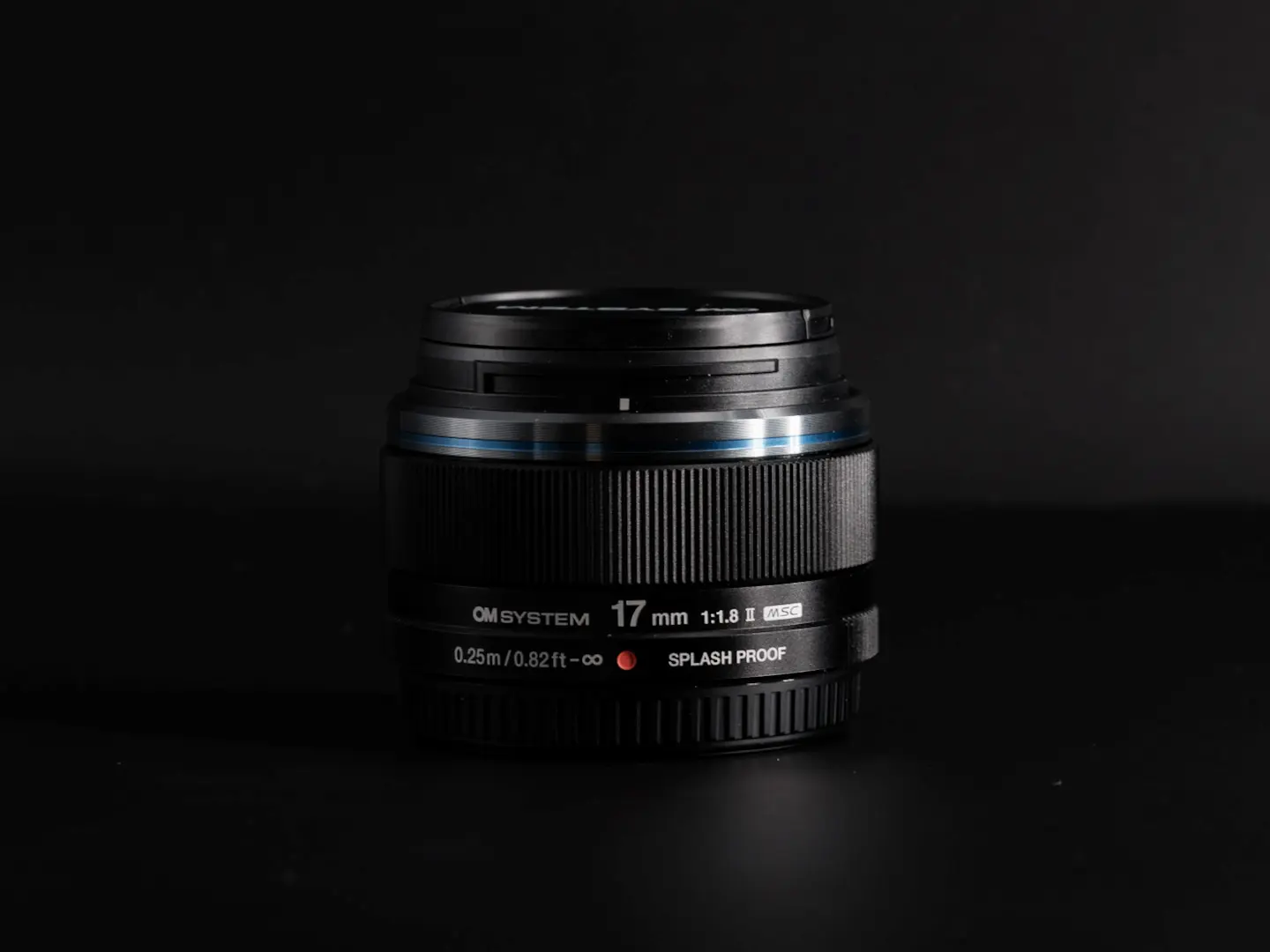
Fast forward to today, and OM System has refreshed the lens as the 17mm f/1.8 Mark II. On paper, the big change is weather resistance — and paired with the OM-3, I finally have a small, sealed package that’s perfect for travel, family, and everyday photography. See my favourite travel photography lenses on the OM-3 for more about that.
The OM System 17mm f/1.8 Mark II isn’t trying to be the sharpest or most impressive lens in the system — it’s designed to be small, reliable, and always with you.
But is this just a rebadge with a tougher shell, or did OM System improve the optics too?
In this review, I’ll go through the new lens, highlight what’s changed, and help you decide whether the 17mm f/1.8 Mark II is worth adding to your kit. If you prefer the 25mm focal length, I reviewed the original Olympus 25mm 1.8 lens.
TL;DR
While the OM System 17mm f/1.8 Mark II is a decent but not exceptional performer, it offers a very compact 35mm-equivalent lens that’s now weather-sealed. It makes for a fantastic travel or everyday-carry lens when paired with the OM-3 or OM-5. However, if you already own the original version, it’s not worth upgrading unless you specifically need the added weather sealing.
OM System 17mm f/1.8 Mark II — Key Specs
- Focal length: 17mm (34mm full-frame equivalent)
- Maximum aperture: f/1.8
- Optical design: 9 elements in 6 groups (with aspherical elements)
- Minimum focus distance: 25 cm
- Filter thread: 46 mm
- Aperture blades: 7 (rounded)
- Weight: 120 g
- Mark II updates: Weather sealing + ZERO (Zuiko Extra-low Reflection Optical) anti-reflective coating
What’s Changed From the Original 17mm f/1.8?

One of my biggest gripes with the original Olympus 17mm f/1.8 was the lack of weather sealing. When I paired it with my old E-M5 Mark II, I never truly had a sealed system. While I’ve often risked using non-sealed lenses in light rain, the wet season here in the Philippines can drench you in minutes. Add in the constant humidity and dusty environments, and weather sealing becomes less of a luxury and more of a necessity.
The 17mm f/1.8 Mark II finally adds IPX1 weather resistance. It’s rated as splash- and dust-proof and will handle vertical rain without issue, though sideways monsoon downpours are technically beyond its guarantee. In reality, I’ve already had the OM-3 with the 17mm II slung over my shoulder in heavy showers, attached to my Peak Design camera leash, and it performed flawlessly. I’m confident it can handle most conditions I face here.
Another change is the removal of the manual focus clutch, which helped trim a few grams and make the lens a little shorter than the original. Personally, I’m fine with this trade-off — I never used the clutch much, and the gain of weather sealing is worth it.
The lens also receives OM System’s ZERO (Zuiko Extra-low Reflection Optical) coating, which should improve flare resistance. In truth, I never found flare to be a serious issue on either version, so this feels more like an incremental upgrade than a game-changer.

Buy the OM System 17mm f/1.8 Mark II
- Compact, lightweight, and now IPX1 weather-sealed
- ZERO coating for improved flare/ghosting resistance
- Great everyday 34mm-equiv field of view
As an Amazon Associate I earn from qualifying purchases. This costs you nothing and helps keep this site running.
Otherwise, the lens is the same. The optical formula is unchanged: it’s still sharp, still focuses quickly, but still suffers from a little purple and green fringing in very high-contrast scenes.


Overall, the refresh makes the lens a far more versatile everyday option. Its combination of small size, light weight, and new sealing makes it an excellent match for the OM-3. Is it worth upgrading if you already own the original? Honestly, not unless you really value the weather sealing. But I’m pleased to see OM System refreshing their popular f/1.8 primes with these updates, bringing them closer in spirit to Fujifilm’s compact “Fujicron” lenses. I’d love to see the 25mm f/1.8 II in my kit soon, and I hope the 45mm f/1.8 gets the same treatment. While these 1.8 series of lenses don’t quite offer the same image and build quality as lenses like the 25mm 1.2 pro they do highlight one of the best characteristics of Micro Four Thirds cameras, offering small, lightweight optics with good image quality.
Sample Images below:


What I Use This Lens For
-
Travel photography with minimal kit
This is where the 17mm really makes sense. Paired with the OM-3, it gives me a small, lightweight setup that I can carry all day without thinking about it. -
Family and everyday moments
The 35mm equivalent field of view is ideal for documenting real life — wide enough for context, but still natural for people. It’s a great lens for capturing moments without getting in the way. -
When I want to keep things simple
If I don’t want to carry multiple lenses or overthink my setup, this is an easy choice. One camera, one lens, and I can cover most situations. -
Shooting in unpredictable weather
With the added weather sealing, I’m far more comfortable using this lens in rain, humidity, and dusty conditions — something I always hesitated to do with the original version.
Who’s It For?
- Travel & everyday shooters who want a tiny, balanced setup on the OM-3 (or OM-1 II / OM-5) without sacrificing speed.
- Street photographers who like the classic ~35mm FoV for context-rich images and quick AF.
- Family/documentary photographers who value a discreet lens that’s light enough to carry all day.
- Bad-weather pragmatists who need basic sealing (IPX1) for showers, humidity and dusty environments.
- Weight-watchers on a budget who prefer compact primes over large, pricier PRO glass.
Who Should Skip It
- Pixel-peepers chasing maximum sharpness and flare control — the 20mm f/1.4 PRO is the better fit.
- Bokeh hunters who want creamier separation — consider the 25mm f/1.2 PRO.
- Owners of the original 17mm f/1.8 who don’t need weather sealing — optical performance is essentially unchanged.
Buy the OM System 17mm f/1.8 Mark II
- Compact, lightweight, and now IPX1 weather-sealed
- ZERO coating for improved flare/ghosting resistance
- Great everyday 34mm-equiv field of view
As an Amazon Associate I earn from qualifying purchases. This costs you nothing and helps keep this site running.
OM System 17 mm f/1.8 Mark II – FAQ
Is the OM System 17 mm f/1.8 Mark II weather sealed?
Yes. The Mark II version adds IPX1-rated weather sealing, making it splash- and dust-resistant. It pairs well with weather-sealed OM bodies like the OM-3 and OM-1 II.
What’s the difference between the 17 mm f/1.8 Mark II and the original version?
The Mark II adds weather sealing, uses OM System’s ZERO coating for better flare resistance, and removes the manual focus clutch. Optics and performance remain essentially the same.
Is it worth upgrading if I already own the original lens?
Only if you really value weather sealing. Otherwise, the optical performance is unchanged, so the difference is mostly about durability and peace of mind for outdoor use.
Can I use the 17 mm f/1.8 II on older Olympus cameras?
Yes. It’s fully compatible with older Olympus Micro Four Thirds bodies such as the E-M5 Mark II, though you won’t benefit from weather sealing unless the camera body is also sealed.
Thank you for the lens review and the sample photos! I’m thinking of picking up this version, which seems like a better choice compared to the first one thanks to the newly added weather sealing. Best of luck and happy shooting!