
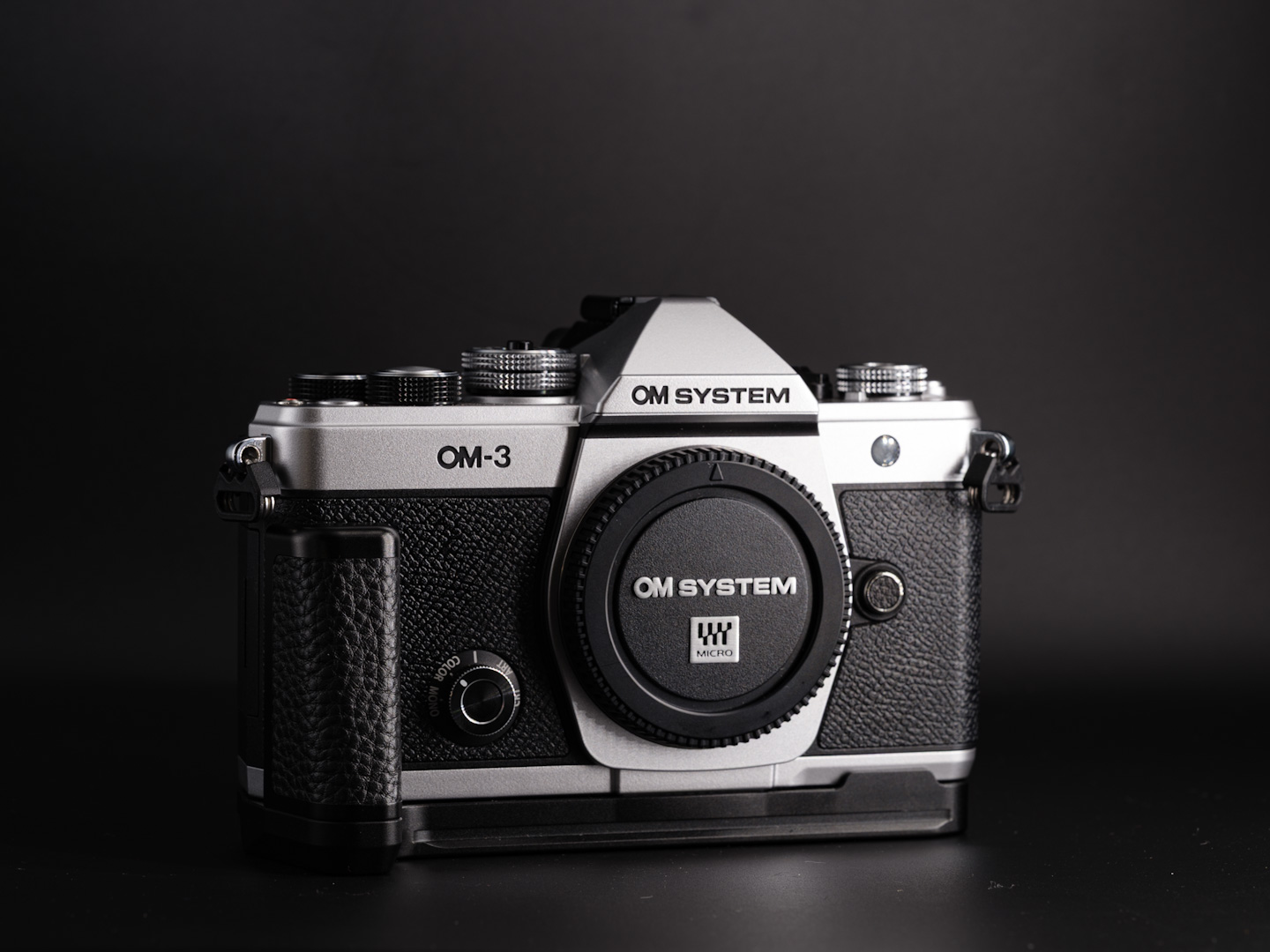
I’ve continued using the OM-3 since publishing this review and have updated the article to reflect my long-term experience. My overall opinion remains unchanged: the OM-3 remains one of the most enjoyable cameras I’ve used in recent years and one of the strongest options available for travel, family and everyday photography. I’ve also expanded this review to include additional thoughts on who the camera is best suited to and the exact OM-3 kit that I personally use.
As you can see from my website, I’ve been shooting with Micro Four Thirds cameras for a long time. I started out with the original E-M5 and used the E-M5 II as my only camera for more than a year. Along the way, I felt the E-M5 line lost its way a little — from the Mark III through to the OM-5, the build and feel just weren’t quite as premium as the early models.
I was also an avid user of the Pen-F and absolutely loved that camera. In a moment of stupidity, I sold it — and I’ve been pining for a replacement ever since, though the used prices are far too steep for my taste.
When the OM-1 arrived, it felt like the first genuinely significant leap forward in years — a proper step up rather than a mild refresh. So when the OM System OM-3 was announced, it immediately caught my attention: a compact, beautifully styled body that seemed to merge the best qualities of the E-M5 II’s build, the Pen-F’s charm (even if not rangefinder-styled), and the internal power of the OM-1 and OM-1 Mark II.
That combination was enough to have me ordering it straight away, along with a few choice lenses. But after owning it for a few months now — does it really live up to that promise? The fact that it features highly in my best cameras for family photography article should be a farily big hint.
My OM-3 Kit
This is the exact OM-3 kit that I currently own and use. Each lens serves a specific purpose, and together they create a compact system that covers almost everything I enjoy photographing.
- OM System 17mm f/1.8 II – My favorite OM-3 lens. It keeps the camera genuinely compact and is ideal for travel, street photography, family moments and everyday use. If the OM-3 has a natural partner, this is it.
- Olympus 25mm f/1.2 PRO – My choice for portraits, family photography and low-light work. It’s larger than the 17mm but delivers beautiful rendering, excellent sharpness and more subject separation than most people expect from Micro Four Thirds.
- OM System 12-40mm f/2.8 PRO II – My do-everything lens. When I don’t know what I’ll be photographing or only want to carry one lens, this is usually the one I reach for.
Together these three lenses give me a lightweight system that covers everything from landscapes and travel photography through to family photos and portraits, while still remaining significantly smaller than an equivalent APS-C or full-frame kit.
Although this camera uses a Micro Four Thirds sensor — a format I’ve shot with for many years — I’m not approaching this review from that narrow worldview. I also own and use APS-C, full-frame, and even medium-format systems, so my judgment of the OM-3 comes from experience across all of them, not just how it stacks up against its immediate peers. These days I shoot mostly travel, street, and family work, but I started out as a professional landscape photographer — and that background still shapes how I see cameras and what really matters in the field. I recently tested the OM-3’s black and white mode against the Nikon Zf. You can see the results here.
TL;DR – Is the OM System OM-3 the perfect compact Micro Four Thirds camera?
- For travel and everyday shooters, pretty much yes. Smaller, beautifully built, IP53-sealed body with class-leading IBIS means you can leave half the kit at home and still get the shot.
- Same brains as the OM-1 II, simplified. 20MP stacked sensor, fast AF (120 S-AF / 50 C-AF) and Pro Capture in a lighter package that’s nicer to carry all day.
- Creative Dial + CP button = you’ll actually use the clever stuff. Live ND, ND Grad, Handheld High-Res, Live Composite and more are one press away — great for travel, street and landscapes.
- Image quality is “good enough” for real work. Clean color, pleasant rendering and workable high ISO for prints up to A3+; larger sensors still win on tonality and shallow DoF, but the gap is smaller than the internet suggests.
- Know the trade-offs: single UHS-II slot, a basic 2.36M-dot EVF and tracking that’s shy of the very best.
- Bottom line: if you want a compact, capable, genuinely fun camera you’ll carry everywhere, the OM-3 is an easy recommendation. If you need dual slots and a higher-res EVF, step up to the OM-1 II.
This article contains affiliate links. If you buy through them, I may earn a small commission at no extra cost to you.
OM SYSTEM OM-3 — Key Specifications
| Mount | Micro Four Thirds |
| Sensor | 20.4MP Stacked BSI Live MOS (Quad Pixel AF) |
| Image Processor | TruePic X |
| ISO Range | ISO 200–25,600 (expandable LOW 80/100–102,400) |
| Autofocus | 1,053-point Quad Pixel PDAF with subject detection (people, animals, vehicles, trains, etc.) |
| IBIS | 5-axis; up to 7.5 EV with Sync IS (approx. 6.5 EV body only) |
| Burst Shooting | 120 fps (S-AF), 50 fps (C-AF), Pro Capture |
| Shutter Speeds | Mech 1/8000–60s; Electronic 1/32000–60s; Bulb/Time |
| High-Res Shot | 50MP handheld / 80MP tripod (14-bit RAW) |
| Viewfinder | 2.36M-dot OLED EVF |
| Rear Screen | 3.0″ vari-angle touchscreen, 1.62M dots |
| Video | DCI/UHD 4K60 10-bit H.265 (OM-Log400), OM-Cinema 1/2; 12-bit ProRes RAW via HDMI |
| Storage | Single UHS-II SD slot |
| Battery | BLX-1; ~590 shots (CIPA); USB-C PD charging |
| Connectivity | Wi-Fi (802.11ac), Bluetooth 4.2, mic & headphone jacks, micro-HDMI, USB-C |
| Weather Sealing | Full-metal body, IP53 dust/splash, freeze-proof −10 °C |
| Size & Weight | 139 × 89 × 46 mm; 496 g (with battery & card) / 413 g body-only |
Body & Handling

When I first picked up the OM-3, it immediately felt like a continuation of my old E-M5 II — solid, dense, and far more premium than the current OM-5-series bodies. The all-metal construction gives it a reassuring sense of quality in the hand, while the faux-leather wrap adds both grip and a refined look. Every button and dial offers firm, tactile feedback. Nothing on the OM-3 feels cheap.
OM System say the design draws inspiration from its classic film SLRs, and I believe them. It’s a very stylish camera — possibly even more beautiful than the Pen-F. The body feels slightly wider than expected, yet remains compact enough to be a perfect everyday-carry with the right lens attached. There’s no front grip at all, just a modest thumb rest on the back, yet the ergonomics still work thanks to the camera’s balance and well-placed controls, especially with lenses like the OM 17mm f/1.8 II.

Every button and dial feels well damped, with thoughtful detailing throughout. For instance, most buttons are slightly raised for easy access, while the Delete and Playback buttons sit recessed so you don’t accidentally hit them when shooting — a small but clever design choice. My only minor gripe is the Record button (which can be reassigned as a function key); it sits awkwardly close to the rear dial and can be tricky to reach quickly.

New on the OM-3 is a dedicated CP button on the rear, giving direct access to all the computational modes (I’ll cover those later). And, in a welcome nod to the Pen-F, the Creative Dial has returned on the front — letting you switch instantly between Color, Mono, Art Filter, and CRT (Color Creator) modes.

I wrote an eBook about using the Creative Dial on the Pen-F back in 2016, and it remains one of my favorite design ideas in any digital camera. It gives you genuine control over your color output. The OM-3 offers four Mono profiles styled after classic films (including a Tri-X-like look) and four Color profiles that mimic different film tones, plus a CRT mode for manual color tinting.

Want the OM-3?
Check PriceAs an Amazon Associate, I earn from qualifying purchases — it helps keep the site running at no extra cost to you.
While I usually shoot RAW with most cameras — even my Fujis, despite their excellent film simulations — the OM-3’s in-camera control makes JPEG shooting far more rewarding. You can fine-tune each Mono and Color profile using the color dial and curves, then add vignetting, contrast, and sharpness. The color wheel even allows ten levels of saturation adjustment per hue, giving you a huge range of creative control directly in-camera.
The OM-3 essentially takes the internals of the OM-1 Mark II and dials them down slightly, delivering nearly all the same shooting options in a smaller, lighter, and more stylish body — one that’s better suited to street, travel, and everyday photography.
What you don’t get is the OM-1’s superb EVF. The OM-3 uses an older 2.36-million-dot panel that’s perfectly usable but certainly not class-leading. In fact, among all the cameras I own, it’s probably the weakest viewfinder — yet still clear enough for practical use. The OM-3 also drops the dual card slots, which may be a deal-breaker for some. Personally, I’ve used SanDisk Extreme and Extreme Pro cards for twenty years without a single failure, so I’m not concerned. This isn’t a workhorse camera; it’s more of a guilty-pleasure camera.

Overall, OM System has done an excellent job with the design. It feels substantially smaller than the OM-1 Mark II, and when paired with lenses like the 17 mm f/1.8 II, it belongs in an entirely different category — almost Fuji X100VI territory in size. With larger lenses like my 25 mm f/1.2 PRO, I do prefer adding an L-grip extension for balance and comfort, but that’s the trade-off for such a compact and stylish body. You can see the best accessories for the OM-3 here.
Image Quality & Sensor Performance

This is the section where a lot of people will tell you that Micro Four Thirds isn’t good enough. It’s also the section where I’ll say, good enough for what?
This is where it helps to ignore the online noise about sensor size and instead think about what you actually shoot — and what you plan to do with your images afterwards.
The OM-3 uses the same stacked 20MP Micro Four Thirds sensor found in the flagship OM-1 Mark II. It offers noticeably better performance than older generation Micro Four Thirds sensors, both in high-ISO handling and in the overall “look” of the files. Yes, it’s still weaker than larger sensors in certain areas — tonality isn’t quite as natural, and once you hit ISO 3200 and above, noise becomes more visible compared to APS-C and full-frame cameras.
But the difference isn’t as dramatic as many make it out to be. We’re talking roughly two-thirds of a stop from APS-C, which in most real-world scenarios isn’t a deal-breaker. I’m happy shooting the OM-3 up to ISO 3200 and will push to 6400 if needed, as long as I’m not printing larger than A3+. And with the AI-powered noise reduction now available in Lightroom and other editors — plus the fact that I actually like adding a touch of grain these days — it’s rarely an issue unless you shoot fast-moving subjects in low light.

Olympus has long been praised for its color science, and the OM-3 keeps that tradition alive with crisp, vivid, and realistic colors that still look natural. I’ll admit that while I like the Natural color profile, the others don’t quite fit my style.

Dynamic range is more than sufficient for typical shooting scenarios, allowing you to lift shadows in post without introducing excessive noise at base ISO. I remember my original E-M5 showing faint noise in blue skies even at base ISO — those days are long gone.
Yesterday, I was sitting in my living room looking after my youngest daughter, Isobelle, with the OM-3 and 25mm f/1.2 PRO in hand. I fired off a few quick shots of her in her stroller at f/1.2. When I looked at them later, there was a painterly quality to the images — especially around her eyes. The fine noise almost resembled brush strokes, and as long as I didn’t zoom in too far in the viewfinder, the photos looked stunning. Not the compositions — these were just casual shots — but the rendering, tonality, and color had a certain magic to them that really caught me off guard.

Bottom line: unless you’re shooting extremely high-contrast landscapes or movement in dark night scenes, the OM-3 performs admirably. For street and travel photography, I have no hesitation using it exactly as I would any of my other systems. The images may look different — but all sensor sizes do, the question is really about whether the camera does what you want it to do and whether you will be happy with the output for your actual needs. Yes, my Fujifilm GFX100S is better, of course it is, it’s $10,000 worth of camera and lens, if it wasn’t better I’d be pretty upset, but that doesn’t mean anything less is useless. The OM-3 is more than capable of producing beautiful, professional-quality results in most scenarios.
Autofocus Performance
As has been the case for a long time, OM’s Single AF mode is fast, snappy, and accurate. When paired with lenses like the 12–40mm f/2.8 PRO, 17mm f/1.8 II, or my 25mm f/1.2 PRO, it’s silent and as quick as you’ll ever need for everyday photography.

Switch over to Continuous AF, and that’s where you really see the benefit of the stacked sensor. Since the original OM-1, C-AF performance on OM System bodies has improved dramatically — and the OM-3 continues that trend. I tested it tracking Sofia as she ran down the beach in Moalboal and was genuinely impressed: every frame was sharp, and it held focus on her effortlessly. That’s something the X100VI would have struggled with.

I’ve also shot the kingfishers that live in our garden using both the OM-1 and OM-1 Mark II, and they’ve been fantastic for that kind of fast, unpredictable movement — darting off a wall to snatch insects and returning to feed their young. The OM-3 essentially offers that same level of autofocus performance, and when combined with Pro Capture, it makes photographing fast-moving subjects remarkably easy — even for someone like me, a wannabe wildlife photographer without the patience to sit in a hide for hours.
If I had to place the OM-3’s AF performance in context with my other cameras, I’d say it sits comfortably above the Fuji X100VI, above the X-T5, and possibly even ahead of my Nikon Z6 III for human face and eye detect AF — though the Nikon still wins for pure subject-tracking accuracy.
In short, it’s very good. Unless you absolutely need that last 10 percent of tracking performance (and are willing to pay 100 percent more for it), the OM-3 will serve you extremely well.
Computational Features
This is where the OM-3 — and OM System cameras in general — really shine. No other system offers such a wealth of computational features that are genuinely useful in the real world.
The OM-3 continues this tradition with Handheld High-Res Shot, producing 50MP files that not only offer more detail but also noticeably cleaner color and lower noise. What many people overlook about this mode is exactly that — it’s not just about resolution; it’s also about improved image quality. It’s not perfect, of course. Any movement in the scene can trip it up, and while the files are larger, the extra detail isn’t always obvious. Still, when you want to squeeze every bit of quality out of a scene, it’s a genuinely worthwhile feature. There’s also a tripod mode that delivers 80MP images, but as I didn’t buy the compact OM-3 to start lugging a tripod around again, I’ve left that one alone. It worked well enough on my older Olympus cameras years ago.

One of the most exciting features that first drew me to the OM-1 — and remains a highlight here — is the in-camera ND filter mode. It combines multiple frames to simulate between one and six stops of neutral-density filtration. When I first tried it, I hoped it would mean I could leave my ND filters at home and still get long-exposure shots at waterfalls or by the ocean. It does exactly that. The results look natural, and yes — I genuinely no longer carry ND filters when I’m shooting OM System cameras.
The OM-3 also adds ND Grad simulation, which works in a similar way. You can choose up to a 3-stop ND grad, and select between soft, medium, or hard transitions. The front dial rotates the angle of the filter in larger increments, while the rear dial handles fine adjustments. The up and down pad buttons move the transition point. It’s an incredibly well-implemented system — fast, intuitive, and genuinely useful. Thanks to the OM-3’s processing speed, setting up and capturing a long-exposure shot like this takes seconds rather than minutes, so you actually use it instead of ignoring it.

For anyone new to OM System, the OM-3 includes all the classic computational tools too: Live View, Live Bulb, and Live Composite — long-exposure aids that show you a preview of the image as it’s being exposed, helping you nail the shot without trial and error. There’s also in-camera HDR (which I avoid, as the results are pretty awful), Focus Stacking with compatible lenses, and Focus Bracketing that works with any lens if you prefer to merge in post.
Combine these modes with what is still the best in-body image stabilization on the market, and the OM-3 becomes far more than just a compact camera with good image quality and autofocus. It’s a complete, self-contained photographic system.
You no longer need a tripod, ND filters, graduated filters, long-exposure apps, or remote shutters. Just grab a spare battery, head out, and shoot whatever subject you want — in any light and in any weather. Thanks to its IP-rated sealing, the OM-3, like the OM-1 Mark II, is a camera that truly lets you travel light and still do everything. It’s reached the point where these OM bodies are fully self-sufficient camera systems.
Who Should Buy The OM-3?
Buy the OM-3 if:
- You want the smallest camera possible without giving up advanced features.
- You enjoy travel, street, family or everyday photography.
- You value portability more than absolute image quality.
- You want access to features like Live ND, ND Grad, Handheld High Resolution and Focus Stacking without carrying extra equipment.
- You appreciate cameras that are enjoyable to use rather than simply technically impressive.
Look elsewhere if:
- You regularly shoot professional work that requires dual card slots.
- You need the very best subject tracking for wildlife or sports.
- You often shoot in extremely low light.
- You want maximum dynamic range and shallow depth of field above everything else.
For many photographers, the OM-3 sits in a sweet spot that few other cameras currently occupy. It’s small enough to carry everywhere, powerful enough to tackle almost any subject and enjoyable enough that you’ll actually want to pick it up and use it.
OM-3 vs the Competition
- OM System OM-1 Mark II: The OM-3 is smaller and offers most of what the OM-1 Mark II does in a lighter, more stylish body. However, if size and design aren’t priorities, the OM-1 Mark II remains the more practical choice — it’s more comfortable to hold, has a superior EVF, dual card slots, and better balance with larger lenses.
- Fujifilm X-T5: The OM-3 offers a much broader feature set — including advanced computational modes, stronger IBIS, better weather sealing, and comparable autofocus performance. If those features don’t matter to you, the X-T5 provides a more traditional photographic experience with higher image quality and a more tactile shooting feel. For pure photography, choose the X-T5; for a complete system, choose the OM-3.
Quick Compare
| Camera | Best For | Key Wins | Trade-offs |
|---|---|---|---|
| OM System OM-3 | Travel, street, family | Compact IP53 body, top-tier IBIS, Live ND/ND Grad/HHHR, Creative Dial + CP button | Single SD slot, 2.36M-dot EVF, not ideal for very low light |
| OM System OM-1 Mark II | Action/wildlife/all-round pro | Better EVF, dual slots, slightly stronger IBIS, balances big lenses better | Larger, heavier, pricier |
| Fujifilm X-T5 | “Pure photography”, IQ | Higher base IQ/DR look, tactile dials, great primes | Weaker IBIS, no Live ND/Grad, weather not IP-rated |
Everything Else That Actually Matters
The OM-3 uses the larger BLX-1 battery from the OM-1 Mark II, rather than the smaller pack used in the OM-5 series. Battery life is solid and about what I’d expect — I can comfortably shoot an entire day on a single charge. That includes an hour either side of sunrise and sunset, plus casual shooting throughout the day.
It also supports USB-C charging, which for me is non-negotiable now. I won’t buy a camera without it.
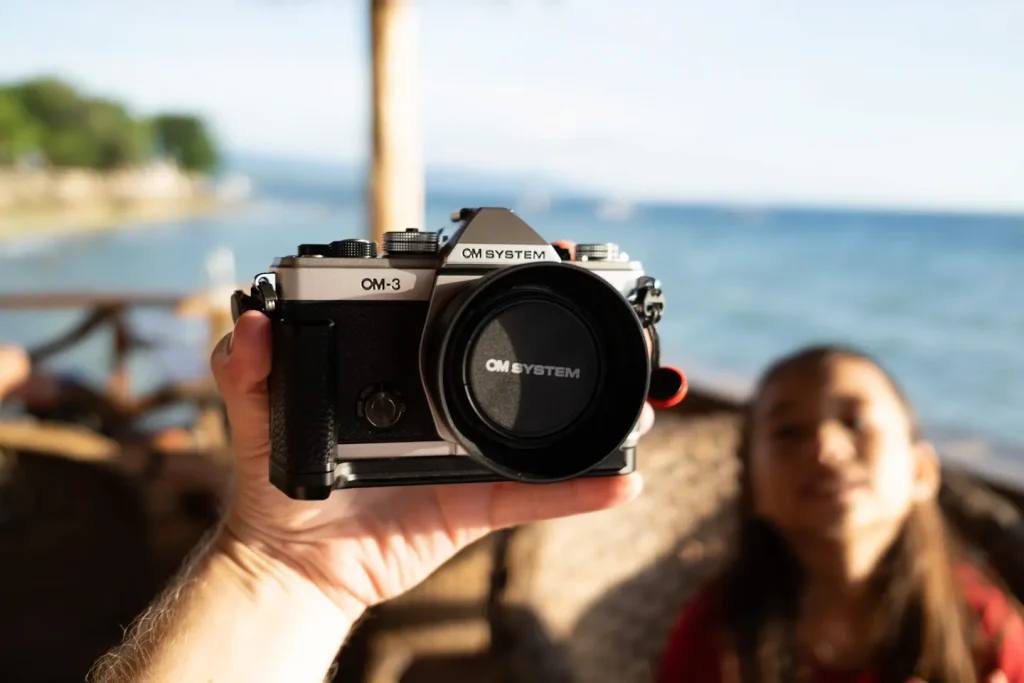
One of the things I’ve always respected about OM System is that they’re the only manufacturer to actually give their cameras an official IP rating. The OM-3, like the OM-1 Mark II, is IP53-rated, meaning it’s more robust than anything else in its class. I’ve trusted OM System cameras in everything from Scottish blizzards to Philippine monsoons, and they’ve never let me down.
The OM-3 also uses the same newer-style menu system that OM says is exclusive to their stacked-sensor models. It’s far easier for newcomers to navigate, logically laid out, and crucially, it actually tells you what each option does — and why certain ones are unavailable. It’s one of the better menu systems out there, though like any, it just takes a little time to get familiar with.
As for the touchscreen, I never use them. I think I swiped an image in playback once — it worked.
- Compact, beautifully built, and weather-sealed (IP53 rated)
- Class-leading IBIS — shoot handheld at absurdly slow shutter speeds
- Genuinely useful computational modes (Live ND, ND Grad, HHHR, Live Composite)
- Excellent color and tonality straight out of camera
- Huge lens ecosystem covering every focal length and budget
- USB-C charging and strong battery life with the BLX-1 cell
- Single UHS-II card slot
- Basic 2.36M-dot EVF feels dated
- Not the best choice for low-light work or those chasing shallow depth of field
- Expensive for a Micro Four Thirds body
Thinking about adding the OM System OM-3 to your kit?
Check Latest PriceUsing the link above helps support this site at no extra cost to you — and means I can keep creating in-depth, ad-free reviews like this one.
Conclusion
The OM-3 is a camera that will suit travel and general photographers who want a compact system and don’t feel the need to bring along the kitchen sink in accessories. Its small, well-balanced form factor, combined with the enormous range of Micro Four Thirds lenses, means you can confidently tackle just about any subject without feeling weighed down.
It’s a beautiful camera — one that’s a genuine pleasure to pick up and shoot with. The computational modes make it easy to experiment, whether you’re exploring macro work, long exposures, or creative color profiles, all without needing to buy specialist gear.
Yes, there are cameras that will give you technically better image quality, more subject isolation, or more prestige with the “cool kids.” But there are very few cameras today that are as enjoyable to use as the OM-3 — and that matters just as much as sensor size. Because ultimately, this is the kind of camera you’ll actually pick up, take with you, and use. And that, more than anything else, is what makes it great.
More OM-3 Articles
OM System OM-3 FAQ
Is the OM System OM-3 good enough for serious work?
Yes. The OM-3 uses the same stacked 20MP Micro Four Thirds sensor and TruePic X processor as the OM-1 Mark II, just in a smaller body. For travel, street, family and general photography it is more than capable of professional-quality results, especially if you are not routinely printing huge or working in extreme low light.
How does the OM-3 compare to the OM-1 Mark II?
The OM-3 is effectively a smaller, more stylish sibling to the OM-1 Mark II. You get the same core image quality, autofocus performance and computational features, but in a lighter body with a single UHS-II card slot and a more basic 2.36M-dot EVF. If you need dual slots, a larger grip and the best viewfinder, the OM-1 Mark II is the more practical choice. If you value size and design over maximum practicality, the OM-3 is the better fit.
Is the single UHS-II card slot on the OM-3 a problem?
It depends on how you shoot. For critical paid work, dual card slots are reassuring. For travel and personal photography, a single UHS-II slot is usually sufficient, especially if you use high-quality cards. For my own photography, I have used SanDisk Extreme and Extreme Pro cards for around twenty years without a single failure, so the single slot is not a concern.
Is Micro Four Thirds still good enough in 2025?
For most photographers, yes. You give up some tonality and high-ISO performance compared to APS-C and full-frame sensors, but the real-world difference is smaller than online discussion often suggests. The OM-3 is easily capable of high-quality travel, street and family images. I am happy to use it up to ISO 3200 and 6400 when needed for prints up to about A3+.
What lenses pair best with the OM-3 for travel?
For a compact and balanced travel kit, the OM System 17mm f/1.8 II is an ideal match. For more versatility, the 12–40mm f/2.8 PRO covers almost any situation. For a more characterful or shallow-depth-of-field look, the 25mm f/1.2 PRO produces beautiful rendering and is excellent in low light.
How good is the OM-3 autofocus compared to Fujifilm and Nikon?
Single AF on the OM-3 is fast and accurate, and Continuous AF benefits significantly from the stacked sensor. In my experience it outperforms the Fujifilm X100VI and X-T5 for face and eye AF, and comes surprisingly close to the Nikon Z6 III. The Nikon still wins for overall subject tracking, but the OM-3 is more than fast enough for kids, street photography and general action.
Is the OM-3 viewfinder good enough?
The 2.36M-dot EVF is usable but not class-leading. It is perfectly fine for everyday shooting but feels dated compared to the OM-1 Mark II and many APS-C and full-frame competitors. If viewfinder quality is a top priority, the OM-1 Mark II is the better choice. If size and design matter more, the OM-3 EVF is sufficient.
Can the OM-3 replace larger systems like full-frame or GFX?
For some types of photography, yes; for others, no. For maximum image quality and large prints, I still use my Fujifilm GFX100S. But for daily photography, travel and family work, the OM-3 is more than capable — and I am far more likely to take it with me. It is less about one system being universally better and more about which camera you will actually carry and use.
A great review and photos I own the venerable EM1-X and use it for lots of different photography subjects – it excels at anything you throw at it.
The OM3 looks a good camera for me in a couple of years
Hi Mark,
Ah the EM1-X, I owned one for a while, what great ergonomics that camera had. The OM-3 is really, very good. I’ll be putting it up directly against my OM-1 Mark II when I get chance to shoot them both together in the not too distant future hopefully.
All the best
David
A great review and very true – It has taken me two years at least to get my em M1MKII and Pana Leica 100-400 working perfectly on C1 for butterflies as I am a volunteer with Butterfly Consevation so I will be keeping that for wildlife. I also have my trusty em M5MKII and Pana 12-60 for travel which produces really sharp and appealing jpegs of places like Venice especially usung Art Vintage !!!.
I just had to buy the OM3 as I am not very good with the finer points of Lightroom or Photo Shop and the thought of lugging tripods and fiddling with filters is not my bag.
I am having great fun with it already having bought a grip for ergonomics. It’s going to keep me happy for years to come trying out all its bells and whistles – macro stacking hand held , high res hand held , blurry water handheld , mono , art , colour palette , the list is endless. I have 12-100 f4 which is top notch for landscape , 25mm 1.8 . 45 1.8 which is sharp as a tack and 90 equivalent for portraits , my 60 macro and a surprisingly good 9-18 !!
converted from Canon 6d and 7dMKII because of the weight of the lenses and I don’t miss having to get lenses calibrated for focussing ; )
The fun has already started.
Hi Gary,
I’m gld to hear you are enjoying your gear. I also have the OM1 Mark II, originally bought with the intention of shooting more wildlife. I may get a chance to do a lot more of that next year if some recent plans come to fruition.
Enjoy your OM-3.
All the best
David
Thank you David for a very nice and thorough review of the OM-3. It’s a beauty of a camera – a jewel! I’m glad that it connects to the original OM-cameras and not the half format Pen-F. I had the original once with the separate cds meter. It was good but the ocular was on the left side and my dominant eye is the left eye.
Most reviews mention that the EVF isn’t the best compared to the EVF of the OM-1 Mk2. I don’t agree. It’s still an Oled EVF and it’s not small. I wear glasses and the I think the EVF is equally good or maybe even better as it’s easier to see the whole screen for me.
I also think it’s the perfect compliment to the OM-1 Mk2 even for birding if you have two teles with different focal lengths. It’s also nice to bring with you for regular photography – it’s very robust and weather proof.
Per
Hi per,
Thanks for your comment. That’s an interesting take regarding the EVF. I’ve not heard that before although I have always been someone that doesn’t always appreciate the viewfinder upgrades that sound significant on paper. Often in reality, I find the upgrades to be marginal, rather than game-changing.
I do find the EVF on the OM1 Mark II better but that certainly doesn’t make the EVF on the OM-3 bad. Overall I agree, the OM-3 is a really nice camera to shoot with. I’ll be shooting more OM System gear once I’m over in Scotland around Spring next year, prticularly the OM1 mark II and OM-3 with a focus on wildlife and landscapes. I’m really looking forward to it.
All the best
David
Thank you David!
I agree that the EVF of the OM-1 Mk2 is “better” if you look at the specificatons. The EVF of the OM-3 is smaller and have less pixels but both are OLED and has a good contrast. I haven’t calculated the actual density of the pixels. If you ask yourself what EVF gives you the best overview of the situation? For me with glasses the EVF of the OM-3 gives the best overview. Both are very good and works equally well in practice but I think the EVF of the OM-3 may be faster to interpret.
This evening I took some portraits with the OM-3 in low light with only two candles and a weak light from the cieliing. I became astonished how good the contrast were in the EVF and how easy it was to take these portraits when I consentraited on the facial expression. It had probably worked equally well with the OM-1II but I didn’t compare.
I’m also in the Fujifilm system and I have a X-H2. It’s a very good camera. It has a very big EVF with a high resolution and it has got rave reviews also because of this. I don’t think it had been any “better” in the situation I described. It’s not all about figures and spec, you must try it in practice and compare. In some situations a smaller EVF can be an advantage and in other situations not an important disadvantage. With the OM-3 I accept this as I don’t think it had been nice with a big hump to make a bigger EVF possible! As always sometimes you have to accept a compromise and even enjoy it!
I have been using this camera OM-3 for a while now. It only becomes better! I have used it with “ordinary” lenses but also with long tele lenses. No problem, it finds the birds!
This evening I travelled with my dog by train to a nearby city. It was a dinner party and I took some pictures. One of my friends asked if I still used my old film cameras? When I went back home I tried some “Street Photography” with the help of the EVF and also from the hip with the screen. I used the 17mm f1.8 II.
I became surprised! NOBODY took notice of me! The pictures weren’t good as the exposure times were too long. I must change the settings and not be afraid of higher ISO and I have’nt! learned the settings yet as I come from another camera brand.
The important thing here is that nobody took notice of the camera!
David. you asked: “Is It the Perfect Compact Micro Four Thirds Camera?”
Can I post a picture I took early this morning at the sunrise?
file:///home/per/Pictures/251228_morgon/Morgon_2WEB.JPG
Yes I think it is! This camera will become a classic!
Per
Sorry that I’ m writing so many comments! I just found this about the OM-3:
Among many other things this compliments your excellent review with some data. There are some specs about the resolution of the EVFs of some common cameras. The EVF of the OM-1 is outstanding among most cameras. The OM-3 is not worse than the others. It has a little lower magnification but in practice it works as well for me as I get a very good overview. This camera is technically as competent as the OM-1 mark 2 and the price is about the same these days. When it was introduced it was significantly lower. It may be more expensive to manufacture because of it’s all metal house. It’s more like a Leica for good or bad!