

Last updated December 27th 2025 for 2026: Note on Compact Cameras:
If you’re looking for genuinely pocketable cameras like the Fujifilm X100VI or Ricoh GR IV, I’ve covered those separately in my dedicated Best Compact Cameras for Travel Photography 2026 guide. I’ve also written an article on the best cameras for family photography.
This article is different — it’s for people who want a more capable travel camera system with interchangeable lenses, better low-light performance, full manual control and room to grow beyond a single fixed lens.
Travel moves fast — the moments you want to capture often happen once, and you don’t get do-overs. Choosing the right camera can mean the difference between a memory saved forever and a moment missed.
I’ve spent the last 15+ years shooting everywhere from quiet English villages to tropical beaches and crowded cities — using Fujifilm, Nikon, OM System, Sony and even medium format GFX cameras along the way.
In this guide, I’ll cut through the noise and share my real-world recommendations for the best travel cameras in 2026, tailored to different types of travelers and budgets. I’ve shot and owned every camera on this list so these are real recommendations based on real shooting.
Looking for a gift idea a photographer will actually use? My Best Gifts for Photographers guide is full of genuinely useful gear — not novelty junk.

What to Consider Before Buying
Choosing the right camera for travel isn’t just about specs — it’s about how the camera fits into your trip and your life. Here are the main factors I look for when deciding what to pack:
- Portability: You’ll carry it all day, often in hot, crowded, or rugged places. A lighter camera means you’ll actually bring it everywhere.
- Lens Ecosystem: The best camera is the one that can grow with you. Make sure there are lenses available for the type of photography you love most (wide landscapes, portraits, wildlife, etc.).
- Weather Sealing: Essential if you shoot outdoors — rain, dust, and humidity are part of travel.
- Battery Life: Always check real-world battery life. Some mirrorless cameras burn through batteries quickly, so bring spares. The ability to charge via USB-C and use powerbanks is increasingly useful.
- Image Quality: This includes resolution, dynamic range, and how the camera handles low light — but also whether it’s good enough for your intended output. There’s little point in hauling a 100MP medium format camera if your images will only live on Instagram.
Now that you know what to look for, here are my top picks for the best travel cameras in 2026 — covering every budget and travel style.
Disclosure: Some links in this article are affiliate links. If you buy through them, I may earn a small commission at no extra cost to you. Thanks for supporting the site—it helps me keep reviews honest and ad-light.
TL;DR — Best Travel Cameras in 2026
Quick picks for different travel styles. All personally owned and shot.
Best APS-C camera for Travel — Fujifilm X-T5
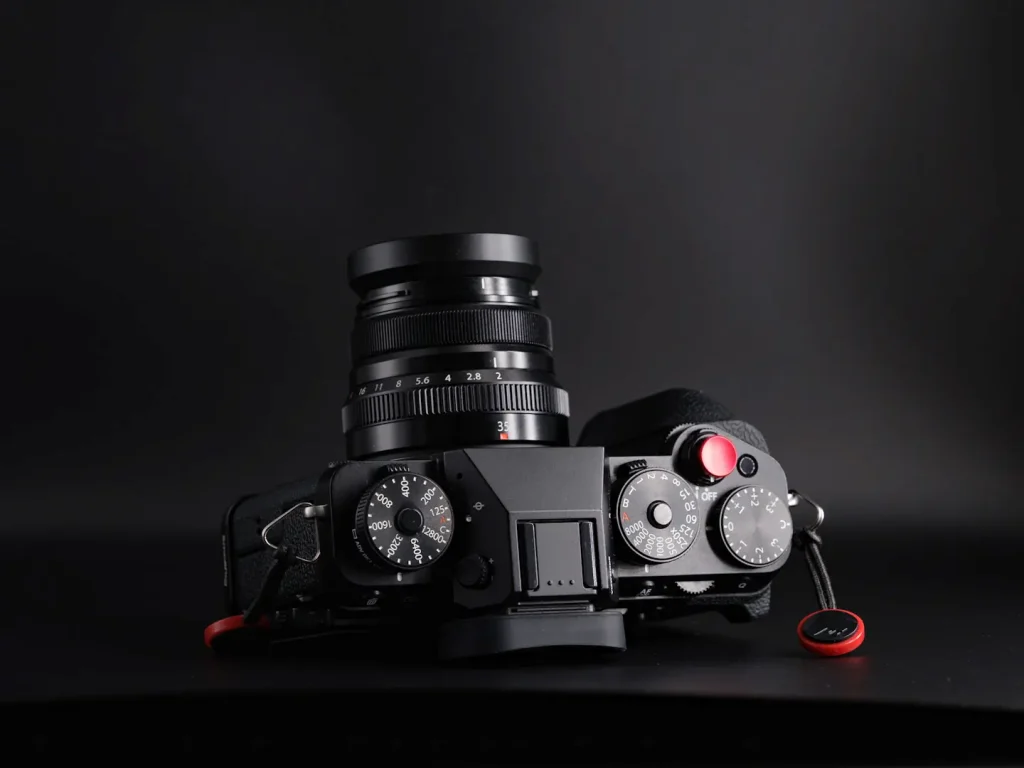
In my opinion, the Fujifilm X-T5 combines the strengths of multiple cameras. When paired with Fujifilm’s compact Fujicron lenses, it’s really not much bigger than the X100VI — but you still get all the handling benefits of Fuji’s physical shutter speed and ISO dials, plus an aperture ring on most lenses. I also put the X-T5 up against the Nikon Zf in a separate article to see how they compared.
The image quality is virtually identical to the X100VI, but there are some important benefits: the bigger NP-W235 battery means it lasts all day for casual shooting, it has dual card slots for peace of mind, and with many of Fuji’s f/2 lenses it’s actually faster to focus than the X100VI.

The big difference, of course, is flexibility. Being able to change lenses means you can create a system that suits you perfectly — from small, lightweight travel setups to pro-grade images with some of the most beautifully rendering primes on the market, like the 23mm f/1.4 WR , 33mm f/1.4 WR and 56mm 1.2WR (Reviews linked)

For me, the X-T5 strikes the best balance of any camera available right now in terms of size, flexibility, image quality, and enjoyment. It’s my most-used camera and, when I sold off all my gear last year to do a complete reset, this was the system I chose to base my personal shooting around. You can see why in my Fuji X-T5 full review.
It’s particularly good for photographing people thanks to Fuji’s film simulations, and with seven custom shooting modes available, I can set up multiple configurations and access them quickly from the Q menu. Honestly, if I could only have one camera for travel photography, this would be the one — it just does everything I need.
A flexible APS-C system with excellent lenses and handling — ideal for portraits, street, and everyday travel.
Check PriceAre there downsides? Sure. The AF — which gets a lot of criticism online — still isn’t up to Sony’s level for fast action tracking, but it’s good enough for everything I shoot. Build quality is very good, though not quite as bulletproof as the next camera on this list, and I personally don’t rate Fuji’s zoom lenses as highly as their primes — so if you’re primarily a zoom shooter, you might want to look elsewhere.
Best Complete Travel System — OM System OM-3

If you want a complete, travel-ready camera that offers everything you could possibly need without hauling a bunch of accessories, the OM System OM-3 should be very high on your list. I discuss why I bought the OM System OM-3 here and you can find my full OM System OM-3 review here.
The OM-3 has the latest stacked Micro Four Thirds sensor, which allows it to focus and shoot extremely quickly. On a recent trip it easily tracked Sofia running down the beach. It’s small and light, so it doesn’t take up much room in your bag, and when paired with tiny, weather-sealed lenses like the OM System 17mm f/1.8 II, it offers excellent image quality in an unbeatably compact package.

Not only is this a beautiful-looking camera, it’s quick to use with enough custom buttons to adjust everything important without menu-diving. It looks retro but uses the faster PASM dial, combining classic aesthetics with modern usability. Yes, the sensor is smaller than the others on this list and has the lowest resolution at 20MP, but it’s still more than capable of producing images that will make you never want to rely on your phone again.
Where the OM-3 really shines is freedom — freedom to leave the tripod at home, freedom to forget physical filters, and freedom to shoot any subject you want thanks to its incredible computational modes: I talk about the things I already love about my OM-3 here along with the best lenses for travel photography with the OM-3 here.
- Handheld High-Res: Get 50MP files with improved color and noise performance (as long as your subjects are still).
- Live ND & ND Grad: Simulate long exposures without carrying filters.
- Live Bulb / Live View: See your long exposure building in real time so you know exactly when you’ve nailed it.
- Starry Sky AF: Perfectly focuses for astrophotography.
- In-Camera Focus Stacking: Create tack-sharp macro images without special software.
- Best-in-Class IBIS: Shoot at night with shutter speeds as low as 1–4 seconds — handheld.
- IP53 Weather Sealing: This is the only brand that gives IPX ratings. I’ve shot OM cameras through Scottish winters and Southeast Asian monsoons without issue.
- Pro Capture Mode: Pre-record frames before you fully press the shutter so you never miss the decisive moment.

The ability of the OM-3 to handle virtually any subject, in almost any condition, is something few cameras can match. Combined with the generally smaller lenses for Micro Four Thirds — everything from tiny kit zooms to professional telephoto lenses — it’s a camera that can go with you anywhere and shoot anything, from an Arctic expedition to street photography in Paris.
All-round powerhouse: tiny weather-sealed lenses, stacked sensor, and amazing computational modes so you can travel light without sacrificing capability.
Check PriceDownsides? Like all cameras, there are compromises. Low-light performance is about ½–⅔ stop behind Fuji APS-C and about 2 stops behind full-frame. It only has a single card slot, so use reliable cards. With heavier lenses, the grip can feel a little small, though that’s easily fixed with a small add-on grip. The viewfinder is an older 2.36M-dot panel, which is a compromise I’m personally willing to make in exchange for everything else this camera offers. It’s also a little expensive compared to some competitors — but there’s simply nothing else on this list that delivers this level of versatility, portability, and capability in one package.
Best Full-Frame Travel Camera — Nikon Z6 III

Remember back in the “What to Consider” section when I said image quality, handling, and lens choice were among the most important things to me? Those priorities are exactly why I picked the Nikon Z6 III — and why I’d argue it’s the best full-frame travel camera available right now. It is one of the few cameras that is great straight out of the box although adding a few key accessories takes it from great to nearly perfect. you can see the full Nikon Z6III review here. There is of course the Nikon Z8 which I compared to the Z6III.
In terms of size, it’s barely bigger than my OM System OM-1 Mark II, yet it packs a full-frame 24MP sensor that delivers some of the best image quality currently available.
What makes the Z6 III special is really the lens selection. While Nikon might not match Sony’s sheer number of lenses, the ones they do offer are absolutely ideal for travel photographers: small, light, and optically excellent. The 24-70mm f/4 and 14-30mm f/4 zooms are incredibly capable, and the 1.8 primes — like the Z 35mm f/1.8 — are among the sharpest, best-rendering lenses I’ve ever used, as I saw in my Nikon Z 50mm 1.8 review. I compared the Nikon Z 35mm 1.8 against the Nikon Z 50mm 1.8 to see which prime you should buy first. They focus fast, are weather-sealed, and are built to last. Crucially, Nikon doesn’t force you to choose between cheap, compromised primes and huge, expensive pro glass — the Z-mount lineup gives you both portability and quality. I’ve personally bought into the 1.8 prime lineup with the 20mm, 35mm, 50mm, and 85mm f/1.8 lenses, and they cover everything I shoot. The Z6 III with those lenses fits comfortably into my Peak Design Everyday Sling bag, and on bigger trips or more demanding shoots, I still have room to add the Z8 without feeling overloaded.

Another big factor for me is ergonomics. The Z6 III (and Z8) have the best handling of any full-frame cameras I’ve used. Every button is exactly where you expect it, the grip is extremely comfortable, and you get dual card slots — one of which is CFexpress Type B for fast bursts and robust video specs.
Speaking of video, if you shoot hybrid, the Z6 III is a monster: 6K internal recording, high frame rates, and professional codecs. But even if you only shoot stills, you’ll appreciate its low-light performance (among the best on any full-frame camera), excellent IBIS (right up there with Panasonic), and its gorgeous 5.76M-dot EVF and top LCD panel. Nikon’s color profiles give you natural but punchy files straight out of camera.
Downsides? Some people argue its dynamic range isn’t as good as certain competitors, but unless you’re regularly pushing landscapes by three or more stops, you’ll never notice. Autofocus is excellent but not quite as sticky as Sony’s latest A7 IV/A7C II models, and I personally prefer a 3-way tilt screen for photography rather than the fully articulating one Nikon uses here.
Still, when you combine everything — the ergonomics, IBIS, low-light performance, and an almost-perfect travel lens lineup — the Z6 III is, in my opinion, the best full-frame camera for travel photography right now.
Balanced full-frame hybrid with superb ergonomics, excellent low-light performance, and one of the best travel lens lineups available.
Check PriceBest Alternatives – Nikon ZF
If you want a smaller, more discreet camera than the Nikon Z6 III that retains most of its strengths while offering a more stylish, tactile shooting experience, the Nikon Zf is it. It uses an older-generation 24MP full-frame sensor, but image quality is every bit as good as the Z6 III. It also shares Nikon’s latest EXPEED 7 processor, which means autofocus performance is very similar in real-world use.
I’ve been using the Zf a lot recently, and performance-wise it’s closer to the Z6 III than many people expect. The real difference is design philosophy. The Zf is a retro-styled camera with physical dials for shutter speed, ISO, and exposure compensation, while still allowing you to shoot in aperture priority, shutter priority, or full auto when needed.
It’s not as comfortable to hold as the Z6 III due to the lack of a pronounced grip, and the second card slot is limited to microSD, which won’t suit everyone. If efficiency and ergonomics matter most, the Z6 III is still the better choice as a primary camera. But if you value the experience of shooting as much as the results, the Zf is an excellent alternative — and a brilliant backup body that offers a different, and often more enjoyable, way of working.
— Sony A7C II
If you want something smaller and lighter with even better autofocus and a huge lens ecosystem, the Sony A7C II is an excellent option. I previously owned the A7 IV (which shares the same internals), and it’s a fantastic camera with the best AF I’ve ever used. The trade-offs? The ergonomics are more cramped, the viewfinder isn’t as nice, and I don’t trust its weather sealing as much as Nikon’s. Sony’s 1.8 primes are cheaper and lighter but don’t quite match the image quality or build of Nikon’s Z-mount primes.
Best Value Full-Frame Travel Camera — Panasonic Lumix S5II

It would be hard to write this article without including one of the best-value full-frame cameras available: the Panasonic S5II (I personally own the S5IIX, which for stills is basically identical). I originally bought the S5IIX for video work, back before I switched my focus fully to this website — and yes, it has excellent video specs — but I think it’s hugely underrated as a stills camera.
The ergonomics are honestly among the best of any camera I own. Every button seems to be exactly where I expect it to be. The body feels solid yet remains relatively compact for a full-frame camera. What stands out most to me, though, is the image quality, which is excellent. High ISO performance is very strong (possibly a touch better than the Z6 III), and Panasonic’s color profiles are beautiful. The Natural profile produces realistic yet vibrant colors, and the black-and-white options — L Monochrome and Leica Monochrome — are stunning.

Autofocus, while not class-leading, is absolutely good enough for people and general photography. In my experience it’s about on par with the Z6 III, though I do wish Panasonic would show a box around the eye in focus rather than crosshairs. IBIS is arguably the best in any full-frame camera right now, and the dual card slots plus the ability to load your own creative LUTs (color porifles) into the camera make it a very flexible tool.
While Panasonic doesn’t offer the same breadth of lenses as Nikon or Sony, they’re part of the L-Mount Alliance (with Sigma), so there’s still plenty of choice. I really appreciate Panasonic’s thoughtful design: the three lenses I own — the 20–60mm, 50mm f/1.8, and 85mm f/1.8 — are all similar in size and share the same filter thread size. This means I don’t have to buy duplicate filters, and for video shooters, you wont have to re-balance your gimbal every time you swap lenses. The lenses are good performers, weather-sealed, and in my experience Panasonic’s sealing is trustworthy — I’ve used their Micro Four Thirds cameras in monsoons without issue. the build quality of the lenses is not quite up to the Nikon Z 1.8 primes i mentioned above but the benefit is that saves you a bit of weight while still getting good optical performance.
When you factor in the often ridiculously good deals available on the S5II and S5IIX (I got my S5IIX + lenses for around $2500) , you get a well-specced, well-designed, and very enjoyable full-frame camera at a significantly lower price than most competitors. For anyone wanting full-frame quality without breaking the bank, it’s a compelling choice.
Full-frame performance, excellent IBIS, great color profiles, and thoughtful lenses — all for far less than most competitors charge.
Check PriceDownsides? Honestly, there aren’t many at this price point, but I do find the camera a bit slow to operate. Startup time takes a moment, and even pressing the playback button introduces a slight delay before images appear. And outside of the often-discounted 20–60mm kit lens and the excellent 50mm and 85mm f/1.8 lenses, some of Panasonic’s other lenses are fairly expensive.
Best of the Best (Money No Object) — Fujifilm GFX100S

This next option isn’t specifically a “travel camera” — but if we even travel back just a few years, it would have been unthinkable to use a medium format camera for travel photography. And yet, with the GFX100S (which I own) — and now the Mark II version — we do, unbelievably, have the option to go all out and use medium format for travel.
Yes, it’s significantly heavier than the other cameras on this list, but I still use my GFX100S for travel when image quality is the absolute priority or I’m shooting a specific project and want the very best I can get. The body is about the same size as my Nikon Z8, very comfortable to hold with a solid grip, plenty of custom buttons, dual card slots (SD only), a top LCD for quickly checking settings, and a good viewfinder.
Personally, I wouldn’t pair this camera with zooms — they’re just too big — but there are primes that work well as a travel kit and keep things manageable. Lenses like the 45mm f/2.8, 50mm f/3.5, 55mm f/1.7, and 80mm f/1.7 are not that large and are certainly smaller and lighter than the pro f/2.8 zooms many people travel with on full frame.

The GFX100S offers a 102MP medium format (some argue not “true” medium format) sensor that’s 1.7× larger than full frame. It’s excellent in low light, gives you Fuji’s wonderful color profiles, and outputs 16-bit RAW files. For medium format, its autofocus is actually quite reasonable — no, it won’t follow your kids as they sprint down the beach, but for anything that isn’t moving at breakneck speed, it can keep up. (I presume the Mark II is even better, though I still need to test it.)
If you want the absolute best for a once-in-a-lifetime trip — perhaps Yellowstone National Park — traveling with the GFX100S is totally doable. The resulting image files will blow you away: you can print them as large as you want, crop aggressively, and know you made the photos the best they could possibly be.
People often talk about the “medium format look,” and without diving too far into technicalities, it’s real. The combination of better tonality and how focal lengths behave on a larger sensor gives images a unique look. If you want the best without paying $50,000 for a Phase One, Fuji offers it in a reasonably sized package without having to remortgage the house — maybe just sell a kidney.
Perfect for those trips or projects where image quality is everything — medium format detail, tonality, files you can print large and crop deeply.
Check PriceAre there any downsides to the GFX100S? Well, there’s no getting around the fact that this setup is bigger and heavier than all the others here. You also need to consider where you’re traveling. You might not want to carry such expensive equipment — whether because of the risk of damage or loss, or simply not wanting to attract attention in countries where your gear might represent more than the average annual salary. Autofocus will mean you miss some shots, so if your style leans toward candid moments and capturing life as it happens, this won’t be a good choice. If you mainly post to social media, this is definitely overkill. And if you just want medium format without the bulk, there’s the recently released GFX100RF, which is essentially a medium format X100VI.
Final Thoughts

Choosing the best travel camera isn’t about buying the most expensive one — it’s about picking the one that matches how you actually shoot and travel. If you want a pocketable camera, I’ve covered that separately in my Best Compact Cameras for Travel Photography 2026 guide. This page focuses on mirrorless/system cameras that give you room to grow — from the flexible Fujifilm X-T5 to full-frame bodies like the Nikon Z6 III and Panasonic S5II. And if image quality is the absolute priority, the GFX100S even makes medium format travel-viable.
Whatever you choose, the most important thing is to get out there and use it — the best camera for travel is the one you have with you when the moment happens. If you found this guide helpful and you’re planning to buy one of these cameras, using the links on this page helps support the site at no extra cost to you — and lets me keep creating in-depth, honest guides like this one.
Safe travels, and happy shooting.
I wonder where the updated OM5 II fits in the travel ecosystem? Consider a 12-100 or combination 12-45 and 40-150 for 1 kg package.
Currently, looking for a lighter alternative to my Sony A7R IV which with a Sony 16-25 F4 and Tamron 28-200 (2kg) sat in my pack on a bike ride in Korea for a month. Killed my Sony RX100V in a rainstorm after the bag it was supposedly safe in leaked.
Hi Mark,
I hope you enjoyed your Korea trip. I think the OM5 II is that real, lightweight, complete package that has plenty of features but just lacks some of the high performance/speed features of the OM-3 and OM1 II. I haven’t shot it myself yet but may try and get hold of one if my planned move back to Scotland comes to fruition next year as I think it would be pretty well suited to Scottish landscapes. Ah, I’m afraid I dont have too much faith in Sony weather sealing. Om System and Nikon are the ones I trust the most in bad weather.
All the best
David