
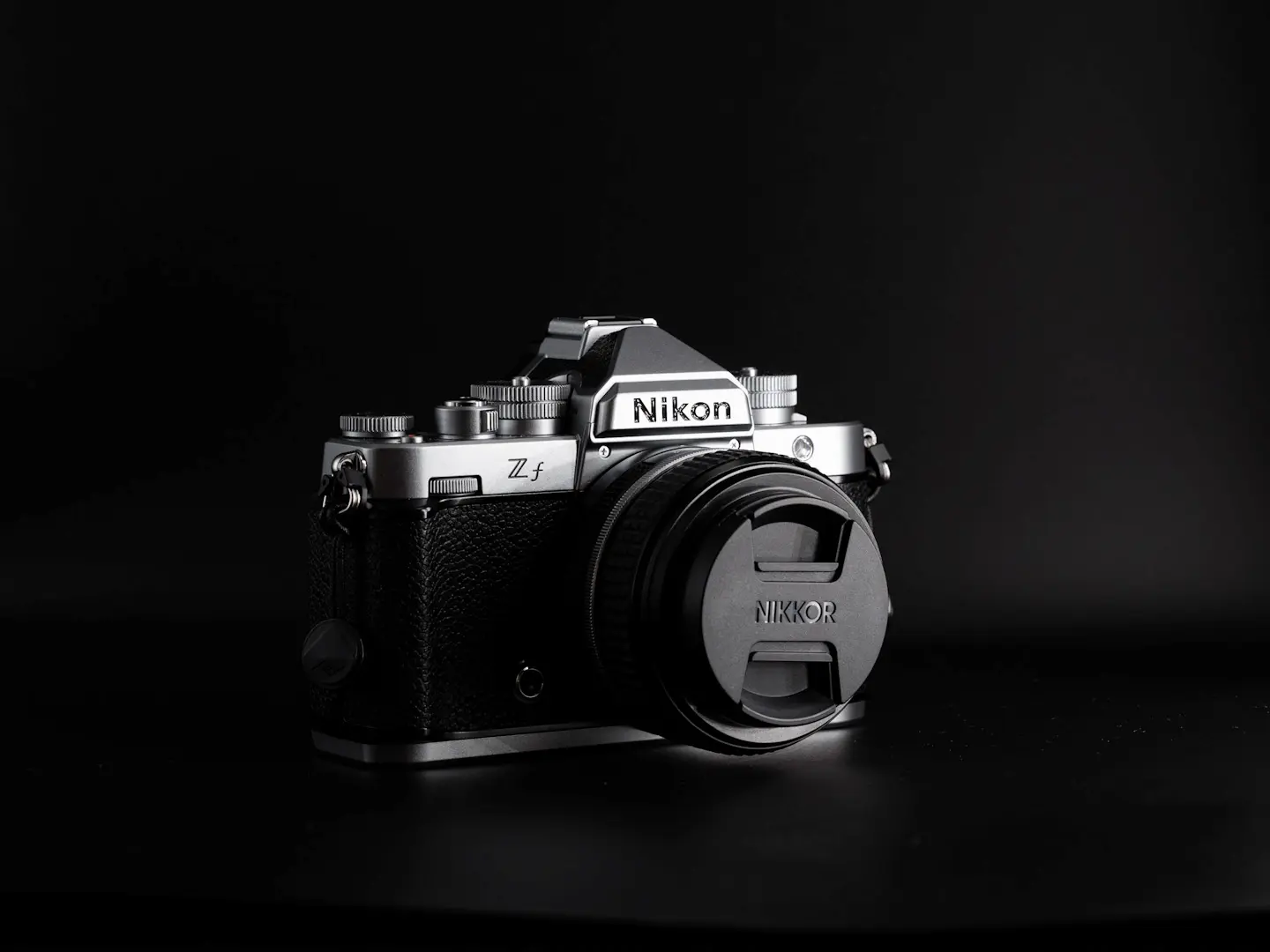
Back around 2014, there was a camera that called to me in a way that very few DSLRs ever did. That camera was the Nikon DF — a full-frame DSLR that seemed to have everything I needed, wrapped in the heart and soul of a bygone era. With its stunning looks and retro dials, I longed for a DF for years, but I was never in a position to buy one.
Fast forward to today, and Nikon has once again released a camera for people who value the experience of shooting — and yes, an appreciation for aesthetics that so many modern cameras simply don’t fulfil. On paper, the Nikon Zf hits all the right marks: a full-frame sensor with excellent image quality, housed in one of the most beautiful camera bodies I’ve ever seen, backed by modern autofocus and features. See my full Nikon Zf review for more detail.
For a broader look at how this camera compares within the system, see my guide to the best Nikon Z camera for photography.
A little over a month ago, I bought the Nikon Zf along with the 40mm f/2 SE to see whether it performs as well as it looks.
And very quickly, I realised something:
The Nikon Zf isn’t just another camera.
It’s a reminder of why people are coming back to Nikon.
The Missing Piece in Nikon’s Lineup

I’ve been a Nikon shooter since the DSLR days, but it’s no secret that Nikon was a little late to the mirrorless party. Sony — and later Canon — got a jump start, and by the time Nikon entered the Z system era, the gap was noticeable.
The first two generations of Nikon Z mirrorless cameras showed real promise, particularly in terms of image quality. But in my opinion, they weren’t quite ready to compete with what Sony and Canon were producing at the time. Autofocus lagged behind, the cameras didn’t feel as fast or as fluid in use, and while they were excellent for landscapes, they weren’t yet convincing all-rounders.
Then everything changed.

The introduction of the Z9 — and later the Z8 — marked a clear turning point. Nikon wasn’t just catching up anymore; they were showing what they could truly do. Today, I genuinely think Nikon has the best all-round camera and lens lineup of any full-frame mirrorless brand. The cameras feel like a continuation of where Nikon left off with the D850 and D750 — confident, capable tools designed for photographers who want performance without compromise.
But even with all of that progress, something was still missing.
The Z9, Z8, and Z6III are among the very best cameras available today in their respective segments, but they’re not what I would call emotional purchases. You buy them because they’re exceptional at what they do: outstanding image quality, superb ergonomics, deep feature sets, and a lens lineup that’s second to none where it really matters. I recently compared the Nikon Zf vs the Z6III.
They’re tools — and I love that about them.
But many Nikon shooters have also felt the pull toward cameras where the shooting experience itself is part of the enjoyment — cameras that slow you down, make you more deliberate, and reconnect you with why you started taking photographs in the first place.
The Nikon Zf promises to be that camera. If you want to get your camera set up quickly then here are the best settings for the Nikon ZF and accessories I use with my Nikon ZF as well as the best lenses for the Zf.
If you’re building out a Nikon Z kit, I’ve put together a full, experience-led guide to the best Nikon Z lenses based on real-world use.
Why the Nikon Zf Matters in 2025

I’m from a generation where the switch to digital was already underway. For professional work, it’s all I’ve ever known. And yet, I’ve always felt the pull of film — that romantic, nostalgic urge to step away from technology and reconnect with photography in a slower, more deliberate way. I’ve shot 35mm, medium format and 4×5 film.
At the same time, I’m also a realist.
The price of film has skyrocketed in recent years, driven largely by its renewed popularity. And here in the Philippines, the practicalities make it even harder: sourcing film reliably, finding a lab I trust, or setting up consistent home development simply isn’t realistic.
For my own personal work, that gap has been filled by Fujifilm and in particular the X-T5 which I compared to the Zf here.
I’ve been shooting Fujifilm on and off for over a decade. Cameras like the X-T and X-Pro lines, along with the X100 series, offer much of the same appeal — physical controls for shutter speed and ISO, aperture rings on the lenses, and bodies that are genuinely pleasurable to use. They scratch that itch for something slower, more intentional, and more meaningful.
And I’ll be honest: they make me feel like an artist, not just someone firing off frames. That matters to me.
The Nikon Zf feels like Nikon’s answer to this exact pull — not just for me, but for many Nikon shooters who quietly do the same thing: using Nikon Z cameras for serious work, while reaching for something else purely for enjoyment.
For a long time, I believed Nikon and Fujifilm together made the perfect combination.
The arrival of the Zf changes that equation.
For the first time, Nikon has a full-frame Z camera that genuinely speaks to that emotional side — one that’s beautiful, enjoyable to use, and still fully compatible with the Z system and lenses many of us already own.
Over the next few weeks, I’ll be putting the Nikon Zf up against my Fujifilm X-T5 to see whether it can truly replace it — and whether it really is the missing piece in the Nikon Z system for photographers who love to shoot, not just need to shoot for work.
Why So Many Photographers Are Switching Back to Nikon Z

In the early days of mirrorless, Nikon simply wasn’t at the same level as the other two brands in the so-called “big three.” Sony, in particular, had pulled ahead — especially when it came to autofocus technology and, early on, lens availability.
At the same time, there was growing pressure on long-time Nikon DSLR shooters to make the jump to mirrorless. Once it became clear that the days of the DSLR were numbered, sticking with older systems stopped feeling realistic. For many of us, the choice wasn’t really between brands we liked — it was about which system could actually deliver what we needed at the time.
For a lot of Nikon shooters, that meant Sony.
Not because we preferred Sony, but because Nikon simply wasn’t offering a mirrorless system that felt ready yet.
Like many others, I’ve shot various Sony cameras over the years. From the original A7R adapted with manual focus lenses, right through to the Sony A7 IV paired with GM glass. I have a huge amount of respect for what Sony has achieved. Their cameras perform extremely well and, on paper, they often lead the industry.
But they’ve never quite worked for me.
If I had a pound for every time I’ve heard the phrase “Sony cameras feel like computers, not cameras,” I’d probably be able to buy a studio full of Phase One bodies by now. And while that might sound harsh, there’s a truth to it. For my own way of shooting, Sony cameras have never felt particularly intuitive or enjoyable. They do the job — often brilliantly — but they don’t make me want to pick them up and head out the door.
That’s where the shift back to Nikon begins.
With the Z9, Z8, and now the Z6III, Nikon has built a mirrorless system that genuinely covers almost everything a professional photographer could want. Image quality, autofocus, ergonomics, build quality, and lens lineup — it’s all right there, and it’s all top-tier.
For all practical purposes, Nikon is now fully back.
But there was still one thing missing.
A camera that wasn’t about work. A camera that wasn’t chosen because it was the most efficient tool for the job. Something more personal. Something beautiful. A camera you’d want to take out with your family at the weekend, or pack for a short trip where you’re not thinking about clients, deliverables, or autofocus tracking modes.
A camera you use purely for the love of photography.
The arrival of the Nikon Zf fills that gap — and that’s why it matters in 2025.
Why I Came Back to the Nikon Zf

Last year, I spent some time at my mum’s house in the UK with Sofia. I had just bought the Nikon Z8, the Z6III, and the Nikon Zf, and I had around two weeks to work out what realistically fit into my bags — and what I could justify keeping.
In reality, I had about seven days to properly live with the Nikon Zf.
Coming from years of using Fujifilm, a few things immediately worked against it. I was used to Fuji’s dial layout, to having aperture rings on most lenses, and to the size and weight of the X-T5. The Zf felt heavier by comparison, and the control layout didn’t feel intuitive to me straight away. I also didn’t yet have the muscle memory for Nikon’s approach to controls in the same way I did with Fuji.
Then there was time pressure.
With a flight looming, I had to make a quick decision — and without the luxury of working through the finer points of the Zf’s handling, I made the call to send it back. At the time, the Z-mount primes that made sense for the Zf also didn’t look as compelling to me on paper as Fujifilm’s lineup. I made the decision with my head, not my heart — something I don’t always do particularly well.
I returned the Zf with a clear sense of regret, and the lingering feeling that I’d been a little too hasty.
Fast forward to 2025, and that feeling hadn’t really gone away.
With a deeper understanding of Nikon’s Z system, more time spent shooting Nikon bodies, and a clearer sense of what I value now compared to even a year ago, I felt the pull to give the Nikon Zf a second bite at the cherry. This time without deadlines. Without flights. Without forcing a decision before the camera had a chance to settle.
I’ll be reviewing the Nikon Zf properly very soon, and comparing it directly to Fujifilm and other Nikon cameras. But after around six weeks with it this time, I can say one thing with confidence:
It’s a much better camera than my rushed first experience allowed me to realise.
I retired in 2009 still using film as I had not a clue about digital. The prices were ridiculous and generally clients did not expect the true costs. I was 60 and could not see any more future for myself in photography when everyone was making a dash for digital. Then a young lady whom I’d helped with her photography degree showed me her Canon 40D and how easy it was to use. I was hooked. In 2010 I purchased a Nikon D5000, as I had been using Nikon FM2’s. The D5000 was science fiction Nd was all I needed now photography was now a hobby. In February 2017 I upgraded to a Nikon D5500 due to it’s higher iso in order to document my new granddaughter in available light. The D5500 was magical. Then July 2017 arrived the Nikon D850. I was instantly smitten. I was madly in love. It could do everything but my beautiful gorgeous wife reasoned the price was ridiculous just for a hobby. Then in November 2018 Nikon made tempting offers and lowered the price. My dealer also gave me a tempting discount I could not refuse. I paired the D850 with my Nikkor 28/300 zoom lens and shoot 99.9 percent of my work with the combination. I purchased a backup D850 and cannot see me needing any other gear. I shoot all forms of documentary, environmental portraits as well as studio, weddings, landscapes, wildlife, macro, there does not seem an end to what it cannot do. I am almost seventy seven so my D850 with the Nikkor 28/300 will see me out. One final note I have no weight issues.
Hi John,
Thanks for your comment. It’s really interesting to read other photographers perspectives. I personally think the D850 is the best DSLR ever made so it does not surprise me at all that you are smitten with yours. I’ve been seriously tempted in recent years to pick up a used one.
All the best
David