
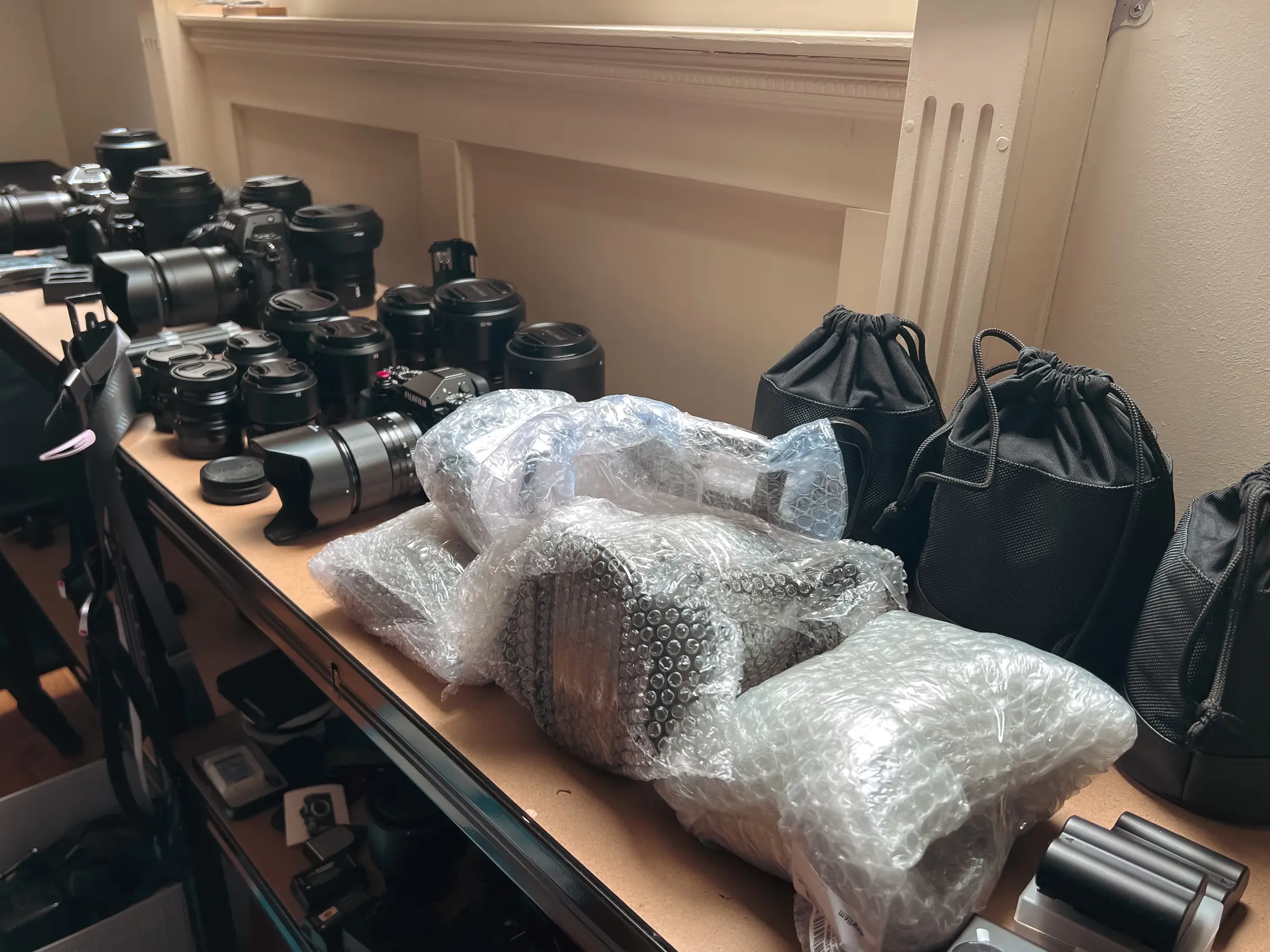
As a photographer of over two decades, I have cycled through more gear than I care to count. I’ve shot and owned virtually every mainstream system, from DSLRs to the latest mirrorless cameras. Two years ago, I was briefly back in the UK, took a look at my gear collection—and that’s truly what it had become—and simply couldn’t justify keeping it all.
At the time, I was living out in the Philippines. It was too hot for my fair-skinned European biology to stand around waiting for the light in that kind of oppressive heat. I was mostly shooting candid street and travel photography, so I decided to simplify my kit down to what actually suited my environment and the work I was actually doing. I longed to shoot landscapes again, to pursue wildlife, but the reality was that in the environment I found myself in, it wasn’t going to happen. As much as I wanted my dreams to justify keeping the gear, the reality was that I had a huge pile of money tied up in equipment that wasn’t being used. I sold everything and settled on a Fujifilm kit.

But those dreams never died, and neither did the itch—GAS returned. In this article, I am going to break down what I think led to this relapse, and how—having simplified once again down to one system, alongside several vital mindset shifts—I plan to make it stick this time.
How I got here…. Again.
I’ll be honest, I feel like somewhat of a hypocrite writing this article having declared two years ago that I’d moved beyond GAS. But hear me out, because I’m going to work through my own thought process and logic and lay everything bare, in the hope that it makes sense and may be useful to other photographers.
Why I had GAS
As a photographer, I see, I envision, I plan shots. That naturally leads me to envision what a new camera or lens can give me. It leads to thoughts such as: If I just had more dynamic range, my shots might be better; maybe a larger sensor will suddenly transform my images; that prime will allow me to create shots I can’t now; that new AF system will help me become a wildlife photographer; or, I simply need another focal length to ensure I can cover subjects X, Y, and Z as I don’t want to be caught short in the moment.
Next is my own personal situation. When I was living in the Philippines, it was difficult—10 years living in a different culture and environment from the one that I grew up in, oppressive heat, poor infrastructure, different cultural norms, and a totally different sense of humor, as well as serious marital issues, led to me feeling quite despondent. I felt trapped by my environment and situation, with no obvious path forward. I clung on to my dreams of returning to landscape photography and pursuing wildlife photography, and buying that gear felt like a step closer to making it happen.
The truth is, I wasn’t really looking for more gear; I was looking for happiness, contentment, and a way to move towards making my dreams a reality, and the gear was a physical manifestation of that pursuit. It gave me hope, it gave me a short-term buzz that the dream was still alive—and then, when I re-started this website in June 2025, it gave me the absolute justification to buy more gear because now it was supposedly for “work” and income.
The website became a viable business and, when our developmental concerns for my youngest daughter Izzy arose last year, it enabled me to move us all to the UK to access the support that we knew she needed.

But here is the truth from a photographer who has owned compact cameras, Micro Four Thirds, APS-C, Full Frame, and Medium Format systems all at the same time: not one piece of equipment changed my photography in any meaningful way.
Yes, medium format rendering was nice. Yes, the portability and computational tricks of my OM System cameras were nice to have. Yes, those incredible Fuji prime lenses and tactile dials felt wonderful to use, and yes, the AF of the Nikon Z system meant I had a fighting chance of capturing wildlife shots. But beyond my own way of seeing, beyond the basic kit of what I actually needed, the gear simply acted to cloud my vision and purpose.
Every single camera system I owned was capable of doing what I needed and producing professional-quality work if the person behind the camera was good enough. I realized that everything about buying new gear was an excuse. An excuse for me not to perform, not to chase my real dream, an excuse for my failures in life and in photography.
There are, of course, certain items that you need. If you are genuinely shooting wildlife, a good AF system is essential. If you are shooting landscapes, decent focal length coverage is needed. But when you take a look at what you shoot—and as your photography, style, and vision mature—you come to realize that you tend to shoot in a particular way and that it actually takes very little gear to achieve. Now, I’m not saying gear isn’t needed; I can hardly talk when I mainly shoot landscapes and family photography these days and have kept my Nikon Z8 because it also allows me to pursue wildlife photography. But I have sold off every other camera system by looking at what it is I actually want to shoot, what I realistically have the capacity to shoot given my location, available time, and skill level, and what I intend to do with the final images, and chosen the system that best meets my needs.
See how I’m using my gear and how simplifying my kit is working out.
So what brought on my desire to downsize?
As those of you who have read previous articles here know, several factors have brought all this to a head for me. The financial constraints of chasing this gear treadmill led to me questioning the very viability of the business model I was pursuing. Buying in camera gear to review is expensive; I don’t get freebies from brands—nor do I want them—but we are talking about spending thousands of dollars per year just to keep up with the tech cycle. Secondly, AI is, in my opinion, starting to answer the basic questions that people are often looking for when searching for reviews of a particular piece of gear. That is only going to continue, which eats into the traffic available to independent photographers like me. In turn, I’d be fighting for an ever-smaller piece of the pie, so it’s not a viable long-term strategy, although still a profitable one in the short to medium term.
But more importantly than that, the recent upheaval in my personal life, with Izzy heading back to the Philippines, has had me questioning everything. Do I really want to go out and shoot for reviews? Is this what I actually want to do? Does it give me contentment? Does it encourage me to photograph in the way I want? Is it even a creative life when I’m tied into search algorithms, brand marketing, and feeding the consumerist machine that I naturally feel inclined in every other aspect of my life to rail against?
I think you can guess what answer I found when doing a lot of soul searching lately.
So how do you also jump off that GAS treadmill?
It’s not easy to do with the pressures of being a photographer, whether amateur or professional. Social media puts gear in front of us more than ever, often more than the photography itself. We are constantly fed a narrative that in order to compete, we have to keep up, buy the latest gear, or we are fed the fear that we are missing out if we don’t have that f/1.2 prime or the latest face-tracking autofocus.

The truth is that every camera in the mid-to-pro-level space since my Canon 5D Mark II is good enough to produce images that will meet all but the most stringent professional image quality requirements—and if you are subject to those, you likely already know exactly what gear you need. Certainly, every mirrorless camera in the last two to three generations is already good enough for general photography in terms of autofocus. Almost all mirrorless lenses produced in the last five years are more than sharp enough to print 30×20-inch prints of exceptional quality, and are beyond anything you would ever need for social media or your own marketing.
So the question becomes more personal than is this camera or lens good enough? For general photography in 2026, they almost all are, from midrange Micro Four Thirds cameras all the way through to Fuji GFX medium format. The question becomes:
- What type of photography do I want to do?
- How much am I prepared to spend in order to do it?
- What is the end goal of the photos that I am going to create?
- What compromises am I willing to accept in selecting the right gear for me?
If you can answer those questions honestly, then all the noise surrounding the latest and greatest iteration of the Sony A7 Mark One Million becomes irrelevant, because you will have selected a camera that covers your actual needs. Any future upgrade really becomes optional—a nice-to-have, not a need-to-have.
As a more mature photographer—in age, at least—I think that most photographers, given disposable income, go through a phase of buying gear. But if you look at many established, high-level photographers, you will notice a trend. They are not chasing gear. They are not hoarding gear. They don’t carry a huge bag full of every single lens possible. They use one or two camera bodies and a small selection of lenses that do everything they need and fit their style. They cannot be marketed to because they have passed the stage of having imposter syndrome; they are established, and have a vision and a way of working that gives them the confidence not to chase validation through owning the latest equipment. They simply don’t need it.
And so someone like myself can learn a lot by simply watching established photographers whom I respect, focusing on vision, goals, and purpose, and actually spending my time where my passion lies: taking photos with what I have. Accepting certain compromises and limitations means understanding that I can have all the gear in the world, but without the work ethic, practice, vision, and passion, it would just be another ornament on my shelf, gathering dust.
To be clear, this article isn’t a blanket condemnation of buying things. There are plenty of photographers who need specialized gear—a particular tilt-shift lens, demanding autofocus requirements, or a strict level of file output—due to their commercial demands. That’s a completely different story; those are genuine needs dictated by professional requirements.
There are also hobbyists who simply enjoy gear as an extension of the craft, or who shoot a wide variety of subjects and prefer dedicated tools for each job, and who have the financial means to do so. I see no problem with that if it genuinely brings you joy. It’s no different from someone buying a sports car when they already have a practical car for the week, or just about any other hobbyist indulgence.
What I’m discussing here is something entirely different: buying gear because it masks a deeper creative or personal issue, or buckling under the marketing pressure to constantly upgrade, improve, or expand your kit not out of functional necessity, but out of an inherent, anxious pressure to compete, keep up, or validate your worth as a creator.
Why did I pick up a camera in the first place? It was to record moments and freeze them in time, to be able to wonder at the majesty of the world beyond seeing it with my own eyes. And now, as I enter my third decade of photography, I see it as my way of asking questions and trying to make sense of the world.
I don’t need more gear to do that. I need more time, to look deeper, to ask more meaningful questions, and to improve the way in which I use the gear to translate those answers into my photos. That’s what all my projects revolve around.
The truth is, I don’t have all the answers—this is just my experience. I don’t know what the future will bring. There are so many things I don’t know: I don’t know when I’ll see my youngest daughter again, and I don’t know if I can build the life to bring her back. I don’t know if I can successfully chase this dream, and I certainly don’t know if it will pay the bills.
But I do know that if I don’t follow my passion, if I don’t try, then I will always be left wondering what creative life I could have had—and what life I could have given her.