
Last updated January 12th 2026:
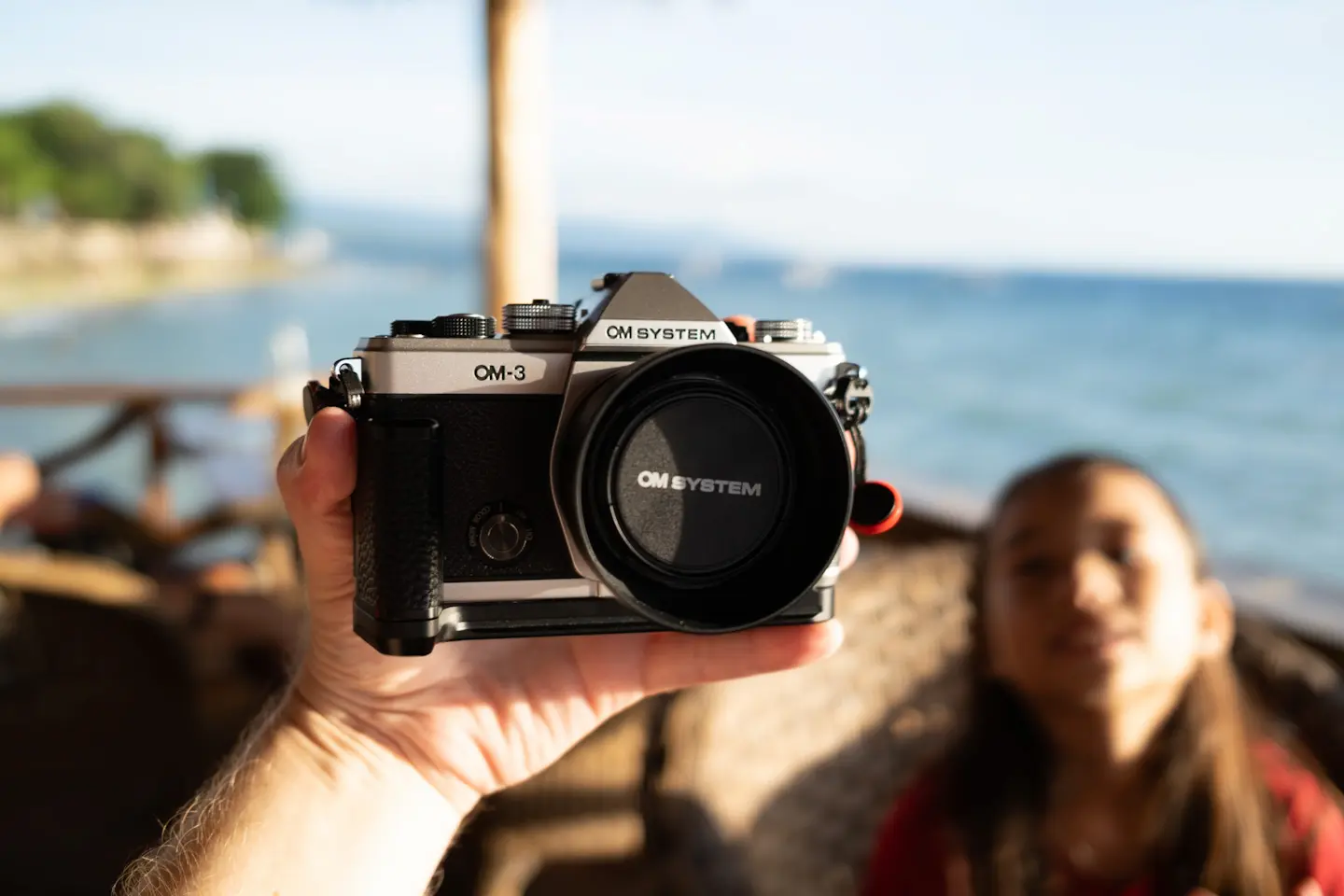
This article is based on real-world testing. I’ve used the Fujifilm X100VI since its release, and the OM System OM-3 was tested extensively throughout August — including on my latest trip to Moalboal in the Philippines.
I know some people will say “why compare a fixed-lens camera to an interchangeable-lens body?” I heard the same thing years ago when I compared the Olympus Pen F with the Fujifilm X100T. And yes, on paper they’re not direct competitors.
But in practice, they share a lot: both are beautifully designed, retro-styled cameras. Both are small, lightweight, and perfect for anyone who wants something better than a phone without carrying a full-frame kit. For travel, family, or everyday shooting, that makes them natural alternatives. If you want my thoughts after shooting another year with the Fuji X100VI I wrote an article on my experience.
I use my Fujifilm X100VI constantly — it’s one of my most-used cameras. But when I saw the OM System OM-3 with its compact design and the option to pair it with the updated 17mm f/1.8 II, my curiosity got the better of me. Could the OM-3 replicate the way I use the X100VI when paired with the OM Systems 17mm f/1. II lens — while also offering the flexibility of a fully featured interchangeable-lens system when I needed it and, is Micro Four Thirds still a viable system in 2025. I added a few essential accessories to the OM-3 just as I did to my X100VI.
I’ve been shooting with both Fujifilm and Olympus/OM System cameras for over a decade, dating back to the original OM-D E-M5 and Fuji X-Pro1. I know both systems inside out, and I genuinely like them for different reasons. In this article, I’ll walk you through how each performs as a travel, family, and everyday camera — and ultimately, help you decide which one fits your style best.
TL;DR — OM System OM-3 vs Fujifilm X100VI
Although one is a fixed-lens camera and the other uses interchangeable lenses, the OM System OM-3 and Fujifilm X100VI often appeal to the same type of photographer: someone who wants a compact, high-quality camera for travel, family, and everyday photography.
The OM-3 is the more capable and flexible camera. It offers faster and more reliable autofocus for moving subjects, excellent weather sealing, interchangeable lenses, and powerful computational features such as Live ND, Live Composite, and high-resolution modes that allow you to leave filters and tripods behind.
The X100VI delivers a more focused and immersive shooting experience. Its leaf shutter, built-in ND filter, hybrid viewfinder, discreet design, and superb film simulations make it a joy to use for street, travel, and everyday photography with minimal setup.
If you value flexibility, speed, and adaptability — especially for photographing children or shooting in bad weather — the OM-3 is the stronger all-round tool. If you want simplicity, character, and beautiful results straight out of camera in a truly self-contained package, the X100VI remains hard to beat.
Who Is This Comparison For?
This comparison is for photographers who want a high-quality, compact camera for travel, family, and everyday photography — and are deciding between a beautifully designed fixed-lens camera and a small interchangeable-lens system.
It’s especially relevant if you’re looking to move beyond smartphone photography but don’t want the size, weight, or complexity of a full-frame system. If you value portability, image quality, and an enjoyable shooting experience, both of these cameras make sense — just in very different ways.
You’ll get the most from this comparison if you’re weighing up simplicity and character against flexibility and capability. The X100VI appeals to those who enjoy an immersive, all-in-one camera with a distinct shooting experience, while the OM-3 suits photographers who want room to grow, faster autofocus, and the option to change lenses as their needs evolve.
If you already know you want a full-frame camera, heavy telephoto lenses, or a purely video-focused setup, this comparison is less relevant. But for compact, high-quality stills photography, these two cameras sit in a very similar real-world space.
| Feature / Spec | OM System OM-3 | Fujifilm X100VI |
|---|---|---|
| Sensor | 20.4 MP Stacked BSI Live MOS (MFT) | 40.2 MP APS-C X-Trans CMOS 5 HR |
| Processor | TruePic X | X-Processor 5 |
| IBIS (Stabilisation) | Up to 7.5 EV with Sync-IS lenses | Up to 6 EV |
| AF System | Quad-Pixel Phase-Detection, 1,053 pts | Hybrid AF with subject recognition |
| Continuous Shooting | 120 fps (S-AF); 50 fps (C-AF) | 11 fps |
| Viewfinder | 2.36 M-dot OLED EVF | Hybrid OVF/EVF, 3.69 M-dot EVF |
| Screen | 3.0” 1.62 M-dot fully articulating | 3.0” 1.62 M-dot tilting |
| Features | High-res up to 80 MP, Live Bulb/Composite, ND & grad filters | Leaf shutter, built-in 4-stop ND filter, Built-in flash |
| Video | 4K UHD @ 60 fps, 240 fps FHD | 6.2K @ 30 fps, 4K @ 60 fps, 10-bit 4:2:2, F-Log2 |
| Weather Sealing | IP53 dust & splash resistant | Weather-sealed with additional filter ring adapter and filter |
| Weight | ~496 g (body + battery) | ~521 g (body + battery) |
Design & Styling


Seeing as both of these cameras are — in the camera world at least, and in my eyes too — beautiful designs, which one do I actually prefer? Bear in mind this is, of course, subjective.
There’s no doubt that if you sit the X100VI and OM-3 next to each other, the OM-3 stands out as the more beautiful camera, with its silver finish (I have the black X100VI). I asked my family and a few strangers, and every single one picked the OM-3 as the better-looking model.
However, I don’t think it’s that simple. For me, both are elegant designs. The OM-3 is more overtly pretty, with its retro styling, silver finish, and color wheel reminiscent of old Olympus film cameras. The finish is absolutely first-rate. It has its SLR-style EVF in the middle of the camera, complete with the traditional viewfinder hump.
The Fujifilm X100VI is also a very nice-looking camera but goes with the rangefinder styling, with the viewfinder sitting inside the main camera body, off to the left. Some may prefer one over the other. For me, being left-eye dominant but able to shoot with either eye, it makes little difference. However, the viewfinder on the X100VI is 3.69 million dots versus 2.36 million on the OM-3. In reality, switching back and forth between the two, there are differences, but they’re marginal and not a deal breaker either way. What may be a deal breaker for some is that the X100VI also offers an optical viewfinder thanks to its hybrid design. I use the EVF 99% of the time so it’s not a deciding factor for me.
I definitely appreciate the beauty of the OM-3, but I’m quite drawn to the more subtle design of the X100VI. I guess as a slightly introverted person, the X100VI in black suits me well. I can’t call a winner here, as both look incredible.
If you’re already considering picking one up, here are the latest prices:
Affiliate disclosure: If you use these links, I may earn a small commission at no extra cost to you. As an Amazon Associate I earn from qualifying purchases.

The thing that struck me with the OM-3 is the quality of the controls and dials. Every dial turns with exactly the right amount of resistance to feel solid and purposeful, yet not so much so that it’s difficult to operate. All the buttons are raised just enough to find them when operating the camera without having to look. The shutter button feels perfect, with just the right amount of pressure needed for a half-press to focus and then a full press to take the photo.
The only minor negatives for me would be the on/off switch being on the left-hand side of the body (Olympus and OM Systems have always done this, and I still don’t know why), and the record button on top of the camera being tiny and awkward to find. No problem for us stills shooters, except I’ve re-programmed mine to turn eye AF on and off. The front color wheel dial is also a little stiff to turn, which means that for me, it’s a two-finger job. Rather than being able to quickly change it with my right hand while holding the camera, I have to do so with my left hand reaching around the body.
I also noticed that the camera strap attachment point is slightly in the way when I’m gripping the camera, although after a bit of messing around I found a position where it now sits comfortably between my index and middle fingers. There is a small thumb rest at the back of the body which helps with grip during longer shooting sessions, and the front is covered in a faux-leatherette material that gives a little purchase. Overall, considering there is very little to grip on to with the OM-3, it is surprisingly decent to hold — though it definitely benefits from an L-Grip being added.
Build quality, as I mentioned, looks to be top notch, with weather sealing that I would — and have — trusted in the worst the monsoon season can throw at me here in the Philippines. I’ve shot the EM1 Mark II and others from Olympus/OM in torrential rain here with them slung over my shoulder, and they haven’t so much as blinked. The OM-3, with its IPX53 rating, is better sealed than earlier Olympus models, so I have no worries in this regard.
Overall, I’m really pleased with the build quality of the OM-3. It feels like a tool, not a toy, and that’s important to me. In the hand it feels wider and slimmer than my X100VI, and very similar in weight when the 17mm f/1.8 II lens is attached.

The X100VI feels equally well built but takes a more minimalist approach. The rear of the camera looks more sparsely populated with buttons, even though it offers a joystick (not found on the OM-3). It also, of course, offers real dials for shutter speed and ISO, as well as an aperture ring on its lens, whereas the OM-3 uses the standard PASM dials for dialling in exposure settings. PASM is quicker in use, but Fuji’s dials offer a more fun experience.
The OM-3 offers a decent rear LCD screen which is fully articulating. One of the benefits of this is that it’s fully protected when closed. The X100VI’s screen is beautifully designed and sits flush with the body, yet offers a simple tilt up/down mechanism. The Fuji’s is better for shooting discreetly, the OM-3’s is more flexible.


Overall, design and handling is quite different between the two. Although the OM-3 looks just as retro as the Fuji, it is suited to faster-paced shooting — as we’ll also see later on. When I first picked up the OM-3, my initial instinct was that the X100VI is more comfortable and felt more natural in my hand. However, as I shot the OM-3 more and more in Moalboal, here in Cebu, I really started to like it. It’s still not quite as comfortable as the X100VI, which feels softer and more rounded. However, add an L-grip to them both and they start to feel very similar. I wrote a detailed article on the best accessories to add to your Fuji X100VI here.
Overall, I’d say the Fuji gives the experience of a retro camera with its looks and physical control dials, whereas the OM-3 simply gives the appearance of one.
Features & Image Quality


In my opinion, both Fujifilm and OM System have always produced some of the best SOOC JPEGs in the industry — but they go about it in very different ways.
Fujifilm leans into its film simulations, which offer a fantastic array of looks, many of them with a nostalgic vibe. There’s likely a film simulation to suit all tastes. Personally, I shoot in Classic Chrome most of the time. If you want to get your X100VI quickly set up for shooting then download my free setup guide as well as downloadable settings file to load straight on to your camera. It includes AF setup as well as custom functions and Fuji film recipes already added.


The OM-3 also produces great JPEGs, but they’re less about nostalgia and muted tones and more about vibrant, realistic colors. If you want things right in-camera and want lots of immediate choices, normally I’d say go Fuji. However, the OM-3’s color wheel gives you a huge amount of freedom to create your own looks if you’re willing to put in the time. It has a novel way of allowing you to do this through its color wheel for both color and monochrome profiles.
It’s the old Pen F vs X100 argument again: do you want Fujifilm’s immediately accessible film simulations (plus custom recipes widely shared online), or do you prefer the freedom of OM System’s more intuitive, Lightroom-style color wheel where you can see adjustments live in the viewfinder as you shoot?
High ISO Performance
APS-C vs Micro Four Thirds isn’t a huge gap these days, but yes — the X100VI performs slightly better once you get up to ISO 6400. It’s not just that there’s less noise; the Fuji’s noise pattern is more uniform and therefore more pleasing to the eye. The difference is small, around 1/3 to 1/2 a stop.
Personally, I like having Fujifilm film simulations available as Lightroom profiles for RAW files, but at the end of the day, they’re just color profiles. I can get results I like out of both cameras.
Lenses and Rendering
Comparing the Fuji’s fixed 23mm f/2 to the OM System 17mm f/1.8 II, both are sharp, but the Fuji is better corrected for chromatic aberrations. I’ve noticed more purple and green fringing with the 17mm f/1.8 II. That said, the OM-3 lets you switch lenses — and when I paired it with the 25mm f/1.2 Pro, the results surpassed the Fuji lens, though at the cost of size and weight.
Black & White Profiles

Fujifilm is rightly known for its beautiful Acros profile, one of my favorites for rich black and white with excellent tonality. The OM-3 also has fantastic black and white options via the color wheel, with three profiles as standard. Profile 2 is meant to replicate Tri-X, but I find it a bit too contrasty, so I’ve tweaked it and am still settling on my preferred look.

Computational Features vs Classic Tools
Where the OM-3 really shines compared to the X100VI is in features. It offers Live View, Live Bulb, and Live Composite, which make long exposure photography incredibly easy by giving you live feedback as the exposure builds. It also offers both tripod-based (80MP) and handheld (50MP) high-resolution modes. These not only increase detail but also reduce noise at higher ISOs while improving color fidelity. They don’t come without some issues though, for instance I have found that handheld high-res mode’s benefits in terms of detail are inconsistent.

On top of that, the OM-3 includes software-based ND and graduated ND filters. In my testing, they often do a great job of replicating long exposures and balancing high dynamic range scenes without bracketing. There are caveats (which I’ll cover in my full review), but overall, they’re impressive.

The Fujifilm X100VI doesn’t have these computational features, but it does have tricks the OM-3 can’t match. Its leaf shutter allows for extremely fast flash sync speeds, and when combined with the built-in flash, it makes fill flash in bright daylight easy. It also has a built-in four-stop physical ND filter that lets you shoot shallow depth-of-field portraits in bright light — something the OM-3’s software-based ND can’t replicate.
Autofocus
Now let me start this section by saying that, while the X100VI is not the fastest focusing camera in the world, for single shot, everyday photography I have found it to be perfectly fine. It’s way faster than the Ricoh GRIII for example. However, the difference between it and the OM-3 when trying to capture faster action is pretty significant. I attempted shots of Sofia running towards me on the beach that I honestly wouldn’t even attempt (and didn’t) with the X100VI. Out of several series of over 50 shots that I took, only a couple were out of focus. I repeated this test twice and the results were always the same. So if capturing your children speeding around while on vacation is important to you, then there is only one option here that I could hand on heart say will do the job. The OM-3 is significantly better in these kinds of scenarios.

Some links are affiliate links. If you buy through them, I may earn a small commission at no extra cost to you.
Who Should Buy Which?
Both of these cameras are excellent — but they suit very different shooting styles. This is the simplest way I’d choose between them.
Choose the OM System OM-3 if…
- You want flexibility from interchangeable lenses and advanced features.
- You often photograph children, movement, or fast-paced scenes.
- You value strong weather sealing and reliability in poor conditions.
- You like leaving tripods and filters at home (Live ND, Live Composite, HHHR).
- You want one compact camera that can adapt to many different scenarios.
Choose the Fujifilm X100VI if…
- You want a simple, immersive, all-in-one shooting experience.
- You love Fujifilm’s film simulations and strong SOOC JPEGs.
- You regularly use fill flash, a leaf shutter, or the built-in ND filter.
- You prefer discreet street and travel shooting with minimal setup.
- You want a camera that encourages you to slow down and just enjoy photography.
Overall
Both cameras are fantastic tools. The OM-3 is more flexible, not just because of interchangeable lenses, but because its features let you leave your tripod and filters at home while still being able to shoot handheld 50MP high-resolution images. I’d trust its weather sealing above the X100VI’s, too. If you want flexibility, adaptability, and a camera that can cover an incredible range of shooting scenarios, the OM-3 is a superb choice — especially for Micro Four Thirds shooters who want a compact but versatile system.
The Fujifilm X100VI doesn’t have as many bells and whistles, and its AF performance isn’t as quick, but what it offers can’t quite be replicated by the OM-3. That’s the genuinely immersive shooting experience: the leaf shutter, built-in ND filter, rangefinder styling, simplicity, discretion (especially in black), and those superb film simulations. If you want beautiful results straight out of camera without having to tweak much, the X100VI delivers.
Frequently Asked Questions
Is the OM System OM-3 better than the Fujifilm X100VI?
The OM-3 is more versatile thanks to interchangeable lenses, faster autofocus, and advanced computational tools like Live ND and high-res modes. The X100VI focuses on simplicity and the shooting experience, with its leaf shutter, built-in ND filter, and Fuji’s film simulations.
Which is better for travel photography?
Both are excellent. The X100VI wins for compactness and all-in-one shooting, while the OM-3 offers more flexibility if you want multiple lenses and weather-sealed durability for unpredictable conditions.
Can the OM-3 match Fuji’s film simulations?
Not directly, but the OM-3’s color wheel lets you create custom looks in-camera. Fuji’s Classic Chrome and Acros remain unique, but OM’s color control is surprisingly flexible once dialed in.
Is the X100VI good for photographing children or fast action?
It can handle everyday movement, but the OM-3’s autofocus system is faster and more reliable for bursts or tracking subjects like kids running or sports.
Olympus puts the power switch on the left basically because famed camera designer Yoshihisa Maitani chose that for his original Olympus OM-1 in 1972. The modern “SLR” look Olympus/OM System cameras are all riffing on the Maitani look. Even the Pen-F puts it on the left, in its case a very functional knob that looks like the rewind knob on a classic 1940s vintage Leica or Canon. I started with the OM-1 in 1974 and own a bunch of Olympus/OM cameras including the Pen-F but no OM-3.
Hi David,
Thanks for the insight. It’s only a minor thing really, I just prefer it on the right, preferably how Nikon (or Fuji) does it with a switch around the shutter button. I remember the Pen F fondly. I looked at getting another but the used prices were pretty steep when I checked last year. Do you own any of the more recent OM cameras?
All the best
David
Hi, I bought om-3 quite recently and I like camera,.especially paired with the pancake pens (or almost pancakes like lumix 12-32mm). I was a bit surprised by the autofocus part of your review – you mentioned that om-3 is far better for shooting action than X100VI. I have never owned Fuji, but I own sony a6600 and for shooting anything which moves ( and has eyes 🙂 ) I prefer to use sony camera, which still has better autofocus than om-3. To sum up- I have never realized the autofocus weakness of fuji.
Hi Ivan, Sony is very good at AF, if your A6600 is anywhere near the A7IV then it’s a step up from the competition at the moment. This comparison was specificallly about the X100VI, some of the Fuji lenses on different bodies are faster to focus.
When i had Olympus bodies I reprogrammed on/off to the rear AF switch. That worked really well.
Hi Chris,
I’ve done that on previous bodies but recently I prefer using that switch to quickly change between af modes.
David
I suggest a comparison with the Fuji X-T5 would be more appropriate. It’s also an ILC, and in South Africa where I live, it is about 2/3 the price. Not to mention a bigger sensor, etc.
Hi Keb,
That comparison is coming in the future.
David
Should’ve compared it to an X-T5 (which is basically the Fujifilm equivalent of the OM-3)
The only thing is that the X-T5 is slightly bigger but you could’ve just taken that into account in the comparison
I’ll be doing that comparison soon. It’s a bit more detailed so will take a little longer to post.
Great insight into two amazing cameras which makes my decision the non easier. I’ve used previous olympus cameras and the choice and size of lenses is unmatched. Both cameras seem to deliver everything I would need and im leaning more towards the fuji. Perhaps if OM system had released a new pen f then it would be a simple choice.
Hi Gary,
Sorry for making your decision harder.
Both are very good, I’m sure you wouldn’t be disappointed with either. If you can get hands on that might sway you one way or another.
All the best
David
Hi David
I have tried to download your settings for the Fujifilm X100vi. I get a message saying “Success” but when I check my email, there is nothing. I have tried numerous times.
Hi John,
Thanks for getting in touch. In the email there is a link that you have to click which will take you to the download page for the settings files. However, I shall put it here for you too. Click on this link and then on the page it takes you to, scroll down and then click on the box that says download X-T5 and X100Vi setup files. The files will then dowload and you can select the X100VI settings file to load on to your X100VI. There is also a readme file which gives instructions on how to do put the files on to your camera as well as an ebook.
All the best
David
Thanks David! That worked. I’ve found the Fuji menu system just as convoluted as the previous generation of Olympus menus. I’m looking forward to trying out your settings!
Hi John,
That’s great that you got it all working. This is exactly why I made these settings files available. As someone who uses different brands and of course, their menus, having a decent starting point saves so much time.
Enjoy your X100VI.
All the best
David
Hi David,
Great comments and many thanks for your input.
Have a question. I do have GFX100RF and XT5 with some prime lenses but with no telephoto lens. I live in The Hague. I love my setup but I want to carry a snappy Ricoh GRIIIX or IV-monochrome like camera to complement as a second camera for random street and portraits, thou Ricoh is unfortunately too fragile for my surroundings. Do you suggest OM-3 with 17mm f/1.8, 25mm f/1.8, 45mm f/1.8 as an option? Or would be a duplication for someone who has an XT5? Basically I need a weather sealed Ricoh but couldn’t find anything in the market. Many thanks in advance. Kaan
Hi Kaan,
Thanks for your comment — that’s a good question and one a lot of people run into.
If I’m being honest, the OM-3 would mostly duplicate what your X-T5 can already do. With Fuji’s smaller f/2 primes (23mm, 35mm, 50mm), the X-T5 already covers that same space in terms of size, image quality and usability. The OM-3 is a bit smaller, but not enough that it really becomes a different type of camera in practice for your intended shooting.
The real problem — which you’ve already identified — is that there simply isn’t a weather-sealed Ricoh-style camera on the market. Nothing truly pocketable with a fixed lens and proper sealing exists right now.
The closest alternative to a Ricoh GR III/IV is actually the X100VI.
It isn’t pocketable in the same way, but it is:
weather-sealed (with filter adapter)
genuinely small and light
excellent for street and environmental portraits
In real use, the X100VI fills the “always with me” role far better than a second interchangeable-lens body like the OM-3. It’s the camera I use as my own EDC.
So if your goal is a second camera that complements the GFX and X-T5, rather than duplicating them, I’d personally look at the X100VI before adding another system.
If you already have one, then honestly I’d say you’re already covered — and at that point it becomes more about simplifying what you carry rather than adding more gear.
Hope that helps,
David
Very helpful real life comparison. I ended up with the OM3, which I’m really enjoying, but keep wondering what the other side of the fence would be like. The colour settings you’ve used on the OM3 are great. Have you shared your settings anywhere? I haven’t found the right combination yet.
Hi Drew,
Thanks for your comment. It’s always tempting to see what else is out there. Both the OM-3 and the X100VI are excellent cameras but definitely excell at different things. I’ve just been out to the same location today with the OM-3 as I visited on Wednesday with the X100VI. Same conditions too. I ended up playing around with the ND filter on the OM-3’s computational modes and got some shots I simply couldn’t have with any camera but the OM-3/OM-1/OM1 II. I haven’t shared my settings yet as I haven’t fully dialled them in but expect to do so over the coming weeks now that I’m in Scotland and will be shooting more regularly again. I will post an article here once I’m fully happy with them.
All the best
David