

As someone who shoots travel, landscape, and street photography, by far my most treasured photos are of my daughters, Sofia and Isabelle. Sofia is 9. Isabelle is 18 months. They’re growing up at a pace that genuinely catches me off guard, and one of my main motivations for photography now is simple: to hold on to these fleeting moments and have something meaningful to look back on when I’m old and grey (which, realistically, probably isn’t all that far away).
I’m sharing that because it matters. The purpose of this article isn’t to impress anyone with specs or keep up with camera trends — it’s to remove the noise and simplify things down to what actually works for family photography.
- Nikon Zf: My top recommendation overall. The best balance of image quality, autofocus reliability, lens choice, and a design that doesn’t intimidate kids.
- OM System OM-3: The best smaller, lighter alternative. Excellent autofocus, huge lens flexibility, and easy to live with day to day.
- Fujifilm X-T5: A beautiful camera with lovely colour and a more considered shooting experience, but requires more familiarity with its autofocus system.
This list isn’t about the most powerful or impressive cameras. It’s about the ones that make it easiest to capture genuine family moments with the fewest missed shots — without turning photography into a chore.
This article is for parents who want better photos of their children without turning photography into a job. If you care more about capturing real moments than learning camera theory, want something that works reliably in everyday light, and don’t want your camera to change the dynamic with your kids, you’re in the right place.
If you enjoy tweaking settings, chasing perfect sharpness, or treating family photography as a technical challenge, some of the cameras here may feel understated — and that’s intentional.

One of the first things I’ve learned from photographing my own kids is that big, bulky, top-of-the-line mirrorless cameras — like the Nikon Z8 — are often the worst possible tools for family life. Kids don’t welcome having something large and intimidating pointed at them all the time. It changes the atmosphere instantly. Everything starts to feel too professional, too cold, and you end up with the kind of family photos we’ve all seen before: children lined up, forced smiles, being told to “look at the camera.”
Those aren’t the photos I want to look back on.
For me, any camera I use for family photography has to meet a few non-negotiable criteria. It needs to be unintimidating — even better if it looks stylish rather than serious. It needs to be small enough that I’ll actually bring it with me. The image quality has to be good enough to print from. And the autofocus has to keep up with a 9-year-old and a 1-year-old who have absolutely no interest in dad directing them.

That last point matters more than people realise. The best family photos, in my experience, are candid — genuine moments unfolding naturally, not anything staged or choreographed.
I shoot with a lot of different cameras, across multiple systems, but there are only three that make this list, and that’s for very good reason. These are the cameras I actually reach for when photographing my own children — and I’ll explain exactly why below.
Some of the links in this article are affiliate links. If you choose to buy through them, I may earn a small commission at no extra cost to you. I only recommend cameras and gear that I’ve personally owned and used.
Nikon Zf — The Best Camera for Family Photography Overall

If I had to recommend one camera for capturing family moments, the Nikon Zf would be it.
The Nikon Zf offers the best overall combination of image quality, autofocus reliability, lens choice, and design for family photography. Being full-frame, the image quality is excellent — particularly in lower light — and that matters when you’re shooting indoors, in winter, or during those quiet moments in the evening when life actually happens. In practice, the Zf consistently produces good-looking images in lighting conditions where other cameras start to struggle.

The Nikon Zf uses physical control dials for shutter speed and ISO, along with an exposure compensation dial, which makes the experience of shooting it genuinely enjoyable. At the same time, you’re not locked into that way of working — you can switch to full auto, aperture priority, or other modes and concentrate only on the controls you actually want to adjust. It also features a dedicated black-and-white switch, making it easy to move seamlessly into monochrome when the moment suits. It’s a small detail, but in practice it’s a lovely way to capture more stripped-back, timeless photos of your family without breaking your flow.
Where the Zf really stands apart for family photography is autofocus. It’s fast, reliable, and confident in a way that lets you stop thinking about it altogether. When you’re chasing a 9-year-old and a 1-year-old who have no interest in cooperating, that reliability is everything. Missed moments aren’t something you get back. I wrote an article on my Nikon ZF settings which shows exactly how I set up the camera.
Lens choice is another huge strength. Nikon’s Z-mount lineup is excellent, and it includes genuinely lightweight, purpose-designed lenses that suit family photography perfectly — the 40mm f/2 SE being a great example. You get high image quality without ending up with a camera that feels oversized or clinical.
Nikon Z also offers some excellent zoom options that stay relatively compact, such as the NIKKOR Z 24-70mm f/4 S, which works extremely well for family photography. And if you like those softer, more “dreamy” looking portraits with the background gently melting away, the full-frame sensor in the Nikon Zf makes that easier to achieve than with the other cameras on this list.
Just as importantly, the Zf doesn’t feel intimidating. It’s beautifully built, looks stylish rather than professional, and doesn’t create that uncomfortable “dad turning into a photographer” atmosphere. I shot our entire Christmas Day with it, and it never felt like a barrier between me and my kids — which, for me, is the ultimate test. It does benefit from a few key accessories to make the shooting experience even better.
Who it’s for: Parents who want the most reliable results with the fewest missed moments. If you value fast, dependable autofocus, excellent image quality in all kinds of light, and a camera that feels enjoyable rather than intimidating, the Zf is the easiest recommendation here.
Nikon Zf
My top recommendation for family photography overall — combining reliable autofocus, excellent image quality in all kinds of light, and a design that doesn’t intimidate children.
Check latest pricesOM System OM-3 — The Best Smaller, Lighter Alternative

If the Nikon Zf is the best all-rounder, the OM-3 is the camera I’m most likely to grab simply because it’s so easy to live with. You can read my full OM-3 review here.
It’s smaller and lighter (with the right lenses) than both the Zf and the X-T5, which makes a real difference over time. A camera that’s easier to carry is a camera you bring with you — and that matters far more than marginal differences in image quality.

The OM-3 is also a beautiful object in its own right. It doesn’t look like a tool meant for work, which helps kids relax around it, and it’s incredibly well built despite its size. Autofocus is excellent — not quite at the level of the Zf, but close enough that it’s never held me back when photographing fast-moving children.
One of the OM-3’s biggest strengths is flexibility. The lens lineup is outstanding, ranging from small, lightweight primes like the 17mm f/1.8 II to professional lenses such as the 40-150mm f/2.8. Lenses are generally cheaper, smaller, and easier to carry than their full-frame equivalents.

Image quality is very good — and yes, it’s absolutely good enough for professional-looking results. Don’t listen to anyone who tells you Micro Four Thirds can’t produce serious images. I’m comfortable printing files from the OM-3 up to around 30×20 inches without hesitation.
The OM-3 also lets you fine-tune colour in-camera to a greater degree than the other cameras here. There’s a dedicated colour dial that allows you to adjust things like hue, saturation, and curves without needing to dive into menus or rely on editing later. There’s also a dedicated black-and-white mode, with genuinely beautiful monochrome profiles that are easy to tweak in-camera. It’s a very intuitive system and works particularly well if you like your images to look the way you want straight out of the camera.

It also offers a range of computational features that make it incredibly versatile for travel and landscape photography alongside family use. Once set up, it’s quick, intuitive, and easy to operate. The main weakness is low-light performance compared to full frame, but that can be offset to a large degree with fast lenses like the updated f/1.8 primes or, if you want something special, the 25mm f/1.2 Pro.
Another advantage for family photography is depth of field. With the OM-3, you naturally get a bit more of the scene in focus for a given aperture compared to larger-sensor cameras. I won’t bore you with the physics, but in real life it simply means it’s often easier to keep more than one child sharp in the same photo — which is surprisingly useful when your kids are playing together and refusing to stay on the same plane of focus.
If you prefer the flexibility of zoom lenses, very good options like the 12–40mm f/2.8 PRO II are also noticeably smaller and lighter than equivalent zooms for Fuji or Nikon, which again makes a difference when you’re carrying a camera around all day with kids.
Who it’s for: Parents who want a smaller, lighter camera they’ll actually bring with them. If you value flexibility, strong autofocus, and the ability to dial in the look you want straight out of camera — without relying on editing later — the OM-3 is an excellent choice for family photography.
OM System OM-3
A smaller, lighter option that’s easy to live with day to day — offering strong autofocus, excellent flexibility, and the ability to dial in the look you want straight out of camera.
Check latest pricesFujifilm X-T5 — Beautiful Colour and a More Considered Shooting Experience
The Fujifilm X-T5 is still an excellent camera for family photography, and for some people it will feel like the most emotionally satisfying one to use — even if it isn’t quite as reliable in fast-moving situations as the two cameras above. My full Fuji X-T5 review is here and a direct comparison between the Nikon Zf and Fuji X-T5 after lots of use is here.

One of Fuji’s biggest strengths is colour. Straight out of camera, the X-T5 produces beautiful results, particularly for people and skin tones, which is a genuine advantage if you don’t want to spend your evenings editing photos after the kids are in bed. For family photography, that matters more than people often admit.
Fujifilm also offers more in-camera colour profiles — called film simulations — than the other options here. In practice, that means you can get beautiful, finished-looking images straight out of camera using simulations like Classic Chrome or Acros (black and white), without needing to tweak settings or spend time editing afterwards.

Like the Nikon Zf, the X-T5 uses physical dials for shutter speed, ISO, and exposure compensation, giving it a slower, more deliberate shooting experience that many photographers love. Unlike the Zf, most Fujifilm lenses also include an aperture ring, so you can control all three exposure settings physically if you want to.
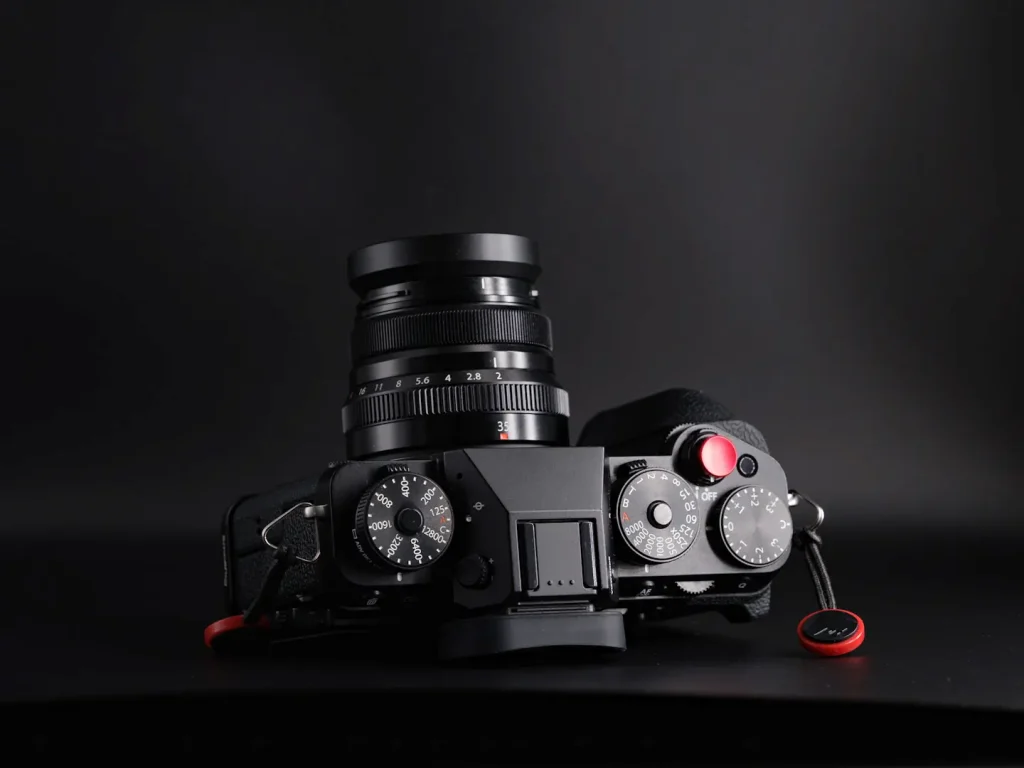
The X-T5’s dials also feel a little more complete in use, as they override camera settings directly rather than working alongside them. That said, if you don’t want to think about settings at all, you can still switch the camera to auto and let it handle everything for you — it works perfectly well that way too.
Fuji’s lens lineup is another major reason the X-T5 remains such a strong option. There’s a fantastic range of primes, from small and lightweight f/2 lenses like the 35mm f/2, right through to professional-grade options such as the 33mm f/1.4 WR. There are also excellent zooms available, including the 16–55mm f/2.8 II, which makes the system very flexible overall although the best zooms are getting up there in size relative to the other options on this list.
So why does it sit behind the Nikon Zf and OM-3 for family photography? Autofocus. While the X-T5 is absolutely capable, both the Nikon Zf and OM-3 are more reliable when it comes to tracking fast-moving children. That difference shows up most clearly when moments unfold quickly and you don’t get a second chance.
Ergonomically, the X-T5 is very comfortable when you add a few key accessories, and with the right lenses it can be smaller and lighter than the Zf. In practice though, with a decent strap, none of these cameras are genuinely heavy. For me, the deciding factor is simply that the Nikon and OM System cameras make it easier to forget about the camera altogether and stay focused on what’s happening in front of you.
I really enjoy using the X-T5 and have consistently chosen it to record family moments over the years. That said, I’m an experienced photographer and I’ve spent a long time learning how to get the best out of Fuji’s autofocus system. It takes a little more time to master than the other two cameras above, and that’s ultimately why — as a general recommendation — I place the Nikon Zf and OM-3 ahead of the X-T5 for family photography.
Who it’s for: Parents who enjoy the experience of photography and care about colour straight out of camera. If you like physical controls, Fuji’s film simulations, and don’t mind spending a little time setting the camera up properly, the X-T5 can be an excellent and very rewarding camera for capturing family moments. If it helps, I make my full Fujifilm settings available to download for free here.
Fujifilm X-T5
A beautifully designed camera with excellent colour straight out of camera and a more considered shooting experience — ideal if you enjoy photography as part of the process and don’t mind a little setup.
Check latest pricesWhy Some Very Capable Cameras Aren’t Included Here
There are a lot of cameras that are more than capable of capturing great family photographs — including several that I personally own and use, such as the Nikon Z8, the Nikon Z6III, and the Fujifilm X100VI. Excluding a camera from this list doesn’t mean it’s incapable, or that you can’t get wonderful results with it.
The reason they’re not included here is much simpler than that.
For family photography, the experience of using a camera matters just as much as the image quality it produces. Some cameras look and feel too professional and intimidating when pointed at children, which immediately changes the dynamic and leads to more self-conscious, staged photos. Others are large or heavy enough that you’re less likely to bring them with you consistently — and a camera left at home captures nothing at all.
In other cases, it comes down to autofocus reliability and flexibility. While many cameras can produce excellent results in the right hands, not all of them make it easy to consistently capture fast, unpredictable moments without thinking about settings, focus modes, or technique. For this article, I’ve deliberately prioritised cameras that remove friction and reduce missed moments, rather than cameras that an experienced photographer can learn to work around.
That’s the key distinction. This isn’t a list of the most powerful or impressive cameras available — it’s a list of the cameras I can confidently recommend specifically for family photography, based on how they behave around real children in real situations.
Family photography isn’t about perfect cameras or perfect settings. It’s about being present, noticing the small moments, and giving yourself the best chance of coming away with photos that still matter years from now. The cameras in this list aren’t here because they’re impressive on paper — they’re here because they get out of the way and let real life happen.
Very nice writeup. I really like my nikon zf but sometimes i wish it was a bit lighter. Thats why i sometimes think of trading it with the om 3…
Best regards christoph
Hi Christoph,
The ZF is fantastic but yes, it’s not quite as light as the OM-3 which is also fantastic for pictures of the family. What lens are you using on the ZF?
All the best
David
Hi,
most of the time i use the 40mm f2 or the 26 f2.8 which are great lenses. For hiking i also have the 24-200, which i dont like as much as the 12-100. I really miss the CP features back at my olympus days.
Since i am a dad for almost 2 years now and my second kid is coming in february, i am not sure which system is the „best“ for my needs. Best regards christoph
Hi Christoph,
Congratulations on your second child. You’re going to definitely be putting any camera you have to good use.
I think the main question you need to ask yourself is, does the Zf create friction for you when taking photos. If the answer is yes, would the OM3 alleviate that friction. If the answer is no, then keep the Zf.
I also really enjoy the computational modes on the OM System cameras, they make it so easy to experiment and do different types of photography.
I’ll be writing up some comparisons in the new year between my various cameras that will go in to more depth. Hopefully they will be helpful.
All the best and Happy New year.
David
Hi Christoph,
I have been reading your articles on different cameras. I am wondering which camera you would recommend for taking pictures of my kids and also scenic landscapes? Would the Nikon Zf, OM-3, or the X-T5 still be good cameras for this?
Thank you,
Genevieve
Hi Genevieve,
Thanks for your question.
The recommendations in my article would defintiely be good for your use. Personally I would go with the Nikon Zf or OM-3 as the autofocus will keep up with your kids better and more easily than the X-T5. I chase my 9 year old and an 18 month old with all of those cameras and the Nikon and OM System models keep up better with more consistant and reliable results. The X-T5 can do it too but you need the right lenses and set up so it takes a bit more fine tuning and practise.
All the best
David
Hi David!
Do you have any recommendations for focus settings for the XT-5?
Thanks: Peter
Hi Peter,
Thanks for your question. I share my exact settings file which was actually updated to the latest firmware yesterday. It includes AF settings, custom buttons and custom Film recipes. You can sign up for my settings file download in the link here – https://the-cotswold-photographer.kit.com/e61f66405f
All the best
David
Thanks David!
If you are in Hungary near Lake Balaton, definitely come and see me! Congratulations on your work!