
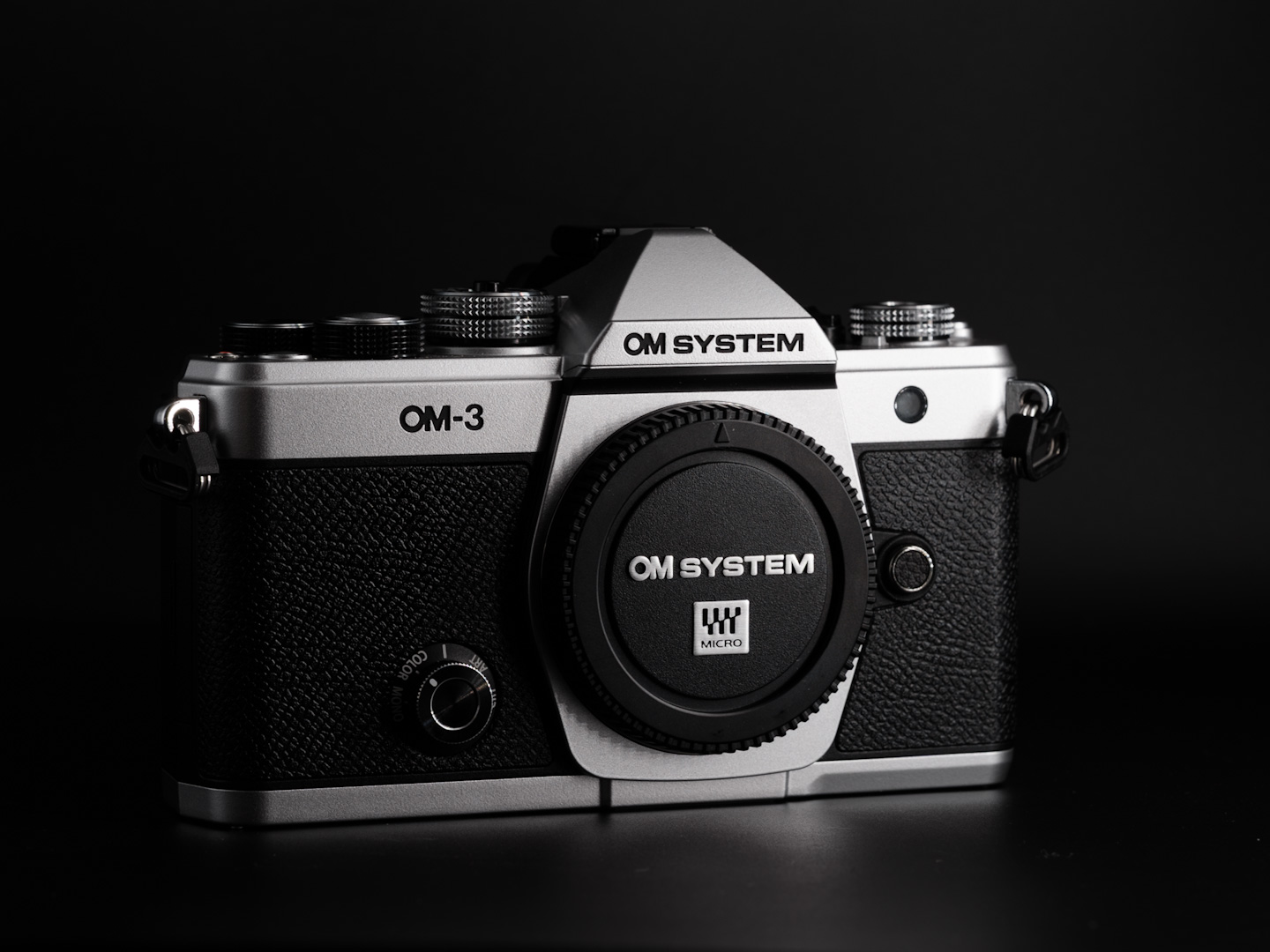
When I first saw the OM System OM-3, my immediate thoughts were of nostalgia for the Olympus Pen-F that I owned and shot all those years ago. The Pen-F, while it had some serious flaws, was one of the most enjoyable cameras I’ve ever used. Beautifully designed — possibly the best-looking camera of the modern era — with good image quality, competitive autofocus, and a brilliant implementation of Olympus’ color engine through the color wheel. It was small, light, and allowed the use of Olympus’ excellent lens lineup. If you’re wondering if Micro Four Thirds still makes sense in 2025 then I wrote this article.
The OM-3 seemed to promise all of those things, but updated: a beautiful design (this time SLR-style rather than rangefinder), access to the same deep lens lineup, and crucially, proper weather sealing when paired with lenses like the OM Systems 17mm 1.8II lens which I review here — one of the Pen-F’s most obvious omissions.
If that’s all it had been — essentially a rebadged E-M5 with new styling — I probably wouldn’t have bought it. But what tipped me over the edge was the fact that the OM-3 seems to contain the guts of the OM-1 series inside. Having used both the OM-1 and the OM-1 Mark II, I know just how powerful those cameras are. Packing that level of performance into such a compact, lightweight body made me sit up and pay attention. The OM-3 still needs some essential accessories to get the best out of it so I put together what I use in the article linked.
First Impressions

A camera that looks good isn’t enough on its own — it has to make you want to shoot and it has to perform. But boy does it look good.
There are some compromises, and the ones that stand out immediately are the lower-resolution EVF at 2.36 million dots and single SD card slot. I can live with these if the rest of the camera lives up to expectations although I think at the price point, OM Systems really should have given the camera the viewfinder from the OM-1 series.
What I was really after was the most compact interchangeable lens system possible without stripping away performance. And that’s what the OM-3 feels like. The latest OM System bodies are effectively entire shooting systems in their own right. Computational features like handheld hi-res, Live ND, and in-camera graduated ND modes remove the need for tripods, ND filters, and other accessories — hugely powerful for travel photography, which is where I’ll use the OM-3 most.
Out of the box, my first impressions of the build are excellent. The metal construction, solid dense feel, well-damped dials and buttons all inspire confidence. The screen doesn’t feel flimsy, and you can tell the IPX rating is the real deal.

In terms of handling, it feels familiar — I’ve been an OM/Olympus user since the original E-M5 in 2012/13. The ergonomics are generally good, though I’d say that having shot the Fuji X100VI and X-T5 a lot lately, the O-M3 doesn’t feel as natural yet. The OM-3 feels short but wide, somewhere between the Nikon Zf and Fuji’s X-T line in terms of comfort. To help, I’ve added a small Haoge grip extension, which improves handling, though I’m also shooting it barebones to see if it’s simply a matter of getting used to the design.

My Travel Kit with the OM-3
I plan to shoot the O-M3 mainly with the following lenses:
- M.Zuiko 12–40mm f/2.8 PRO II
- M.Zuiko 17mm f/1.8 II
- M.Zuiko 25mm f/1.2 PRO
That combination will let me see how the OM-3 balances everything from tiny primes to pro lenses. My goal is for the OM-3 to be a travel-focused camera that can handle everything from landscapes to portraits, while staying light and portable. It won’t replace my Fuji kit, but it will complement it — just as Nikon does in its own way..
A Spiritual Successor to the Pen-F

Photographers have been calling for a true Pen-F successor for years, and while the OM-3 isn’t that directly, I think it’s the closest thing yet. It feels like the spiritual successor: updated, modernized, and improved enough to give the concept a chance at commercial viability.
Yes, the price is a little high. But factor in what you save by not needing tripods or filters — or compare it to the cost of a full system switch — and the OM-3 starts to look more reasonable.
Is it good value? That’s something I’ll only know after more time: shooting in varied scenarios, testing the results, and making large prints. Once I’ve done that, I’ll share a no-nonsense review, alongside comparisons with the OM-1 Mark II which I also have with me now.
Final Thoughts
For me, the OM-3 isn’t just about specs. It’s about having a compact, weather-sealed, professional-level tool that still makes me want to pick it up and shoot. It feels like the Pen-F spirit lives on here — only this time with the power of the OM-1 series behind it. And that combination was too tempting to resist. After a month of solid use I wrote about the things I already love about the OM Systems OM-3.
Thankyou for your review.
I have Olympus em- d mi mkii with pana Leica 100-400 for wildlife – I have bought the om3 because I found the OM1 mkii not ergonomically good for my stubby hands , the grip being too deep. Anyway I also bought the OM3 for its looks and throw back to the pen f.
My immediate thoughts are I will use it for landscape and street – I also have bought a grip which has added stability. I will use it with the 25mm 1.8 and the 12-100 f4. I am not that good with lightroom or photoshop so the in built high res , live nd and grad nd will do me proud. I will also use the inbuilt photo-stacking with my 60mm 2.8 macro. And one day the starry night setting !!
For travel I have the Olympus em-d m5 mkii with Panasonic 12-60 3.5-5.6 which for me is a fantastic combination – I had great success in Venice recently using the art filter vintage ii setting and the 25mm 1.8. If it ain’t broke don’t fix it – see Flickr Gary Margetts LRPS.
Hi Gary,
Thanks for reading my website and taking the time to comment. This article was just an initial thoughts piece, a full review and comaprisons etc will be coming soon. I’ve just spent a few days away with the OM-3 and am abou to go through the images now that I’m back home. The more I used the camera, the more impressed I’ve been with it so far.
I took a look at your Flickr, some lovely shots on there.
I have small/medium hands yet I find the OM1 Mark II incredibly comfortable. Just goes to show how subjective these things can be.
All the best
David
I am interested in a modern four thirds camera to go with my GX9 twin setup, one for theatre photography. I tend to buy Panasonic but I find the G9II a big heavy camera.
When you do your full review could you talk about weight and bulk please?
Hi Tom,
Yes that will definitely be included and I’ll include comparison to some other cameras to in order to give reference points.
I’ve also owned the gx9 and g9II so will add a little context there too.
All the best
David
Hi David,
I came across your website as I am entertaining an idea to get into Micro 4/3 world. So far I’ve been a Fuji user, currently owning XT5 but had owned X100V, Xpro-3 and GFX system. Last year I sold GFX and bought Nikon ZF, for it’s retro appeal and sensor. With 24-120 it’s a heavy kit though to carry, especially on hiking adventures. For me XT-5, while still a very capable camera lost it’s appeal, which Fuji had with XT-2. It might be me too 🙂 I recently came across OM-1 MK II and rented it for a weekend, I was positively surprised with it’s capabilities, speed and agility. IQ is also very acceptable. Still, with 12-40 2.8 it’s heavier than XT-5 with Sigma 28-50 2.8. That’s how I ended up renting OM-3 for the upcoming weekend and from what I saw and read, it might be replacing my Xt-5 and even ZF. I plan to use it for hikes, with 12-45 and 40-150 f4 and add a small prime for causal street shooting. Reading your blog helps me tremendously, I also consider handgrip (I have one for ZF too) and on paper, the camera seems to be a perfect match. I love it’s aesthetics, I am curious how it will handle with gloves in winter conditions during hikes or everyday use. I am wondering if you were comparing Om-3 to XT-5 or ZF, I saw you mentioned both cameras on your posts.
best from Krakow, Poland.
Robert
Hi Robert,
Thanks for your comment. I’m glad that you are finding the website useful. I will be comparing the O-M3 directly with the X-T5 in the future. In short, for pure photography, the X-T5 is slightly better, as a complete system the OM-3 is hard to beat as it’s just so flexible and capable.
All the best
David
Great, looking forward to reading it!