

I’ve lost count of the number of times I’ve heard it: “Why would I carry a camera when my phone takes such great pictures?”
And I get it — your phone’s already in your pocket, it’s small, it’s quick, and it’s probably the best it’s ever been.
But here’s the thing no one tells you: there’s a moment, somewhere between your first travel snaps and your tenth trip, when a phone’s limitations quietly start holding you back.
The tricky bit? Figuring out exactly when that moment arrives.
In this post, I’ll break down the real-world tipping points — the ones that make it worth carrying “a proper camera” — from casual weekend trips to once-in-a-lifetime adventures.
I put together an article on the best compact cameras for travel photography if you just want to see what to buy.
Why Phones Are Great — and Awful — for Photos
Like most people, my phone is always in my pocket. Last year Sofia and I went back to the UK to visit my mum, and on Black Rock beach in Wales we built a huge sandcastle — the kind she’ll always remember. When it came time to grab a few photos, I instinctively pulled out my iPhone 13 Pro instead of my “proper” camera.


For quick record shots, phones are great. Easy, convenient, and in good daylight the results look perfectly decent. With all the computational magic going on in the background, you don’t even need to think about exposure — just point, tap, done. That simplicity is why phones have taken over budget photography.
But let’s be honest — using a phone as a camera can be painful. In portrait mode I either jab the on-screen shutter (which feels like poking my finger somewhere I shouldn’t), or fumble the side buttons and switch the screen off by accident. Even when I hit the right one, I usually wobble the phone at the exact moment it takes the shot. Add in sun glare and the random times it decides I’m in video mode instead, and suddenly the “easy option” feels anything but.

Where Phones Start to Struggle
Whenever I look back at my phone shots, they’re instantly recognisable — the same flat lighting, the same sterile colours, the same point-and-shoot perspective. The phone makes too many decisions for you, and as soon as you look at the file on anything bigger than the phone screen, the weaknesses become obvious. Unless you deliberately go out trying to “prove” your phone can take great photos (as YouTubers often do), the results are almost always meh — dull, disposable images you’ll rarely revisit unless they’re tied to a fond memory.
But if a memory is that important, why wouldn’t I want to use a proper tool for the job? A dedicated camera lets me see clearly through a viewfinder, compose with intent, and come away with cleaner files that have real colour depth and tonality — files I can print large and proudly share.
Phones lean on computational tricks to cover their limits. HDR modes flatten contrast by rescuing highlights and shadows, but also rob you of creative control. Night modes perform wizardry that produces a bright image — but often one that looks nothing like what your eyes actually saw. And don’t get me started on portrait mode: it might work if you’ve got a shaved head like a fresh Marine recruit, but add real hair and you often end up looking like you’ve lost a game show and had a tub of jelly poured around your head.
Sure, phones can occasionally pull off a decent shot. But more often than not, the magic is missing — replaced with technically correct, but soulless results.
👉 And that’s exactly where real cameras step in: they give you back the control, the depth, and the creative spark that phones can only imitate.

When It’s Time to Move Beyond Your Phone
Phones are brilliant for quick snaps, but when you’re travelling or documenting family moments, there comes a point where they start letting you down. You’ll feel it in moments like these:
Creative control on the road → You want to blur motion in a bustling Tokyo street or isolate your child against a dreamy mountain backdrop. Phones fake it with software; a camera lets you make it happen for real.
Low light dinners → You’re at a tiny restaurant in Rome, the table lit by nothing but flickering candles. You take out your phone and end up with a noisy, blurry mess. A camera with a proper sensor would have kept the warmth and detail.
Iconic landmarks → That once-in-a-lifetime shot of the Eiffel Tower or the Taj Mahal looks flat and dull because your phone’s tiny lens can’t capture the scene the way your eyes do. With a real camera, you get depth, clarity, and a print-worthy memory.
Candid family moments → Your kids are running on the beach in golden evening light. You fumble with your phone, tapping at the screen while the moment disappears. A camera with a viewfinder and responsive shutter would’ve nailed it.
Printing memories → On your phone, that shot of your child’s first time seeing the ocean looks fine. But when you try to print it for the wall, it falls apart. A camera file holds up and becomes something you can treasure forever.

The Real Upgrade: Lenses and Comfort, Not Just Camera Specs
Here’s the truth: moving from a phone to a “real” camera doesn’t mean you need to spend thousands chasing the biggest sensor or the latest flagship body. The real leap in quality comes from two things:
- The glass you put in front of the camera
- How comfortable you feel using it
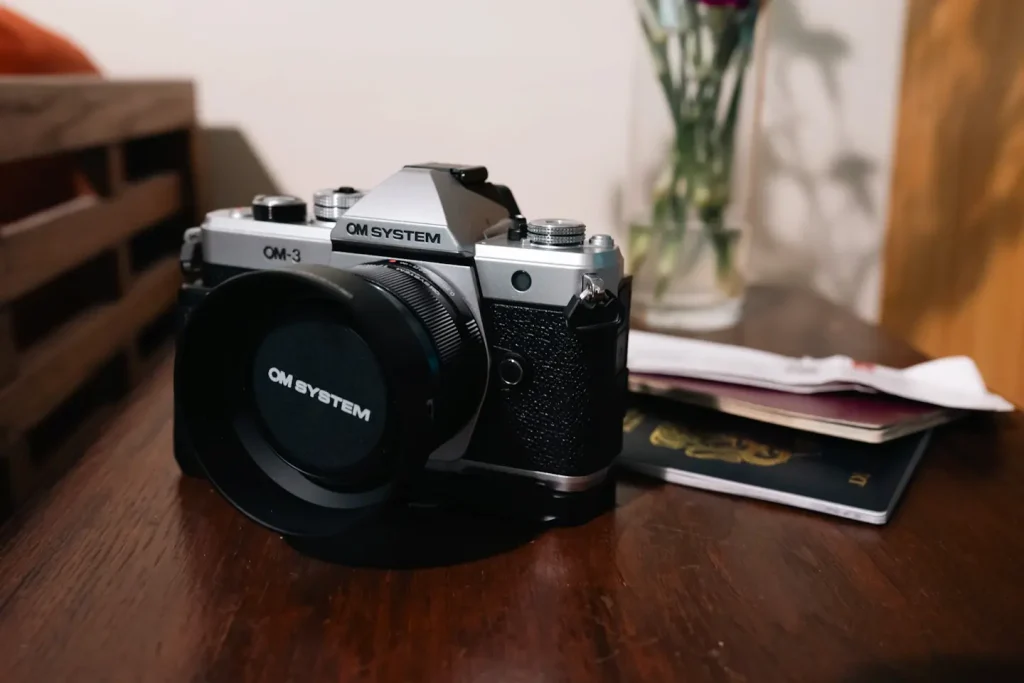
A top-of-the-range full-frame camera with a cheap kit zoom will often give worse results than a modest Micro Four Thirds body paired with a sharp prime lens. A simple 25mm f/1.8 on an OM System camera or a 50mm f/1.8 on a Nikon Z6III will transform your images more than megapixels ever could.
Instead of obsessing over technical specs, ask yourself these questions when choosing your travel camera:
- Will I actually carry it with me day after day?
- Does it feel good in my hands, with controls that make sense to me?
- How do I want to see the world — wide and contextual, or tighter and more isolated?
For me, this became very real after a breakup. I left the UK and decided to sell virtually everything I owned. All the gear I’d collected over the years was gone, and I kept only one camera: the Fujifilm X100T. For over a year, that single fixed-lens camera was all I used. Far from feeling limited, it actually taught me how to see the world with that one focal length. I didn’t miss shots. In fact, the opposite happened — I learned how to anticipate, compose, and simplify, and my photography grew stronger because of it.
If you’re just starting out, a 35mm-equivalent lens is the perfect everyday companion. Prefer subject isolation? Go for a 50mm equivalent. From there, the classic three-lens travel kit is all you really need:
- 28mm or 35mm for storytelling and context
- 50mm for natural perspective and subject separation
- 85mm for portraits and detail shots
That’s it — three lenses that will cover almost everything, from family holidays to once-in-a-lifetime adventures. It’s exactly the foundation I use across all my systems today, and I only add more specialised lenses when I truly need them.
So, When Is It Actually Worth the Jump From Your Phone?
The answer isn’t about megapixels, sensor size, or whatever flashy spec is being shouted about this year. It’s about intention. The moment your photos mean more to you than simple record shots — when you want them to feel like photographs rather than quick snaps — that’s when it’s worth making the jump.
A dedicated camera changes everything. You look through a viewfinder, you see differently, you compose with care. You start to recognise light, moments, and stories in ways your phone simply can’t encourage. And when you pair even a modest camera with a great lens, your photos begin to take on a consistency and depth that transforms them from “just another snapshot” into a body of work that truly feels like yours.
So the upgrade point isn’t when your phone “isn’t good enough” anymore — it’s when your memories and your vision deserve something better. When you want photographs you’ll be proud to print, to frame, or to show your kids years from now. That’s when the jump matters.
👉 If you’re curious about Fuji specifically (my own system of choice for much of my travel work), check out my breakdown of the the best Fujifilm cameras and lenses for travel photography — a practical guide to setups that balance portability, image quality, and storytelling flexibility.
Great article, couldn’t agree more on every single point.
Hi Jonathan, Thanks for reading and taking the time to comment. Maybe I’m a dinosaur but phones and I just don’t work for photography 😀 All the best. David
Well, in this case I’ll also happily be a dinosaur 😀 but hey, we’re also accompanied by Gen Z and their digicam revival.
One additional major difference for me regarding phone vs. camera is that it almost never happens that I look at my old phone shots. They are all fire-look-once-and-forget shots.
On the other hand, I often find myself browsing through my older camera shots.
Keep up the good work on this site 👍
Hi Joanthan,
haha, true, it’s aalso why I decided to focus on my website rather than Youtube. I’m just not cool enough for Youtube and don’t like the clickbait tactics needed to get views. I totally agree, it’s rare I go back through my phone photos.
Thanks and all the best.
David
I started at photography with a pixel phone.
Yes the problem was that the photos came out perfect for sharing and viewing on small screens. Even on normal wr inches pc monitor and read ready for print. Bit the results were to munch HDR and not what i exactly showed.
To be honest Google fixed that by using a bigger sensor and results were more natural.
Do there isn’t a reason for “compact” points and shoot cameras. Even the 1inch type.
But for street photography a dedicated camera with an aps-c sensor and the ability to use lenses and zoom is want make the difference for me.